
Fascinating Ancient History Of Fingerprints
A. Sutherland - AncientPages.com - Fingerprints have been a source of people's great fascination and can be traced back to ancient times.
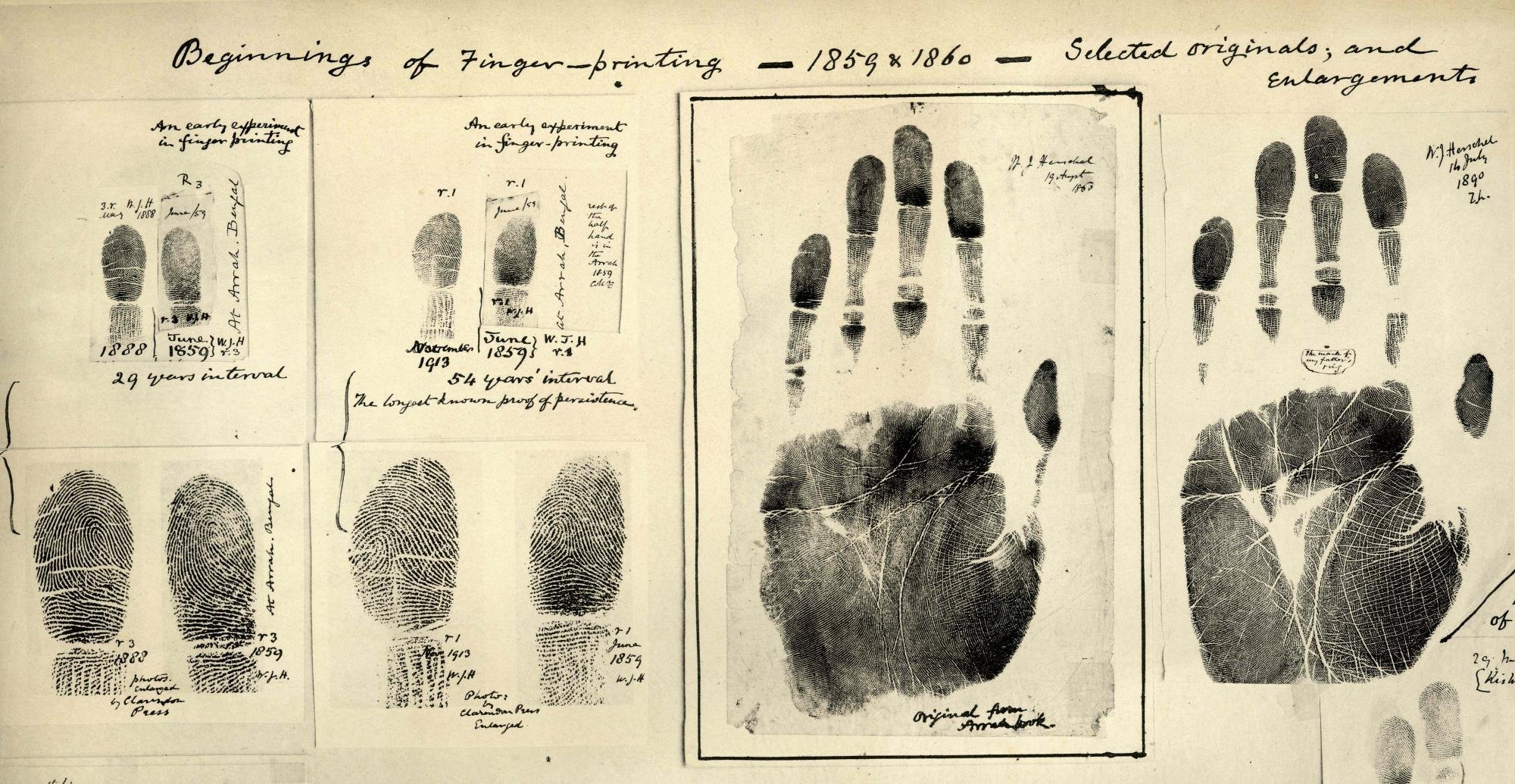 Handprints and fingerprints made by W. J. Herschel. Public Domain
It is not easy today to establish whether the fingerprints were placed on the artifacts, walls, and documents intentionally or coincidentally.
The earliest records of fingerprints are dated to 7,000 BC and originate from Jericho, near the Jordan River in the West Bank of the Palestinian territories. Neolithic bricks from this ancient city contain thumbprints of ancient bricklayers, as mentioned in K. M. Kenyon's book "Archaeology of the Holy Land."
In this ancient city, bricks were found imprinted by pairs of thumbprints of the bricklayer who built a house. Circa 3,000 BC, in Mesopotamia, people placed fingerprints on clay tablets to confirm business transactions. In constructing the king's storehouse, each brick was purposely provided with a "digital impression" as finger imprints.
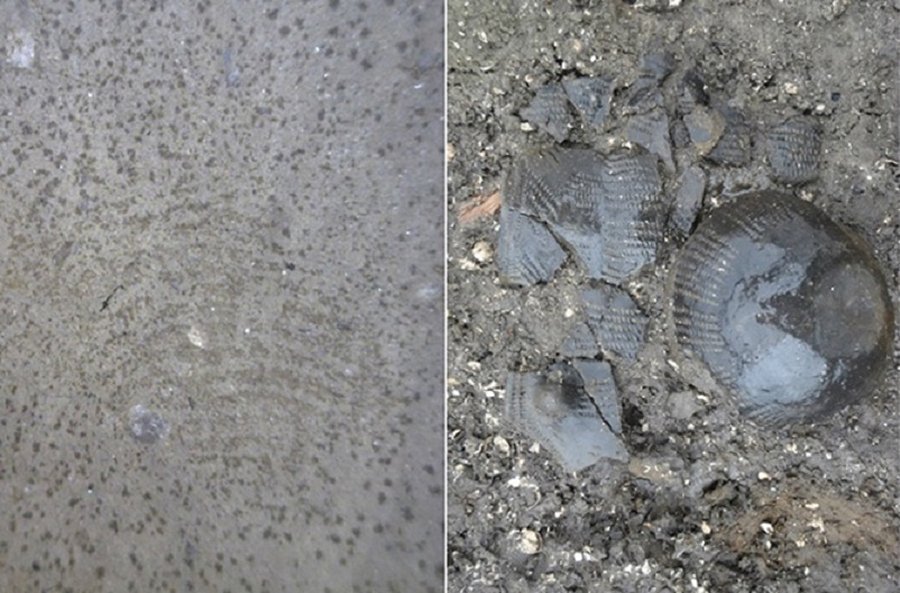 Left: The 5,500-year-old fingerprint and Right: the funnel beaker as it was unearthed. Credit: Line Marie Olesen/Museum Lolland-Falster.
In ancient Egypt, a similar procedure was used to construct royal buildings. The walls of Egyptian tombs are decorated with fingerprints.
Ancient artifacts containing carvings of fingerprints, dated to 3,000 BC, were discovered in Northwest Europe at New Grange on the coast of Ireland and in Brittany, France.
Many artifacts discovered in burial chamber passages and tombs from this period were covered with fingerprint ridges. About one year ago, archaeologists unearthed pieces of a 5,500-year-old ceramic vessel from an ancient fjord east of Rødbyhavn near Lolland, Denmark, and there was an old fingerprint on it.
People lived in Nova Scotia for more than 11,000 years, as confirmed by written history and oral tradition. For example, the outline of a hand with etchings representing the ridge patterns on fingertips was once scratched into the slate rock beside Kejimkujik Lake in Nova Scotia.
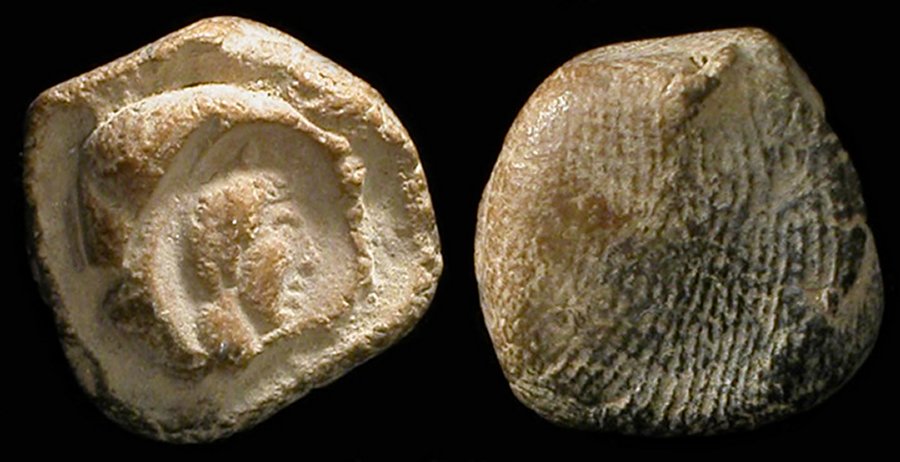 In the Greek and Roman periods, there have been found Many clay bullae have been unearthed during the excavations in the ancient ruins in Greece and various Roman sites. Photo via Forensics
Prehistoric cave artists and pot makers used to "sign" their works with an impressed finger or thumbprint. A similar tradition was widely used by artisans who put fingerprints on ancient Babylonian seals, clay tablets, and pottery.
Archaeologists found fingerprints on Greek and Chinese pottery, bricks, and tiles in Babylon and Rome and imprints of fingers embossed on 6,000-year-old Chinese ceramics.
According to a Chinese historian, Kia Kung-Yen, who lived in the Tang period, there was a custom to put thumbprints on clay seals and inked fingerprints to "sign" legal documents regarding loans, debts, and contracts.
The oldest " survived " documents are dated to the 3rd century BC. The imprint, deeply embedded in the seal, is a significant identifying mark.
Ancient records from 14th century Persia inform that one government official, a physician, made an important discovery. Namely, he observed that no two fingerprints were exactly alike! As we see, he was one of many to attend to the fingerprints' unique feature.
Chinese records dating to the Qin Dynasty (221-206 BC) include details about using handprints as evidence during burglary investigations, and clay seals with friction ridge impressions were commonly used during both the Qin and Han Dynasties (221 BC - 220 AD). Could it mean that the ancient Chinese were fully aware of the uniqueness of a fingerprint?
If this is so, there is strong evidence that the Chinese knew the importance of the individuality of fingerprints a very long time ago.
Sir William James Herschel (1833 – 1917), whose father and grandfather were astronomers, decided to choose another career. He joined the East India Company and began his work as a British civil servant in India.
More and more interested in fingerprinting, Herschel made a variety of experiments and soon realized that a person's fingerprints do not change over time! In 1916, one year before he died, Sir Herschel published his work entitled "The Origin of Fingerprinting."
In "Advances in fingerprint technology," edited by Henry C. Lee R.E. Gaensslen, it is said that "Henry Faulds (1843-1930), a medical missionary for the Church of Scotland, was very interested in fingerprints. In one of his experiments, he removed the skin from the fingers (!) of his patients after fingerprinting them."
When the skin regrew on the fingertips, he fingerprinted them once more. He noted that the ridge detail was the same as before the skin was removed.
He concluded that fingerprint patterns were variable, but ridge detail was immutable.
Written by – A. Sutherland AncientPages.com Staff Writer
Copyright © AncientPages.com All rights reserved. This material may not be published, broadcast, rewritten or redistributed in whole or part without the express written permission of AncientPages.com
Expand for referencesReferences:
Hawthorne, Fingerprints: Analysis and Understanding
Castronovo, The Oxford Handbook of Nineteenth-Century American Literature
M, Specter, The New Yorker
Iranian.com
More From Ancient Pages
-
 Flying Objects Were Present In Ancient Skies
-
 Hidden Connection Between The Zodiac, Ancient Egypt, Freemasonry And Christianity
-
 Beautiful Tudor Gold Pendant Linked To Henry VIII And Katherine Of Aragon Discovered By A Metal-Detectorist
-
 Paleolithic Mammoth Tusk Boomerang Found In The Oblazowa Cave Is Older Than Expected
-
 Fatocuriosos.club Guilty Of Hundreds Of Copyright Violations Is Stealing Content Daily From AncientPages.com
-
 Unseen 3,000-Year-Old Inscription On Biblical-Era Piece Of Pottery Deciphered By Researchers
-
 Home Of The Gods – Ancient Cities, Underground Worlds, Incredible Technology And Date Of Departure – Part 2
-
 2,000 Year-Old Books Written By Bian Que The Divine Healer Unearthed
-
 10 Fascinating Facts About Pharaohs
-
 Rare Magic Mirror In Cincinnati Museum Has A Secret Hiding In Plain Sight
-
 4,500-Year-Old Ramp Might Explain How Huge Stones Were Transported To Great Pyramids’ Building Site
-
 Stone Age Statues Were Taken To Britain For Restoration In 1990 – Never Returned Home To Jordan
-
 On This Day In History: The Only English Pope In History Of Catholic Church Elected – On Dec 4, 1154
-
 Empusa – Shape-Shifting Evil Female Demon In Greek Myth And Folklore
-
 Day Of The Dead: From Aztec Goddess Worship To Modern Mexican Celebration
-
 Knights Templar – Among The Most Wealthy And Powerful Of The Western Christian Military Orders
-
 Secrets Of Mica Chambers Of Teotihuacan
-
 Painted Tikal Altar Unlocks The Ancient Secrets Of A Mysterious Maya Period
-
 Vimanas – Flying Machines Soaring Through Ancient Sky Of India
-
 Ancient Mystery Of The Before – Time People – Evidence Of Unknown Advanced Prehistoric Technology – Part 2

