
Famous Viking Ragnar Lodbrok – Legendary Fearless Sea-King Of The North
A. Sutherland - AncientPages.com - There are many stories about the famous Viking Ragnar Lodbrok. He was not an ordinary pirate but a legendary and fearless Sea-King who became one of the most important Vikings in history.
What makes Lodbrok’s history unusual is that he was one of the first ‘Sea-Kings,’ which meant that he, as a Viking gained enough wealth and power through raiding to be recognized as a virtual king.
Who Was Ragnar Lodbrok?
Ragnar Lodbrok was one of the most popular Norse heroes among the Vikings. As a legendary Viking commander who became a scourge of England and France, he is often referred to as a larger-than-life character. Ragnar Lodbrok’s life and adventures are described in the Icelandic Sagas Ragnar’s Tale and The Tale of Ragnar’s Sons.
Ragnar Lodbrok (nicknamed ‘Hairy Breeches,’ referring to the animal-skin trousers that he wore) was born as the son of Sigurd Ring, who was king of both Sweden and Denmark. Ragnar himself claimed to be a direct descendant of the god Odin.

Actor Travis Fimmel plays Ragnar Lodbrok in Vikings The Saga of Ragnar Lothbrok. Credit: Imdb
Lodbrok had several children with different women. In Norway, he met the shieldmaiden Lagerda who fought together at his side. She was a fierce female warrior, and Ragnar eventually married her, and they had three children together. However, their marriage was not happy, and Ragnar traveled to Denmark, where he met the Swedish princess Tora Borgarhjort. She gave birth to two of Ragnar’s sons but died as a young woman. Lodbrok could not cope with her death for quite some time, but later, according to the Völsungasaga, he met the beautiful Queen Alsaug.
Ragnar Lodbrok Conquers Paris
On 8 June 793 C.E, Vikings attacked the Christian monastery of Lindisfarne on the English coast. They landed their longships on the shores of the Holy Island, stormed the church, killed the monks, and left with all treasures their ships could hold. The brutality displayed made them remembered and feared for many years.

Ragnar Lodbrok conquers Paris
This date marks the dramatic beginning of the history of the Viking empires and particularly their role in British history. It was the beginning of the Viking era and the many Viking raids of Ragnar Lodbrok, who was an enemy of Christianity. Ragnar Lodbrok deliberately attacked Christians when the soldiers were kneeling in the church during their celebrations. It was an effective method to catch the enemy off guard.
Ragnar Lodbrok led pirate raids into France many times. His most famous raid was the one he led on Paris in 845 when he commanded over five thousand warriors in a hundred and twenty longships fleet. Despite Ragnar’s strategy of attacking a holy day when churches would be full of potential victims, news of their approach had preceded his army, and most of the population had already fled. The Vikings flooded in, spreading out through the streets in search of plunder. They had been raiding Europe for five decades but never had they looted such a prize.
The Vikings took the French capital and only refrained from burning it to the ground after King Charles the Bald paid them an enormous ransom of 7,000 pounds of silver to leave.
When Ragnar Lodbrok and his warriors returned back to Denmark, they were wealthy and celebrated as heroes.
Lodbrok continued a number of successful raids against France throughout the mid-ninth century and fought numerous civil wars in Denmark.
Where And How Did Ragnar Lodbrok Die?
During his life, Ragnar Lodbrok participated in many raids. He continued fighting even as an old man.

Ælla of Northumbria's execution of Ragnar Lodbrok by Hugo Hamilton (1802–1871). Credit: Public Domain
The location where Lodbrok died remains disputed. The Icelandic sagas and early English sources state Ragnar was eventually captured by the Anglo-Saxon Christian king Aella of Northumbria. It is said that Ragnar was shipwrecked on the Northumbrian coast. He and his crew survived the wreck, but after meeting the Northumbrians in battle, most of his men were killed, and he was captured by Aelle, King of Northumbria, who ordered him executed by throwing him into a pit filled with poisonous snakes.
Ragnar's death eventually leads to the Vikings conquering the whole Danelaw. When the news of Lobdrok’s death reached his sons, they traveled to England to avenge him and kill King Aella. As part of the Treaty of Wedmore, a boundary was drawn across England from London to the Mersey. South of this line, the laws and customs would be those of the English, under the rule of the King of Wessex.
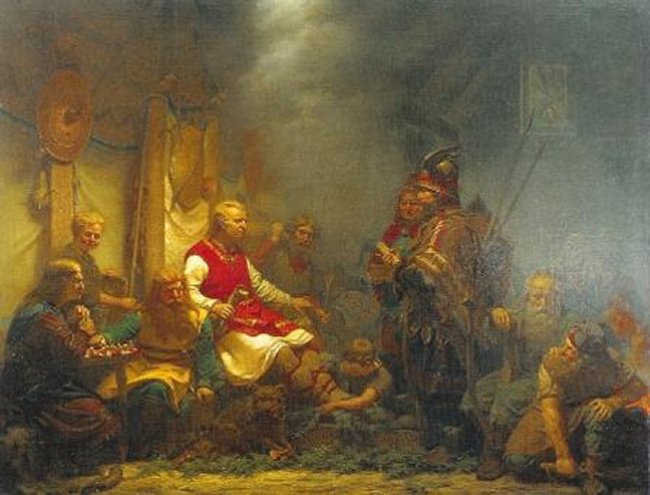
1857 painting by August Malmström depicting King Aella's messenger before Ragnar Lodbrok's sons. Credit: Public Domain
The land to the north and east of this line would be under Viking rule, with Scandinavian laws and customs. This Viking part of England became known as The Danelaw. Today, some historians refer to the Danelaw as 'Scandinavian England'.
In the Danelaw, many warriors of the Vikings' armies settled. Instead of wandering about, raiding, and plundering, they started supporting themselves by farming and trading.
Today, Ragnar Lodbrok is remembered as the legendary fearless Sea-King who was admired and hated by many.
Updated on April 14, 2022
Written by – A. Sutherland - AncientPages.com Senior Staff Writer
Copyright © AncientPages.com All rights reserved. This material may not be published, broadcast, rewritten or redistributed in whole or part without the express written permission of AncientPages.com
Expand for referencesReferences:
Blom T. Vikingar: Saga, sägen och sanning
Carlson, R. Vikings: A History of the Viking Age
More From Ancient Pages
-
 God Ptah ‘Lord Of Memphis’ Was Among The Most Revered Creator Gods Of Ancient Egypt
-
 Science Fiction Was Around In Medieval Times – Here’s What It Looked Like
-
 Sobek: A 2,500-Year-Old Mummified Nile Crocodile – On Display At The British Museum
-
 8,000-Year-Old Human Skeletons Found In Neolithic Village Of Slatina, Bulgaria
-
 What Is The Link Between Drought And The ‘Barbarian Conspiracy’ In Roman Britain?
-
 How Did St. Nicholas Become Santa Claus? – History, Legend And Tradition
-
 Hundreds of Monumental ‘Kites’ Spotted in Arabian Desert
-
 On This Day In History: Michael Servetus Burned At The Stake ‘Atop A Pyre Of His Own Books’ – On Oct 27, 1553
-
 Intriguing Ancient ‘Horoscope’ Scroll Found In The Judean Desert
-
 Rare Iron Age Cauldrons And Their Almost Exact Replica Reveals Its Secrets
-
 LIDAR Discovers Huge Abandoned Zapotec City With Temples, And Ball Courts In Oaxaca, Mexico
-
 Well-Preserved 1,000-Year-Old Ulfberht Sword Found In The Wisla River, Poland
-
 Impressive Study Highlights Female-Led Migration Into Bronze Age Orkney And Wins Prestigious Award For 2023
-
 Ancient Suda: Massive Anonymous Byzantine-Greek Lexicon Dated To 10th Century
-
 Humans Started Wearing Clothes 100,000 To 500,000 Years Ago
-
 Ancient Copy Of Jesus’ Secret Teachings To His Brother James Discovered – First Apocalypse And Future Events Described
-
 Red-Headed Alevi In Kurdistan Could Be Guardians Of Watchers’ Secret Knowledge And Shed Light On The Excalibur Legend
-
 TB Was Transmitted in South America – DNA Study Shows How It Happened
-
 Mysterious Ancient Star People Of The Secret Power
-
 Stone Toilet Of A First Temple Period Luxury Villa Reveals The Jerusalem Elite Suffered From Infectious Disease

