
Famous Viking Ragnar Lodbrok – Legendary Fearless Sea-King Of The North
A. Sutherland - AncientPages.com - There are many stories about the famous Viking Ragnar Lodbrok. He was not an ordinary pirate but a legendary and fearless Sea-King who became one of the most important Vikings in history.
What makes Lodbrok’s history unusual is that he was one of the first ‘Sea-Kings,’ which meant that he, as a Viking gained enough wealth and power through raiding to be recognized as a virtual king.
Who Was Ragnar Lodbrok?
Ragnar Lodbrok was one of the most popular Norse heroes among the Vikings. As a legendary Viking commander who became a scourge of England and France, he is often referred to as a larger-than-life character. Ragnar Lodbrok’s life and adventures are described in the Icelandic Sagas Ragnar’s Tale and The Tale of Ragnar’s Sons.
Ragnar Lodbrok (nicknamed ‘Hairy Breeches,’ referring to the animal-skin trousers that he wore) was born as the son of Sigurd Ring, who was king of both Sweden and Denmark. Ragnar himself claimed to be a direct descendant of the god Odin.
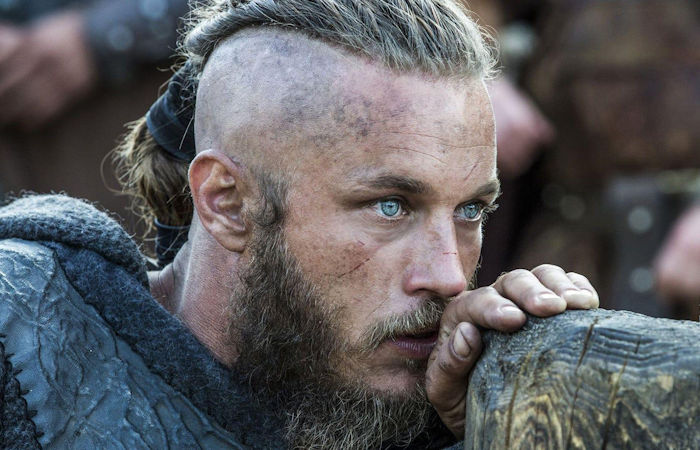
Actor Travis Fimmel plays Ragnar Lodbrok in Vikings The Saga of Ragnar Lothbrok. Credit: Imdb
Lodbrok had several children with different women. In Norway, he met the shieldmaiden Lagerda who fought together at his side. She was a fierce female warrior, and Ragnar eventually married her, and they had three children together. However, their marriage was not happy, and Ragnar traveled to Denmark, where he met the Swedish princess Tora Borgarhjort. She gave birth to two of Ragnar’s sons but died as a young woman. Lodbrok could not cope with her death for quite some time, but later, according to the Völsungasaga, he met the beautiful Queen Alsaug.
Ragnar Lodbrok Conquers Paris
On 8 June 793 C.E, Vikings attacked the Christian monastery of Lindisfarne on the English coast. They landed their longships on the shores of the Holy Island, stormed the church, killed the monks, and left with all treasures their ships could hold. The brutality displayed made them remembered and feared for many years.

Ragnar Lodbrok conquers Paris
This date marks the dramatic beginning of the history of the Viking empires and particularly their role in British history. It was the beginning of the Viking era and the many Viking raids of Ragnar Lodbrok, who was an enemy of Christianity. Ragnar Lodbrok deliberately attacked Christians when the soldiers were kneeling in the church during their celebrations. It was an effective method to catch the enemy off guard.
Ragnar Lodbrok led pirate raids into France many times. His most famous raid was the one he led on Paris in 845 when he commanded over five thousand warriors in a hundred and twenty longships fleet. Despite Ragnar’s strategy of attacking a holy day when churches would be full of potential victims, news of their approach had preceded his army, and most of the population had already fled. The Vikings flooded in, spreading out through the streets in search of plunder. They had been raiding Europe for five decades but never had they looted such a prize.
The Vikings took the French capital and only refrained from burning it to the ground after King Charles the Bald paid them an enormous ransom of 7,000 pounds of silver to leave.
When Ragnar Lodbrok and his warriors returned back to Denmark, they were wealthy and celebrated as heroes.
Lodbrok continued a number of successful raids against France throughout the mid-ninth century and fought numerous civil wars in Denmark.
Where And How Did Ragnar Lodbrok Die?
During his life, Ragnar Lodbrok participated in many raids. He continued fighting even as an old man.

Ælla of Northumbria's execution of Ragnar Lodbrok by Hugo Hamilton (1802–1871). Credit: Public Domain
The location where Lodbrok died remains disputed. The Icelandic sagas and early English sources state Ragnar was eventually captured by the Anglo-Saxon Christian king Aella of Northumbria. It is said that Ragnar was shipwrecked on the Northumbrian coast. He and his crew survived the wreck, but after meeting the Northumbrians in battle, most of his men were killed, and he was captured by Aelle, King of Northumbria, who ordered him executed by throwing him into a pit filled with poisonous snakes.
Ragnar's death eventually leads to the Vikings conquering the whole Danelaw. When the news of Lobdrok’s death reached his sons, they traveled to England to avenge him and kill King Aella. As part of the Treaty of Wedmore, a boundary was drawn across England from London to the Mersey. South of this line, the laws and customs would be those of the English, under the rule of the King of Wessex.
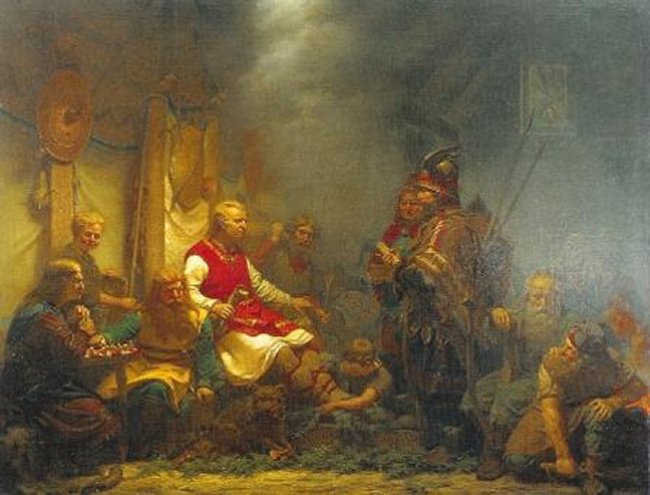
1857 painting by August Malmström depicting King Aella's messenger before Ragnar Lodbrok's sons. Credit: Public Domain
The land to the north and east of this line would be under Viking rule, with Scandinavian laws and customs. This Viking part of England became known as The Danelaw. Today, some historians refer to the Danelaw as 'Scandinavian England'.
In the Danelaw, many warriors of the Vikings' armies settled. Instead of wandering about, raiding, and plundering, they started supporting themselves by farming and trading.
Today, Ragnar Lodbrok is remembered as the legendary fearless Sea-King who was admired and hated by many.
Updated on April 14, 2022
Written by – A. Sutherland - AncientPages.com Senior Staff Writer
Copyright © AncientPages.com All rights reserved. This material may not be published, broadcast, rewritten or redistributed in whole or part without the express written permission of AncientPages.com
Expand for referencesReferences:
Blom T. Vikingar: Saga, sägen och sanning
Carlson, R. Vikings: A History of the Viking Age
More From Ancient Pages
-
 Ancient Dance And Games Offer Glimpses Of Life And Death In Italy 2,500 Years Ago
-
 Easter Island May Offer Proof Of An Alien Apocalypse
-
 Archaeologists Have A Lot Of Dates Wrong For North American Indigenous History
-
 Breakthrough! Evidence Of Previously Unknown Prehistoric Humans Who Lived In Europe More Than 1.1 Million Years Ago!
-
 Ancient City Of Timgad: Largest Roman Settlement Ever Built In North Africa
-
 Exploring Future Evolution: How Will Humans Change In The Next 10,000 Years?
-
 Salt Workers’ Residences At Underwater Maya Site – Identified
-
 Courageous Elizabeth Freeman – First African American Slave Who Filed A Freedom Suit
-
 Viminacium Ancient Roman Camp: Sarcophagus With Skeletons, Rich Grave Goods Found In Serbia
-
 Unexplained Phenomenon In East Anglia – Time Portal And Strange Glimpses From The Past – Part 1
-
 Baffling Sanxingdui Civilization: Why Did These People Have Fascination For Eyes?
-
 Okanagan Indians’ Fascinating Myth Of A Lost Paradise Island Inhabited By White Giants – Are Their Descendants Living in British Columbia?
-
 World’s Oldest Wooden Structure Discovered And It Predates Homo Sapiens – Archaeologists Say
-
 Mystery Of The Ancient Bear Bones In The Aleutian Islands, Alaska
-
 5 Different Types Of Priests In Ancient Rome – Their Role And Responsibility Explained
-
 Brown Hares And Chickens Were Seen As Gods Not Food In Iron Age Britain
-
 Decorative Relief Of El Cerrón Helps To Uncover Unique Identity Of Central Iberian Elite Of Carpetania
-
 The Mystery Of The Serpent Seed
-
 Buried Ancient Roman Glass Has Formed Photonic Crystals – Extraordinary Discovery – Scientists Say
-
 Kiln Was Invented In Mesopotamia Around 6,000 B.C.

