
Bizarre Towering Pillars Of Externsteine: Myths, Legends And Sacred Rituals From Times Long Gone
AncientPages.com - Made of oddly twisted limestone rocks, Externsteine is located in the Teutoburg Forest north of the Rhine in Germany.
Externsteine is associated with heroic myths and legends about brave warriors of times long gone. Related to Scandinavian Eddas and Hitler’s persistent Aryan myth, the Teutonic cult center Externsteine, was also believed to be the site of the famous Yggdrasil - World Tree.

In the 1920s and 30s, the Nazi party used the Externsteine as the symbol of the German identity, but the history and importance of this sacred place goes much further back in time.
According to popular belief, the stones were placed there, at night by giants and they were there burned by the devil, which explains their grotesque and even scary appearance.
This spiritual sanctuary - with sharply outlined against the sky, uneven pillars, about 30 meters high - was once the subject of a fierce battle between the followers of pagan deities and the Christian monks.
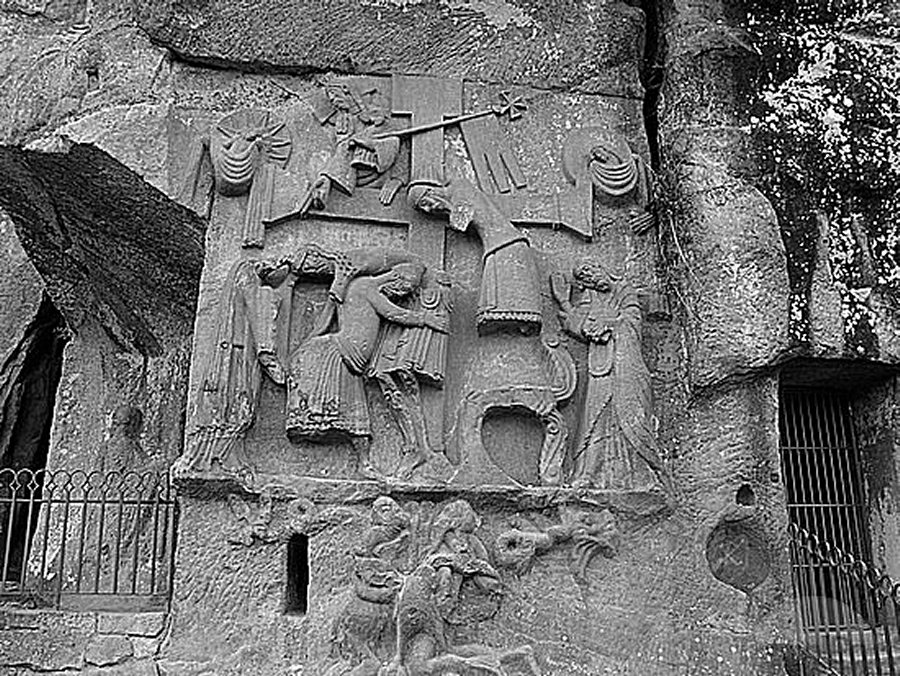
Externsteine - early Christian rock carving - "The descent from the Cross dated to about 9th century.
In the spiritual tradition of the Germanic people, Externsteine played an important role similar to that of Stonehenge in England.
The Teutoburg Forest is surrounded with many prehistoric secrets and so is Externsteine bizarre rocky cluster.
All that is known about this place, especially its origin and meaning, turned out to be deceptive and uncertain. One theory has it, the site was used to many performed in the Stone Age; another suggests its religious functions date back no further than the 12th century.

Amongst tall rock outcrops, there are seen strange appearances of human faces and, mysterious shapes of mythical dragon-like creatures, all apparently formed accidentally by the cracks, fissures and bulges of the rocks.
The Externsteine rocks are about 70-million-year-old sandstone spires with the remainsof a temple still recognizable on the top. This temple has definitely astronomical purpose because its rounded small windows slign with the sun and moon during the summer solstice.
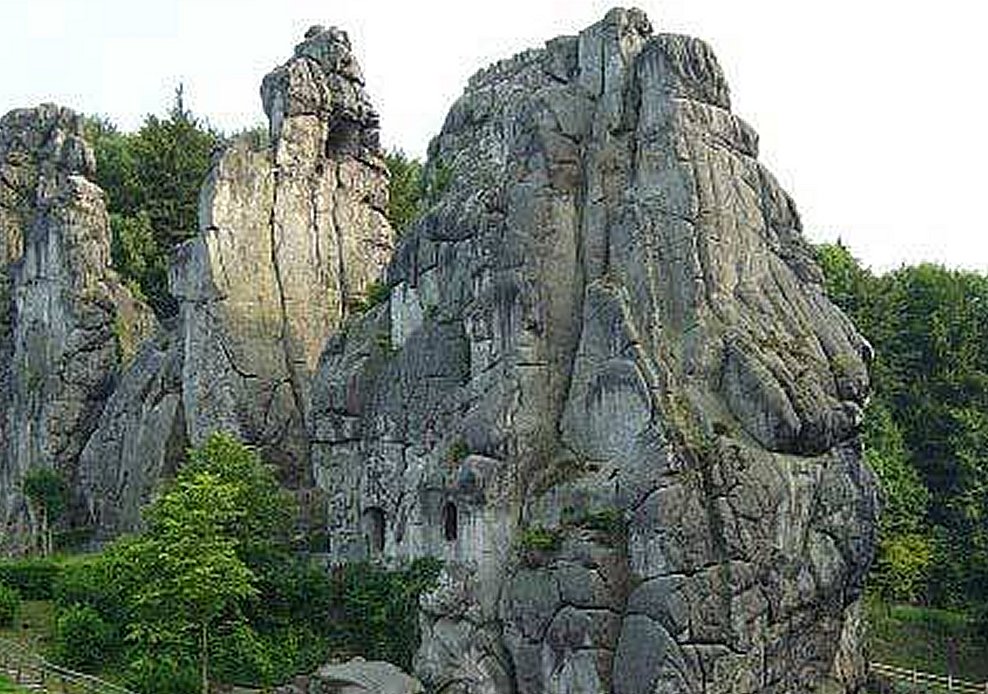
According to astronomers, a part of the stones were used as an observatory.
According to astronomers, a part of the stones were used as an observatory.
There are also chambers, caverns and secret passages, later enlarged and modified by successive generations. There are niches, platforms and stairs leading to nowhere. No one can say, when the rocks were modified into the group of sanctuaries, tunnels and dead-end stairs.
In some of the chambers, researchers found several burn marks and dated to about 700 AD. About this time, the Externsteine was used by the non-Christian Teutonic people, but nothing is known about the motivation that brought these people to the site.

An opening in one of the chambers, is aligned to the midsummer sunrise, and on this particular morning, the sun’s rays directly illuminate a very ugly and mysterious face on the rear wall.
Many people who looked at this face, have a distinct feeling that the whole scenery has nothing to do with the medieval church and its activities but goes far back in time, many centuries before the Hellenistic Age had its beginnings.
While this curious face is unrecognizable, there are other features confirming that at the Externsteine, the ancient Celts once created an important sacred site and later, when the Celts left, the Teutonic people lived in the Teutoburg Forest; they added other features to the Externsteine.
Why is the place called "Externsteine"? No one knows; however, some researchers suggest it probably comes from the name of a neighboring mountainous area - "Egge", which means "the stone of Egge". There is also the first documented reference to this fascinating sacred place in old German texts dated to 1093 AD, which say it calls the "Agisterstein" - "the stone with the dragon cave".
Copyright © AncientPages.com All rights reserved. This material may not be published, broadcast, rewritten or redistributed in whole or part without the express written permission of AncientPages.com
Expand for referencesReferences:
A. Gazin-Schwartz, C.J. Holtorf, Archaeology and Folklore
A. Kaulins, Stars, Stones and Scholars
More From Ancient Pages
-
 Manco Capac: Legendary Founder Of The Inca Dynasty Of Peru
-
 Mystery Of The Watchers And Book Of Enoch – Fallen Angels And Their Secret Knowledge
-
 Genetic Changes In Bronze Age Southern Iberia
-
 Ancient Greek Seven-Room Building And Treasures Found Underwater Off The Coast Of Salamis
-
 Amanirenas – Fearless Queen Of Kush Who Defeated Ancient Romans
-
 Advanced Ancient Irrigation Network Discovered In Mesopotamia
-
 Artifacts Discovered At Yirra Confirm Aboriginal People Lived In Pilbara During The Last Ice Age
-
 Hispano-Visigothic Grave At Ojo Guareña – Resting Place Of A Hermit Who Sought Isolation When The Moors Arrived?
-
 Tides And Hurricane Activity Impacted The Maya Civilization – What Can This Tell About Modern Climate Change?
-
 Enigmatic Ale’s Stones – Sweden’s Megalithic Ship-Like Formation
-
 Ancient World’s Second Largest Library Of Codices, Manuscripts Reopened In Sinai
-
 Enigmatic Voynich Manuscript: Computer Scientists From Alberta Use AI To Decipher Document
-
 What Was The True Meaning Of Pankration And Other Ancient Games
-
 Fearsome Koa Warriors Fought For Spiritual Energy And Mana, The Life-Force
-
 Sharkalishharri Cylinder Seal From The Fifth King Akkad Dynasty
-
 What Was The Agriculture Like In Southeast China In The Late Neolithic?
-
 Mysterious Object In Asuka – The Place Of ‘Flying Birds’
-
 Among Ancient Maya Cacao Was Used In Celebrations And Was Common To All People
-
 Inca Communication: Mailmen Of The Inca Empire Were Fast Roadrunners
-
 Charlemagne – Most Famous Emperor Of Education And Enemy Of Pagan Worshippers – What Did He Really Mean For Europe?

