
Gallic Leader Vercingetorix In Victorious Battle Of Gergovia, 52 BC
A.Sutherland - AncientPages.com - In 52 BC, a massive Gallic stronghold Gergovia was the scene of battle between several Gallic tribes led by Vercingetorix, one of the best-known and greatest Gallic leaders and a Roman Republican army, led by Proconsul Julius Caesar.
Vercingetorix led the Arverni, the most powerful tribe in Gaul in the second century BC along with other tribes, against a common enemy, Rome. This battle was won by Gauls.

Modern view of the Plateau of Gergovia as seen from Le Crest (composite image). The historic battlefield was for the most part in the image's center-right, where today the village of La Roche-Blanche extends uphill. Credit: Dysmorodrepanis - CC BY-SA 3.0
Now called Gergovie, this ancient battlefield was identified with Merdogne, once located on a hill within the town of La Roche-Blanche, near Clermont-Ferrand, in south-central France. Some walls and earthworks are still recognizable from the pre-Roman Iron Age.
There are no surviving Gaulish accounts, therefore much of the early history of Gaul and the knowledge of the war comes mainly from Julius Caesar's Caesar's Gallic War: Caesar's reports on his conquests in Gaul.
According to this source, among the events of 52 BC, probably the most important was the Roman war against Vercingetorix. Caesar recorded an unsuccessful attack on Gergovia. He also explained his setback at Gergovia by blaming his soldiers, who had been over-eager to attack.
Vercingetorix had earlier been expelled from Gergovia so he decided to attack the stronghold during winter 53 BC, while Caesar was busy gathering his army for a strike against the Gauls.
Caesar had to choose between keeping his forces safe over the winter and showing Roman weakness in defense allies, or force Vercingetorix’s soldiers to open battle and risking running out of supplies. He chose the latter, leaving two his legions in Agedincum, and with the 30,000 men of the six legions, Caesar set out in the direction of Gergovia, which Vercingetorix was probably able to guess once he had divined his direction.
The siege of Gergovia took place in the autumn of the year 52BC. The number of Gallic warriors is not exactly unknown, however, they most likely outnumbered the Romans.
See also:
Vercingetorix: Greatest Of All Gallic Leaders And Hero Of The French People
Siege Of Alesia: Last Decisive Battle That Ended Gallic Independence In France And Belgium
William The Conqueror: Ruthless And Powerful Ruler That Changed Britain Forever
Maximilien De Robespierre: A True Revolutionary Man Or A Madman?
Wilhelm Tell: Famous Legendary Crossbowman And Swiss Patriot – Symbol Of Freedom And Dignity
The Iceni’s Queen Boudicca Who Revolted Against Roman Rule
The heights of Gergovia itself stand twelve hundred feet above the plain that they overlook. It is a plateau that is a mile and a half long by a third of a mile wide. Strategically, it was an advantageous place to hold, as there was only one way in, and a small body of troops could hold the entrance to the place.
Vercingetorix knew about it and therefore, he crossed the river Elave, and started marching up and down the bank, mirroring Caesar's movements and destroying all the bridges to keep him from crossing.
The Gauls were positioned on the terraces, located below the oppidum (a defended town) and on the surrounding hills; the Romans, on the other hand, built the main camp and a small annex camp nearby, which they connected with a wide moat. The Gauls, aware of the vulnerability of the western part of their oppidum, rushed to consolidate it.
Meanwhile, three Roman legions (1,500 men) were sent on the eastern sector, succeeded in breaking the Gallic lines of defense, and reached the walls of Gergovie.
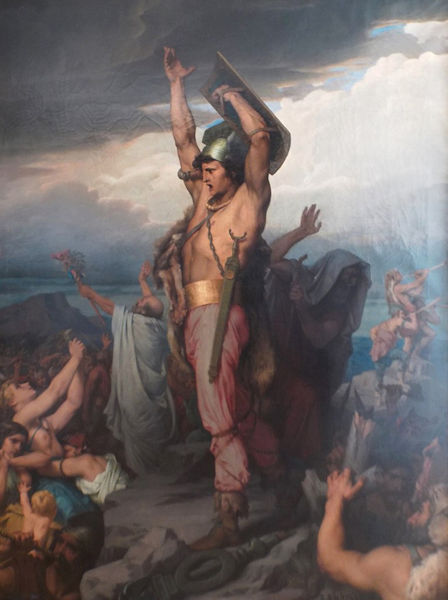
Vercingétorix by François-Émile Ehrmann (1869). Credit: Public Domain
The horsemen of Aedui, (Celtic tribe of central Gaul, allied to the Romans), were positioned on the northern side. Vercingetorix’s warriors, with their horsemen in the lead, rushed back to the eastern sector and drove the Romans back.
The arrival of the Aedui horsemen added to the confusion, as the Romans legionaries confused them for enemies.
Vercingetorix called back his warriors on high positions when he realized that Caesar was sending reinforcement troops. However, Caesar was aware of the heavy losses suffered by his legions (700 men including 46 centurions) and of their vulnerable position because of the topography.
He ordered the withdrawal of his troops.
The Gauls won the Battle of Gergovia and many Aedui warriors rallied Vercingetorix.
Updated on November 26, 2021
Written by – A. Sutherland AncientPages.com Staff Writer
Copyright © AncientPages.com All rights reserved. This material may not be published, broadcast, rewritten or redistributed in whole or part without the express written permission of AncientPages.com
Expand for referencesMore From Ancient Pages
-
 Ancient Legend Is Now Proven True: Sunken Treasure Of Gold And Silver Found
-
 Evidence Of Brain Surgery Performed 3,000 Years Ago Discovered In Tel Megiddo, Israel
-
 Controversial Ruler Tsar Boris Godunov’s Exact Date Of Birth Determined By Scientists
-
 French Grotte de Cussac Cave Reveals Secrets On Life And Death 25,000-30,000 Years Ago
-
 The Carthaginians’ Secret: Mysterious Desert Land Or America Found By Mistake?
-
 Huge Ring Of Ancient Shafts Discovered Near Stonehenge
-
 Archaeologists Unearthed Alabaster Statue Of Queen Tiye In Luxor, Egypt
-
 Fascinating Time Capsule With Secret Code Found In North Carolina
-
 “Hittite Forest” That Grew 4,500 Years Ago Will Be Created In Alacahöyük, Turkey
-
 Mystery Of The Boxgrave Humans – Fossils In The UK Reveal How Ancient Europeans Were Connected
-
 On This Day In History: Massacre In Great Temple Of The Aztec Capital Tenochtitlan – On May 20, 1520
-
 Why Didn’t Alexander The Great’s Body Show Signs Of Decomposition For Several Days? A Never-Before Suggested Explanation – From Scientists
-
 Mysterious Vinca Culture Is Among The Most Advanced Prehistoric Societies In Europe
-
 10 Ancient Chinese Musical Instruments You Didn’t Know About
-
 World’s Oldest Hand Stencils Were Made By Neanderthals In The Maltravieso Cave 66,000 Years Ago
-
 Highly Advanced Robots In Ancient China
-
 Fascinating Legend Of The Seven Sleepers Of Ephesus
-
 Mysterious 2,000-Year-Old Disco Colgante – Unknown High-Tech Device, Representation Of A Spiral Galaxy Or Something Else?
-
 The Burnt City And Its Mysterious Prehistoric Inhabitants
-
 England’s Oldest Bible Reveals Surprising Hidden Secrets

