
Are The Ten Commandments Based On The Forty-Two Principles Of Maat That Appeared 2,000 Years Earlier?
Ellen Lloyd - AncientPages.com - According to Biblical scholars, the Ten Commandments were written by God upon two tablets of stone and then given to Moses on Mount Sinai. This event is supposed to have happened around the 13th or 14th century BC.
What is interesting is that the Ten Commandments are very similar to the 42 Principles of Ma’at that appeared at least 2,000 earlier. There is reason to seriously consider at least 8 of the Christian Ten Commandments were based on Ma'at (or Maat), an ancient ethical and moral principle that every Egyptian citizen was expected to follow throughout their daily lives.
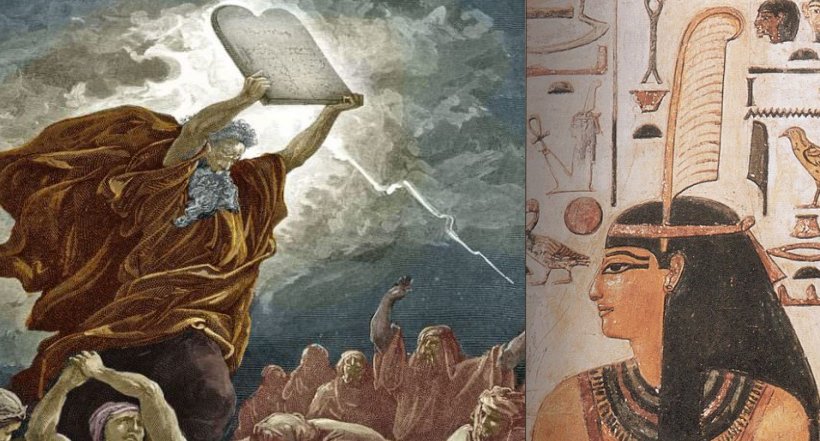
Left: Moses with the Ten Commandments tablet. Right: Egyptian goddess Ma'at.
Maat was an ancient Egyptian goddess of truth, balance, and order. Her name, literally, meant 'truth' in Egyptian and she was a symbol of harmony. Egyptians believed that without her existence, the universe would become chaos, once again.
She was represented as a young woman, sitting or standing, holding a scepter in one hand and an ankh in the other. Sometimes she is depicted with wings on each arm or as a woman with an ostrich feather on her head. In Karnak, inside Precinct of Montu there is a temple dedicated to her. The temple seems to have been built by Hatshepsut, then reconstructed by Thuthmose III.
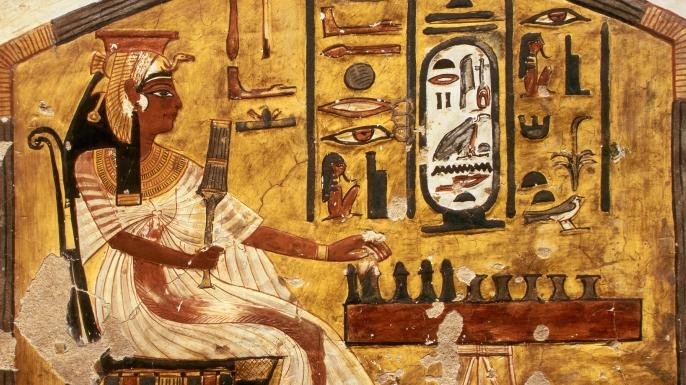
Egyptian goddess Ma'at.
The 42 Principles of Ma'at were created so that ancient Egyptians could follow vital rules and act with honor and truth in manners that involve family, the community, the nation, the environment, and the gods.
From the Egyptian Book of the Dead, the 42 Principles of Ma'at, commonly known as the “Negative Confessions.”
- I have not committed sin.
- I have not committed robbery with violence.
- I have not stolen.
- I have not slain men or women.
- I have not stolen food.
- I have not swindled offerings.
- I have not stolen from God/Goddess.
- I have not told lies.
- I have not carried away food.
- I have not cursed.
- I have not closed my ears to truth.
- I have not committed adultery.
- I have not made anyone cry.
- I have not felt sorrow without reason.
- I have not assaulted anyone.
- I am not deceitful.
- I have not stolen anyone’s land.
- I have not been an eavesdropper.
- I have not falsely accused anyone.
- I have not been angry without reason.
- I have not seduced anyone’s wife.
- I have not polluted myself.
- I have not terrorized anyone.
- I have not disobeyed the Law.
- I have not been exclusively angry.
- I have not cursed God/Goddess.
- I have not behaved with violence.
- I have not caused disruption of peace.
- I have not acted hastily or without thought.
- I have not overstepped my boundaries of concern.
- I have not exaggerated my words when speaking.
- I have not worked evil.
- I have not used evil thoughts, words or deeds.
- I have not polluted the water.
- I have not spoken angrily or arrogantly.
- I have not cursed anyone in thought, word or deeds.
- I have not placed myself on a pedestal.
- I have not stolen what belongs to God/Goddess.
- I have not stolen from or disrespected the deceased.
- I have not taken food from a child.
- I have not acted with insolence.
- I have not destroyed property belonging to God/Goddess
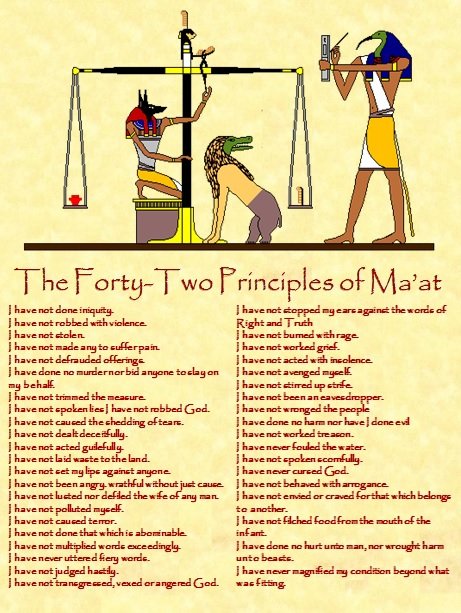
Eight of these rules are similar to the Biblical 10 Commandments. Biblical scholars say that God gave the Decalogue, or 10 Commandments, to the Israelites shortly after they left Egypt. The record of the Ten Commandments can be found in the Bible, both in Exodus 20:2-17 and Deuteronomy 5:6-21.
Ten Commandments List
- You shall have no other gods before Me.
- You shall make no idols.
- You shall not take the name of the Lord your God in vain.
- Keep the Sabbath day holy.
- Honor your father and your mother.
- You shall not murder.
- You shall not commit adultery.
- You shall not steal.
- You shall not bear false witness against your neighbor.
- You shall not covet.
If you slightly reword some of the 42 Principles, you can see that they’re very similar to the 10 Commandments. Reworded principles in bold below.
- Thou shalt not kill, nor bid anyone kill.
- Thou shalt not commit adultery or rape.
- Thou shalt not avenge thyself nor burn with rage.
- Thou shalt not cause terror.
- Thou shalt not assault anyone nor cause anyone pain.
- Thou shalt not cause misery.
- Thou shalt not do any harm to man or to animals.
- Thou shalt not cause the shedding of tears.
- Thou shalt not wrong the people nor bear them any evil intent.
- Thou shalt not steal nor take that which does not belong to you.
- Thou shalt not take more than thy fair share of food.
- Thou shalt not damage the crops, the fields, or the trees.
- Thou shalt not deprive anyone of what is rightfully theirs.
- Thou shalt not bear false witness, nor support false allegations.
- Thou shalt not lie, nor speak falsely to the hurt of another.
- Thou shalt not use fiery words nor stir up any strife.
- Thou shalt not speak or act deceitfully to the hurt of another.
- Thou shalt not speak scornfully against others.
- Thou shalt not eavesdrop.
- Thou shalt not ignore the truth or words of righteousness.
- Thou shalt not judge anyone hastily or harshly.
- Thou shalt not disrespect sacred places.
- Thou shalt cause no wrong to be done to any workers or prisoners.
- Thou shalt not be angry without good reason.
- Thou shalt not hinder the flow of running water.
- Thou shalt not waste the running water.
- Thou shalt not pollute the water or the land.
- Thou shalt not take God’s name in vain.
- Thou shalt not despise nor anger God.
- Thou shalt not steal from God.
- Thou shalt not give excessive offerings nor less than what is due.
- Thou shalt not covet thy neighbor’s goods.
- Thou shalt not steal from nor disrespect the dead.
- Thou shalt remember and observe the appointed holy days.
- Thou shalt not hold back the offerings due God.
- Thou shalt not interfere with sacred rites.
- Thou shalt not slaughter with evil intent any sacred animals.
- Thou shalt not act with guile or insolence.
- Thou shalt not be unduly proud nor act with arrogance.
- Thou shalt not magnify your condition beyond what is appropriate.
- Thou shalt do no less than your daily obligations require.
- Thou shalt obey the law and commit no treason.
According to Biblical accounts, Moses was an Egyptian, meaning that he grew up to worship Egyptian Gods and Goddesses. It's likely that he was familiar with Maat and the 42 Principles.
Written by Ellen Lloyd – AncientPages.com
Copyright © AncientPages.com All rights reserved. This material may not be published, broadcast, rewritten or redistributed in whole or part without the express written permission of AncientPages.com
More From Ancient Pages
-
 Earliest Evidence Of Humans Using Fire To Shape The Landscape Of Tasmania
-
 Millennia Old Extremely Complex Object Of Unknown Origin
-
 Did Ancient Oshoro Stone Circle Serve As A Portal To The Spirit World?
-
 Legendary Sea Monster Exists: Icelandic Government Commission Says
-
 Why Was Lovesickness A Feared Disease During The Middle Ages?
-
 Abundantia: Roman Goddess Who Was Shaking Her Gifts From Cornucopia – ‘Horn Of Plenty’
-
 Sacsayhuamán – Was It Built By ‘Demons’ Or Viracocha The Bearded God?
-
 We Dated A Sacred Aboriginal Women’s Site Used for Birthing Ceremonies And Discovered 7,000 Years Of Tool Making
-
 Leonardo da Vinci’s 280-Meter Long Bridge Design – Tested
-
 Genetic Testing To Trace The Bloodline Of Leonardo da Vinci
-
 How The Kimono Became A Symbol Of Oppression In Some Parts Of Asia
-
 New Clues About The Fascinating Ancient Roman City Falerii Novi Revealed By Scientists
-
 Ancient City Of Tyana And A 1600-Year-Old Rare Octagonal Church Unearthed In Central Anatolia Turkey
-
 They Spoke The Language Of The Gods – Keepers Of Sacred Ancient Knowledge – Part 1
-
 Incredible 2,300-Year-Old Roman-Etruscan Time Capsule Opened In San Casciano dei Bagni, Italy
-
 Angerona – Goddess Of Silence During Cosmic Crises And Protector Of Ancient Rome
-
 Magnificent And Massive Great Wall Of India – Astonishing Ancient Structure Shrouded In Secrecy
-
 Curious Story How Sæmundur The Wise Tricked The Devil Three Times
-
 New Discovery: 2,000-Year-Old Monumental Street In Jerusalem Built By Pontius Pilate
-
 ‘Sensational’ Discovery Of Large Untouched 4,000-Year-Old Grave In Norway

