
What Did Houses For Ordinary People In Sumer Look Like?
A. Sutherland - AncientPages.com - When the Sumerian civilization began to flourish, also daily life in Mesopotamia began to change.
New cities and large towns created new possibilities for people who lived in small villages and were only occupied with haunting and farming.
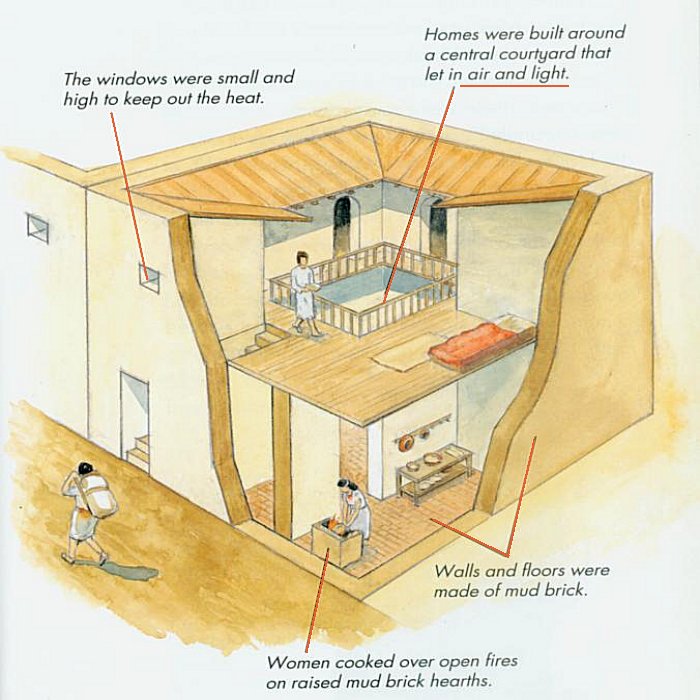
Most houses (approximately 90 square meters) had a square center room with other rooms built around an area that provided access to the light and ventilated the interior.
People in Sumer were divided into three social classes. The upper class included the richest and most influential people such as kings, priests, and government officials. The middle class of the Sumerian society included artisans (skilled workers making metal products, weapons, pottery, or cloth), farmers, fishermen, merchants, and traders, who traveled much to other neighboring towns to trade wheat, tools, and barley for copper.
The lower class included enslaved people who were captured, then sold and bought among the upper class; they worked in temples and on farms.
Sumerians built their houses by themselves
The average house was a small one-story structure made of mud-brick. It contained several rooms grouped around a courtyard. People with more resources probably lived in two-story houses, which were plastered and whitewashed and had about ten or even twelve rooms, equipped with wooden doors, although wood was not common in some cities of Sumer.
The ground floor in two-story houses usually consisted of a reception room, kitchen, and toilet, and servant’s quarters.
Most houses (approximately 90 square meters) had a square center room with other rooms built around an area that provided access to the light and ventilated the interior. Light in the home was provided by small lamps fueled by sesame seed oil.
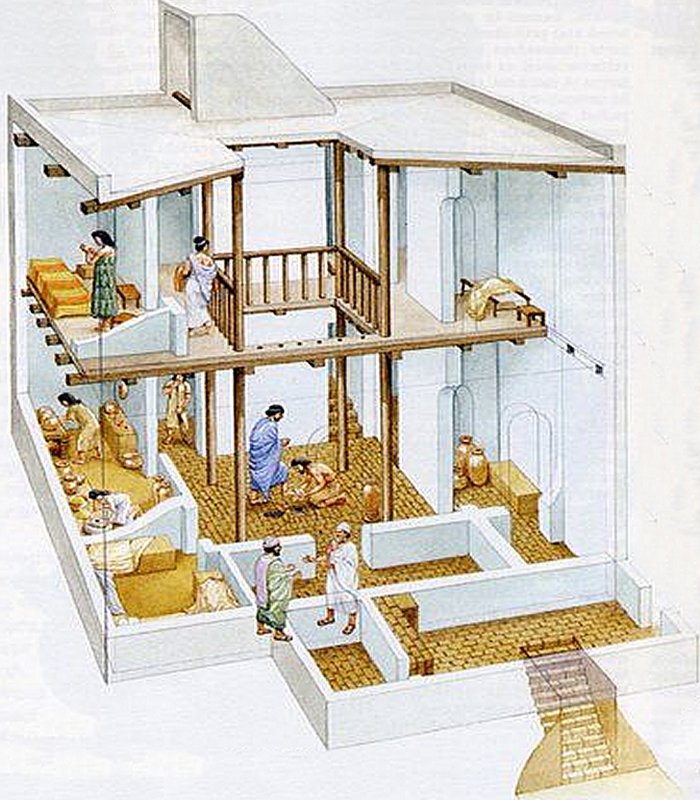
While wealthy people built their houses of sun-dried bricks, other people had only means for construction reeds.
A hearth, placed in the courtyard or in a separate room, was an important part of the house. The windows (often in more expensive houses) were very small and placed at high altitudes. They efficiently isolated the interior of the house from the outdoor heat.
Among basic furniture in the Sumerian house, there were low tables, beds with wooden frames, and high-backed chairs and kitchens with household vessels; there were also baskets and chests made of reed. Walls and floors were often covered with reed mats and skim rugs.
Those who could not afford to buy comfortable, luxurious beds and chairs enjoyed sleeping on mats of woven straw or reeds, which covered the floor of the house.
Under the floor of the house, there was sometimes a family mausoleum where the dead family members were buried. However, there also seem to have been special cemeteries for the dead located outside the cities.
Reed houses were also built
While wealthy people built their houses of sun-dried bricks, other people had only means for construction reeds.

Sumer had no trees for timber but it had the huge reeds in the marshes, and this raw material was widely used in the building of reed houses.
People tied reed bundles or plaited them into mats and set vertically in the ground, like columns, in two parallel rows, and then their peaks were tied.
Stephen Bertman writes in "Handbook to Life in Ancient Mesopotamia":
"Digging a series of holes in the ground, the builders would insert a tall bundle of reeds in each hole. A circle of holes would be used to make a circular house; two parallel rows to make a rectangular one. Once the bundles were all firmly inserted, the ones opposite each other would be bent over and tied at the top to form a roof. For a front or back door, a reed mat would be draped over an opening (either at the ends of a rectangular house, or on the side of a circular one).
Such primitive homes are still made and used by the marsh-dwellers of southern Iraq. In a hot climate like Iraq’s, a well-designed house must protect its dwellers from the sun’s searing heat. The reed houses accomplished this purpose by providing shade. In addition, the thick bundles of reeds provided some insulation. If the house was rectangular and there was an opening at either end, its owners may have enjoyed cross-ventilation as well..."
All humans, no matter their wealth or rank have preserved a very beautiful tradition: gathering at the table for the evening meal. This tradition still continues.
Written by – A. Sutherland - AncientPages.com Senior Staff Writer
Copyright © AncientPages.com All rights reserved. This material may not be published, broadcast, rewritten or redistributed in whole or part without the express written permission of AncientPages.com
Expand for referencesReferences:
Hunter N. Daily Life in Ancient Sumer
Bertman S. Handbook to Life in Ancient Mesopotamia
More From Ancient Pages
-
 Pottery Found On Jiigurru/Lizard Island Rewrites Aboriginal History
-
 Parthenon Marbles: MEPs Call On Boris Johnson To Return Treasures To Greece
-
 Huge Phitos (Jar) Unearthed In Ancient City Of Prusias ad Hypium, Turkey
-
 World’s Oldest Paycheck Reveals Ancient Sumerian Workers Were Paid In Beer
-
 London’s Oldest Theater Red Lion Discovered Beneath Whitechapel
-
 On This Day In History: Most Unusual Emperor Renzong Of Song Dynasty Was Born – On May 30, 1010
-
 Burials Of An Unknown Race Of Unusually Small Humanoids Found In Ohio May Confirm Native American Legend
-
 Mysterious Advanced Underground Civilization And A Secret Society – Astonishing Discovery And Connection – Part 1
-
 Lost Advanced Ancient Forest Civilization In The South West Pacific Could Re-Write History – Legends And Archaeological Findings Examined
-
 Mysterious Sumerian Statues With Big Blue Eyes – A Sign From The Gods
-
 On This Day In History: David I Becomes King Of Scots – On Apr 27, 1124
-
 Strange Mythical Creature Resembling A Sphinx Discovered In A Medieval Bathroom
-
 Keeladi Excavations Reveal Unique 2,000-Year-Old Terracotta Pipelines, Open Water Channel
-
 Ancient Graffiti Unearthed At Roman Vindolanda Reveals What One Roman Thought Of Another
-
 Focus On Unique And Spectacular Gallery Grave In Ancient City Of Dara, Mardin
-
 ‘Wheel Of Giants’: Mysterious Complex Of Circles – Prehistoric ‘Stonehenge’ Monument In The Middle East
-
 Mysterious Ancient Inscriptions Never Meant To Be Read – Biblical Secrets Revealed
-
 Chankillo: A 2300-Year-Old Solar Observatory in Peru
-
 Mystery Of The Yaghan People: The First True Discoverers Of America?
-
 Machu Picchu Was Built With The Royal Unit System – New Research Suggests

