
Binary Code Was Used In Ancient India And Polynesia Long Before Leibnitz Invented It
A. Sutherland - AncientPages.com - In 1703, the German mathematician Gottfried Leibniz demonstrated the advantages of the binary system for computations and by doing so he laid the foundation for computing machines.
However, Leibniz was by no means the first person to discover the binary code. His invention was merely a re-invention based on ancient knowledge.
There is evidence that people in ancient India and Polynesia were familiar with the binary code thousands of years ago.
Having those discoveries in mind, scientists now question the origin of the binary system and the date of its invention.

Ancient Knowledge Of Binary Code in Polynesia
After studying the language of the tiny Pacific island of Mangareva in French Polynesia, Norwegian researchers discovered that one of two number systems traditionally used on Mangareva, had three binary steps superposed onto a decimal structure.
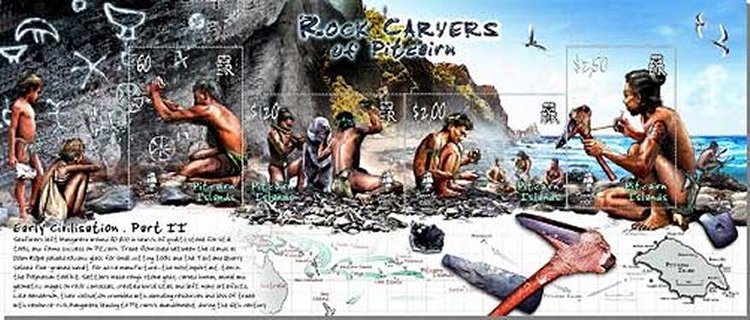
“Polynesian seafarers left Mangareva around AD 800 in search of quality stone for vital tools, and found success on Pitcairn. Trade flourished between the islands and settlers made rough stone gods, carved human, animal and geometric images on rock canvasses, created burial sites and left many artifacts. The Bounty mutineers arrived in 1790 and found their temple platforms, petroglyphs and stone tools giving evidence (and confirmed by Marshall Weisler), that Pitcairn had formerly supported an ancient Polynesian population, most probably from Mangareva.” Image credit: Pitcairn Islands Philatelic Bureau
The Mangarevan invention of binary steps, centuries before their formal description by Leibniz, attests to the advancements possible in numeracy even in the absence of notation and thereby highlights the role of culture for the evolution of and diversity in numerical cognition.
See also:
Was Ancient Egyptian Science Inherited From A Lost Atlantean Civilization?
Scientists discovered that the Polynesians who arrived in Mangareva over 1,000 years ago used a decimal system, as other Polynesians did. However, by A.D. 1450, the Mangarevans were using a system that combined base 10 and base 2. In the Mangarevan language, there are words for the numbers 1 through 9, as with all decimal systems.
For numbers 20 to 80 ancient Polynesians used a binary system, with separate one-word terms for 20, 40 and 80.
Ancient Music Text Reveals Knowledge Of India
There is a very interesting ancient music text written by Pingala, and important ancient scholar and author of Chhandahshastra (meaning science of meters). This ancient musical composition reveals knowledge of the binary system. The text dates to 2nd century A.D. and is with other words more than 1500 years older than Leibnitz binary system.
According to researchers, the Chhandahshastra represents the first known description of a binary numeral system in connection with the systematic enumeration of meters with fixed patterns of short and long syllables.
Use of zero is sometimes ascribed to Pingala due to his discussion of binary numbers, usually represented using 0 and 1 in modern discussion, but Pingala used light (laghu) and heavy (guru) rather than 0 and 1 to describe syllables.
As Pingala's system ranks binary patterns starting at one (four short syllables—binary "0000"—is the first pattern), the nth pattern corresponds to the binary representation of n-1 (with increasing positional values).
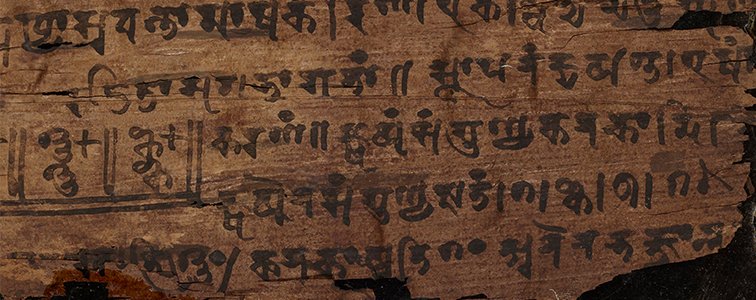
Bakhshali manuscript – Image credit: Bodleian Library
Pingala is credited with using binary numbers in the form of short and long syllables (the latter equal in length to two short syllables), a notation similar to Morse code.
That the binary code was invented in India is hardly a surprise. Not long ago, scientists discovered a very intriguing ancient Indian text known as the Bakhshali manuscript that re-writes the history of number zero and mathematics.
Written by – A. Sutherland - AncientPages.com Senior Staff Writer
Copyright © AncientPages.com All rights reserved. This material may not be published, broadcast, rewritten or redistributed in whole or part without the express written permission of AncientPages.com
More From Ancient Pages
-
 Surprising Discovery Of Rare Turtle Statue Under Bayon Temple In Angkor, Cambodia
-
 Hidden History Of Skull And Crossbones: The Untold Story Of The Templar And Their Connection To The Shining Ones
-
 Horses In Florida Did Not Travel Far Distances – New Study Suggests
-
 Older Than Dracula: In Search Of The English Vampire
-
 Advanced Heating System Discovered In Ruins Of Metropolis ‘City Of Mother Goddess’
-
 Mystery Of The Ancient Giant Wish Stone At Hattusa
-
 Archaeologists Survey Bronze Age Konar Sandal Site In Southeast Iran
-
 5 Myths About The Amazons – Ancient Female Warriors
-
 ‘Vandal’ Of Norwegian Viking Graves Identified But Charges Have Been Dropped!
-
 Why Did Ancient Romans Cut Off Their Thumbs?
-
 Prehistoric Temperatures Of North America’s Oldest Archaeological Sites Shed New Light On Ancient Human Migration
-
 Ancient DNA Reveals Easter Island’s Population Collapse Never Occurred
-
 Hidden Manuscripts Reveal Ancient Sacred Wisdom Of The Gods And Surprises
-
 Never-Before-Seen Colorful Inscriptions And Reliefs At The Esna Temple, Egypt Revealed After Restoration
-
 King Geirrod Betrayed His Brother Agnar And Sent Him To Die But Justice Finally Prevailed
-
 Excavation And Restoration Of New Rooms In The Pyramid Of Sahura In Abusir
-
 Ancient People Handled Sun Exposure Better Than Modern People – An Anthropologist Explains Why
-
 Mesopotamian People Liked To Drink Beer Using Variety Of Drinking Vessels
-
 London Is Twice As Old As Previously Thought – New Discovery Reveals
-
 Great Wall Of Gorgan: One Of The World’s Most Sophisticated Frontier Walls Ever Built Is Now Examined

