
What Is Pax Sinica?
AncientPages.com - Pax Sinica (in Latin:"Chinese peace") was similar in its meaning to Pax Romana, and it applied to the period of peace in East Asia, maintained by social, cultural, ideological, or economic influence of China.
The Pax Sinica is considered the Chinese version of the Romans' Pax Romana, a period of relative peace and stability across the Roman Empire which lasted for over 200 years.
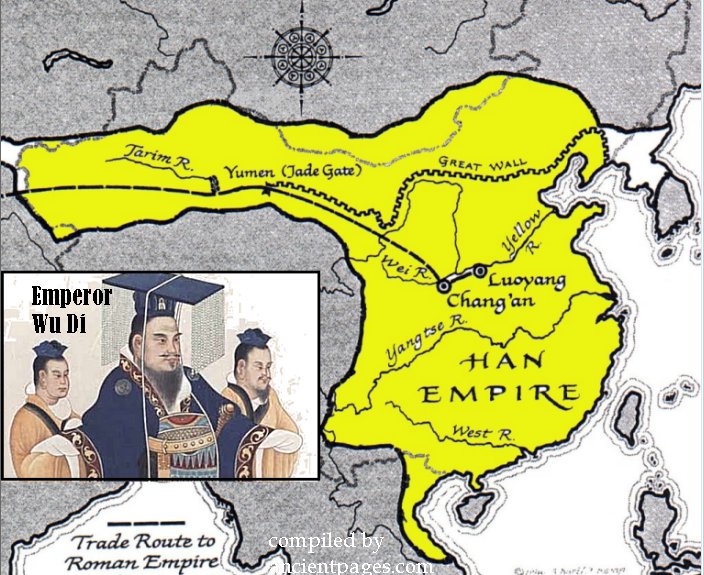
China Han Dynasty Empire - 206 B.C to 220 AD
When the high-ranking emperor of Han, Liu Pang (202 – 195 BC) founded the Han Dynasty in 202 BC, the Chinese began to experience a 400 year period of peace, known as the Pax Sinica.
It had various ways to manifest itself but it first of all concentrated on some basic innovations that were of great importance for the country.
The Han rulers established a strong central government formed of carefully chosen candidates instead of members of the royal family.
The government had to work in the people’s interest. It helped and protected the Chinese citizens, mainly by peace and prosperity.
See also:
Pax Romana: 200-Year-Long Period Of Stability Within The Roman Empire
Pax Mongolica: Time Of Peace And Stability That Helped To Spread Technologies And Inventions
Pax Assyriaca: Important Time For The Neo Assyrian Empire And Surrounding Regions
Among several introduced innovations was the storage of remaining food during times of plenty and selling it during difficult times. It stabilized both prices and feeding the public.
During this time, the Great Wall of China was built, the long-distance travel and trade, which was used to trade silk, spices, and tea with the Roman Empire, also prospered on the Silk Road.
During the Pax Sinica, several developments of the Han Dynasty took place such as the civil service, the first papermaking process was documented in China during the Eastern Han period (25–220 AD). In 140 BC, the land expanded due to conquests of Korea, Manchuria, and Vietnam by Han emperor, Han Wudi.
After the Han Dynasty ended in 220 AD, the Pax Sinica continued during a period of the next six dynasties (the Western Zhou, Tang, Western Han, Eastern Han, Ming, and Qing dynasties), which lasted for over 350 years.
As we said, the Pax Sinica introduced by Han dynasty of China coincided with the Pax Romana of the western world by Rome.
Copyright © AncientPages.com All rights reserved. This material may not be published, broadcast, rewritten or redistributed in whole or part without the express written permission of AncientPages.com
More From Ancient Pages
-
 Unexpected Neanderthal Behavior In Spain’s Southern Pyrenees – Revealed
-
 Monster Water God Gong Gong Blamed For Cosmic Catastrophes In Chinese Myths
-
 Lost William Turner Painting “The Rising Squall” Re-Discovered After 150 Years
-
 Pacific God A’a: Fascinating Polynesian Sculpture Designed To Carry A Human Skull And Bones
-
 Ninkasi – Sumerian Goddess Of Beer And Alcohol – The Hymn To Ninkasi Is An Ancient Recipe For Brewing Beer
-
 Controversial Story And Secret Knowledge Of Li Ching-Yuen Who Lived For 256 Years
-
 Early Humans May Have First Walked Upright In The Trees 7 Million Years Ago
-
 Extraordinary Collection Of Ivory Plaques Dated To The First Temple Period Unearthed In Jerusalem
-
 Stunning Underwater Photos Reveal Secrets Of Legendary Lost City Of Heracleion
-
 Qijia Culture – Its Disappearance Remains An Ancient Mystery
-
 Never Before Seen 3D Images Of Noah’s Ark Finally Revealed To The Public
-
 Hill Of 100,000 Crosses In Lithuania Survived Against All Odds
-
 Legendary Saraswati River Is Not A Legend – It Existed 4,000 Years Ago
-
 On This Day In History: King Alexander II Was Crowned At Scone, Scotland – On Dec 6, 1214
-
 Unknown Neanderthal Lineage Discovered In “Thorin” Who Lived 50,000 Years Ago
-
 On This Day In History: Eugène Dubois Who Discovered Remains Of Java Man Was Born – On Jan 28, 1858
-
 85 Beautiful And Rare Coptic Textiles – A Gift To Museum At Queens College
-
 Fragment Of A 1,750-Year-Old New Testament Translation Discovered
-
 Diyu – Terrible Chinese Hell And Judgement Of God Yama
-
 Submerged Ancient Bridge Found In Genovesa Cave Reveals Humans Settled In Mediterranean Much Earlier Than Previously Thought

