
Enigma Of San Bernardo Mummies That Refuse To Decompose
Ellen Lloyd - AncientPages.com - Due to their extraordinary condition the San Bernardo mummies are undoubtedly an enigma. The mummies simply refuse to decompose, and no-one can explain why.
Unlike other dead people, these bodies have been buried and somehow naturally preserved, the mummification process has taken place without any sort of accidental chemical intervention. How is it possible?
San Bernardo is a small town in Colombia about 3 hours south of Bogota. The mummies are not ancient, but nevertheless very intriguing. They bodies were discovered in the 1950s, when a flood forced people to relocate the local cemetery. When workers moved the graves they were started to discover several corpses that were still in excellent condition. The bodies showed no signs of decay or decomposition. Eyewitnesses said the San Bernando mummies seemed to be in a perpetual state of suspended animation. This is a mystery because unlike for example ancient Egyptian mummies or the strange mummies of Venzone, these bodies showed no sign of complicated mummification processes.

Credit: NTDTV/YouTube
The people who had been buried here were neither famous nor rich. They were locals who had lived in the town and put to rest at the cemetery.
See also:
Mystery Of Lama Dashi-Dorzho Itigilov: A Mummy Whose Body Defies Time
The Tuli Mummy: Botswana’s Only Ancient Mummified Human Body Discovered So Far
America’s Mysterious Pedro Mountain Mummy And The Hidden Race Of Little People
Scientists have speculated how these bodies refuse to bow down to the inevitable passage of time and there are some theories, but none of them solves the puzzle. Some have suggested a local diet may explain why the bodies of the deceased are still in excellent condition. Apparently, the guatila and the baluthere are two unusual fruits commonly eaten in the area.
It is possible these fruits kept the people healthy, but the diet fails to explain why the clothes are still intact. The alleged diet doesn’t also explain why perfectly well-preserved mummies have only been found at one cemetery. This has led to the speculation that there may be some unknown organisms in the ground, at least at this particular place. Another possibility us that the climate in the area may be the reason why the dead refuse to rot. We simply don’t know how this natural, and yet unique mummification process happened.
The extraordinary well-preserved San Bernando mummies still puzzle the scientific community, and the cause has never been satisfactorily solved.
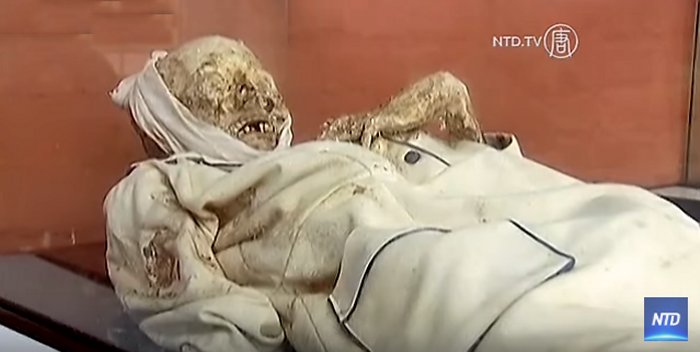
Credit: NTDTV/YouTube
“I think the location of the cemetery, the actual site, I think it is something to do with the Universe, because it never happened at the old cemetery, never. No mummies ever came out from there,”one local said.
Family members have allowed bodies of their loved one to be put on display for educational purposes. Tourists can visit the mausoleum and see some of the best-preserved mummies.
Some of the best-preserved bodies are kept inside a glass case. One person is still dressed in jacket, tie and trousers. If it hadn’t been for the oddly pale face and sunken eye sockets giving him away as a corpse, you could hardly believe you are starring at someone who passed away a long time ago.
Written by - Ellen Lloyd – AncientPages.com
Copyright © AncientPages.com All rights reserved. This material may not be published, broadcast, rewritten or redistributed in whole or part without the express written permission of AncientPages.com
Expand for referencesMore From Ancient Pages
-
 On This Day In History: Edict Of Milan Is Signed – Persecution Of Christians Ends – June 13, 313 AD
-
 Number Nine: Sacred Symbol In Ancient Cultures
-
 Surprising Mask Of A Human Face Found On Cistern Wall In The Ancient City Of Ptolemais
-
 Pharaohs In Trouble: Climate Change And Natural Disasters Led To Political Uprisings In Ancient Egypt
-
 Roman Woman Depicted On Ancient Marble Sculpture Found In Crimea Identified
-
 European Medieval Burial Practices Were Different Than Previously Thought
-
 Excavations At Okazaki Castle Reveal A 400-Year-Old Massive Unbroken Wall
-
 Rare Viking Boat Burial At Kiloran Bay In Colonsay, Scotland Remains A Fascinating Find
-
 Unique Viking Age Silver Treasure Found On Farm Near Stockholm In Sweden
-
 Immortal Mimi Spirits In Beliefs Of Aborigines Of Arnhem Land
-
 Fascinating Portable Art From Torre Cave, Gipuzkoa – One Of The Most Complete Specimens From The Entire Iberian Peninsula
-
 Intriguing Discovery Could Offer Proof Of The Tabernacle – Has The Dwelling Place Of God Been Located?
-
 Was Beautiful Ancient City Of Terracina Home To The First Hellenistic Temple?
-
 Modern Humans Have Their Homeland In Botswana – New Study
-
 Nammu: Sumerian Goddess Who Got The Idea To Create Mankind In The Image Of Gods
-
 Secrets Of An Ancient Greek City Revealed
-
 On This Day In History: Supernova Observed In Constellation Lupus By Chinese And Egyptians – On May 1, 1006 AD
-
 12,000-Year-Old Camel Rock Art In Arabia’s Desert Served As Ancient Signs To Water Sources
-
 Idol Of Pachacamac Inca God Reveals Its Colors
-
 Ancient DNA Reveals Some Northern Europeans Came From Siberia

