
Sokar – Patron Deity Of Ancient Necropolis Of Memphis In Lower Egypt
A. Sutherland - AncientPages.com - In Egyptian mythology, Sokar is an ancient falcon god of the Memphite necropolis, located in Memphis, Lower Egypt. It includes the sites of Giza, Saqqara, and Dahshur, rich in pyramids, mastabas, and tombs.
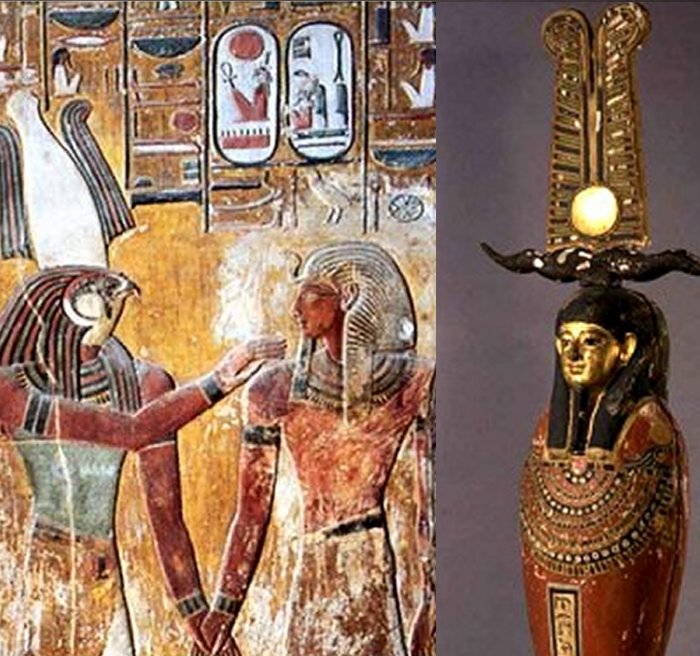
Left: Seti I before Sokar in his tomb on the West Bank of Thebes in the Valley. Image via Tour Egypt; Right: Ptah-Sokar-Osiris figure bears a crown on its head composed of ram's horns, two feathers, and a solar disk. Image credit: Kunsthistorisches Museum, Vienna via globalegyptianmuseum.org
The deity was believed to have many names and Sokar (Sokhar, Sokaris, Seker) was one of them, but the meaning of his name remains unclear. According to the Pyramid Texts, the ancient Egyptians linked his name to the Osiris’ cry for help to Isis 'Sy-k-ri' ('hurry to me'),[1] or possibly “skr”, meaning "cleaning the mouth".
Originally, Sokar was probably a god of craftsmanship; he fashioned silver bowls, as attested in the Book of the Dead, an ancient Egyptian funerary text, used from the beginning of the New Kingdom (around 1550 BC to around 50 BC. In the silver bowls, The feet of the deceased were washed in these silver bowls. Another artifact (unearthed at Tanis) is the silver hawk-headed coffin of a pharaoh of the 22nd dynasty of Egypt, Sheshonq II (945-924 BC. The coffin was found decorated with the iconography of Sokar.
Later, his power rose significantly and he became associated with the underworld and afterlife. Accordingly, he participated in religious ceremonies and was responsible for the reception, cleaning of the deceased ruler, and carrying him on his "henu barque" to heaven, according to the Pyramid Texts (the oldest funerary literature of ancient Egypt).
Emblems And Depictions Of Sokar
Most important emblems of Sokar include a barge, onions, and geese. Depiction of the god Sokar varied much; however, the falcon was his original form.
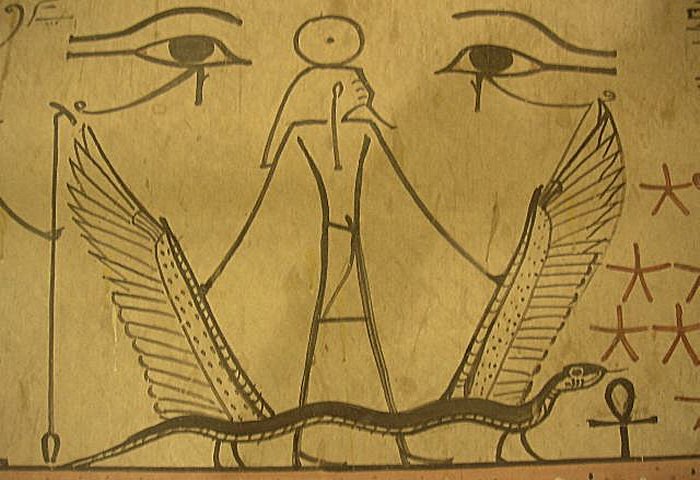
Sokar is represented in the tomb of Thutmose III. Image source
Sokar was depicted in various ways. In depictions dated to the Old Kingdom (c. 2613-2181 BC) he is portrayed as an anthropomorphic figure with the head of a falcon, symbolizing his divine ability to fly in the underworld, on earth, and in the heavens.
He was also showed a hawk-headed man, a mummy or standing or seated on a throne, dressed in the cloth of a funerary god. He wears a White Crown and holds a scepter and a whip - the regalia of Osiris.
As a falcon, he was associated with Horus, wearing the Double Crown. His solar functions are indicated by the presence of the disk and the uraeus, one of many important Egyptian symbols. When in human form, Sokar occasionally wears the Atef crown.
His other symbolic depictions included Sokar wearing “a complex conical crown with sun disk horns and cobras. In the tomb of Tuthmosis III in the Valley of the Kings, he is depicted as a falcon-headed god standing on a multi-headed chthonic serpent, emphasizing his power over the nether regions and their inhabitants… He could also be represented as a squat, pygmy-like male, sometimes with a scarab beetle on his head, and the amuletic deity Pataikos [whose texts from the Late Period identify as Ptah or Ptah-Sokar]…” (Wilkinson)
However, outside the funerary tradition, worship of Sokar is difficult to trace and document.
Amulets of Sokar were not commonly encountered but some depicting squatting, mummiform falcons may represent this particular deity.
God Of Many Epithets And Different Roles
Sokar had a number of epithets and one of them was for example, “he of Rosetau” (the necropolis entrance to the underworld).
Basically, Sokar was a funerary deity acting in the realm of the Memphite necropolis. The Pyramid Texts describe Sokar as a god active in the rebirth of the king and in the ceremonies of confirmation and transfer of royal power.
In the “Book of What Is In The Underworld", Sokar supervises a snake-infested desert region that must be crossed by the sun god and the royal dead.
Sokar has also the title “Lord of the Mysterious Region” and in this role, he dwells in a cavern guarded by the two-headed Aker-sphinx, where he is many times forced to overcome a multi-headed chaos serpent.
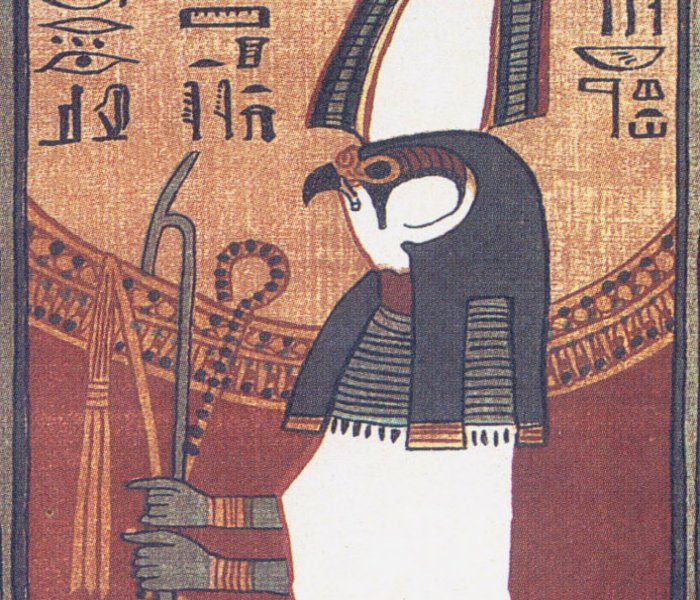
Sokar-Osiris. Facsimile of a vignette from the Papyrus of Ani. Image credit: British Museum
Sokar as the great god with two wings opened symbolizes the deity’s unlimited movement and authority in the afterlife.
In the New Kingdom Period (1550-1070 BC), Sokar regained popularity and in his statues, he was portrayed as a hollow mummy, containing copies of The Book of the Dead or corn kernels. He was called “He Who Is Upon His Sand, which refers to his desert origin.
Ptah, Sokar and Osiris Became One
In the Late Period (525-332 BC), Sokar was identified with Ptah and Osiris. Ptah-Sokar-Osiris was a powerful deity that combined the characteristics and titles of three deities – Ptah, (god of Memphis), Sokar, (god associated with Saqqara and the cemetery of Memphis), and Osiris (god of the dead). As such it had an important role in the funeral traditions of ancient Egypt.
Worship Of God Sokar And His festival
Sokar is known from sites throughout Egypt, mainly through textual sources and later, from the Middle Kingdom onward, through a large variety of depictions.
Sokar was worshiped in many places across ancient Egypt but his main cult center was in Memphis, where the Sokar festival took place each year in the fourth month of the spring “akhet” season in Memphis.
During the ceremony, the god was carried from his temple to assist the king in ceremonial activities (with clearly agricultural aspects) such as hacking up the earth, digging ditches or canals, and driving cattle.
Sokar’s followers who participated in the festival had strings of onions ( one of Sokar’s emblems) around their necks. Onions were used in embalming people - sometimes the skin, sometimes the entire onion. When just the skin was used, it would be placed on the eyes and inside the ears of the deceased to mask the smell.
Later, his festival was also organized in western Thebes. The Festival of Sokar-Osiris was celebrated as a mortuary or lunar festival at night when people took offerings to both the god and the dead.
During one festival, 3,694 loaves of bread, 410 cakes, and 905 jars of beer were distributed.
Written by – A. Sutherland - AncientPages.com Senior Staff Writer
Copyright © AncientPages.com All rights reserved. This material may not be published, broadcast, rewritten or redistributed in whole or part without the express written permission of AncientPages.com
Expand for referencesMore From Ancient Pages
-
 Deir el-Bahri – Sacred Resting Place For The Pharaohs
-
 Çatalhöyük – 9,000 Years Ago: Overcrowding, Infectious Diseases, Violence And Environmental Problems Of Early Farmers
-
 Ancient DNA Study Reveals Surprise About Britain’s Bronze Age – What Happened On The Orkney Islands?
-
 Obsidian Flake From 45,000-Year-Old Tool Unearthed In Armenia
-
 Peculiar Accounts Of Ancient Flying Metallic Dragons And Bells In China And Japan
-
 Gigantic Asipatra: Terrifying Mythical Monster Bird In Hindu Beliefs
-
 Zeus – ‘Cloud Collector’, God Of Order, Law And Justice – Most Powerful God Of Olympian Pantheon
-
 How Strong Is The Link Between Sanskrit And European Languages?
-
 Roman Naval Base of Haltern in Germany Was Rebuilt Four Times 2,000 Years Ago
-
 Is An Ancient Temple Dedicated To The Lioness Goddess Repit Hidden In The Cliffs Of Athribis?
-
 Lemko People – European Minority That Lost Their Homeland And Still Live In Exile
-
 Explorer Discovered A Lost Underground World Beneath Big Sur In North America – But Why Cannot Anyone Else Find It Now?
-
 Never-Before-Seen 3,000-Year-Old Paintings Of Egyptian Goddess Amentet Discovered Inside Coffin Of A Mummy
-
 Ancient Manuscripts About Sea Monsters Solve An Ocean Mystery
-
 Mysterious And Unexplained Encounter With Unusual Tiny Beings In Italy – A Strange Connection – Part 2
-
 New Last Ice Age Findings In Palawan Cave
-
 Qumran: The Dead Sea Scrolls And Their Connection To Enigmatic Essenes
-
 ‘Blue Highways’ Helped Middle Stone Age Humans Who Survived The Toba Supereruption 74,000 Years Ago
-
 Tipón (Tipon): Who Taught The Inca How To Build Artificially Irrigated Garden?
-
 DNA Study Reveals 250 Siberians Became The First Native American Population

