
Winged Sun Disk: One Of The Oldest And Most Important Solar And Religious Symbols
A. Sutherland - AncientPages.com - The winged sun disk has been found in many cultures worldwide from very ancient times. As one of the oldest religious and solar symbols, the winged sun disk was seen in many variations among the Sumerians, the Assyrians, and the Hittites, just to name a few.
The winged Sun signifies omnipresence; it is associated with divinity, royalty, and supreme power in Egypt, Mesopotamia, Anatolia, and Persia. It is interpreted as a solar globe usually carried on the hawk wings of the God Horus, surmounted by the spreading horns of the ram god Amun.
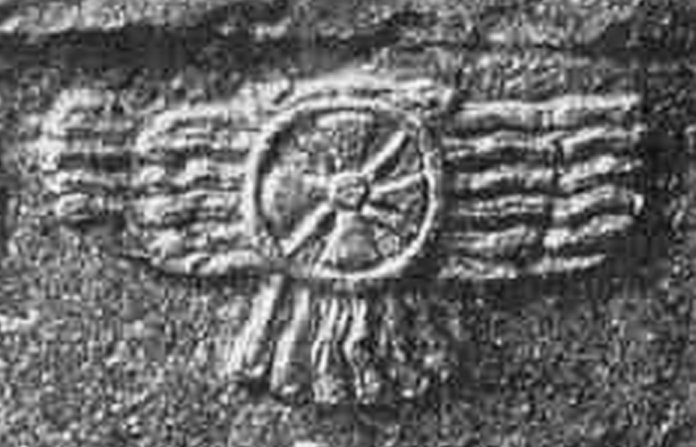 Winged Sun Disk as depicted on Stele to Assurnasiripal II at Nimrud (9th century BC). Image source
Another variation is the sun disk, flanked by two uraeus snakes (cobras) with opened hoods, sometimes wearing crowns on their heads.
The winged disk represents a singular symbol of the Savior, a winged sun, the Sun of Righteousness, arising with healing on his wings.
It is also a symbol of the sun god - Ra. 'Ra' means transforming good into nothing, disaster, and suffering in Hebrew. In China, it is a symbol of heavenly perfection, and in India and Egypt, it symbolizes a metaphorical rise in higher spheres.
In the occult, it has become a symbol of power. It is often used on tarot cards.
Winged Sun Disk In Ancient Egypt, Mesopotamia And The Levant
In ancient Egypt, the symbol is attested from the Old Kingdom (c. 2613-2181 BC) and usually flanked (on either side with a uraeus. As a symbol of protection, it has been found on stela and above temple entrances since the Middle Kingdom. It was called 'the Behdety' and as such, it was associated with the God Behdety, who (after being combined with Horus) became known as Horus of Behdet - as hawk-winged sun disc originating in the Nile Delta.
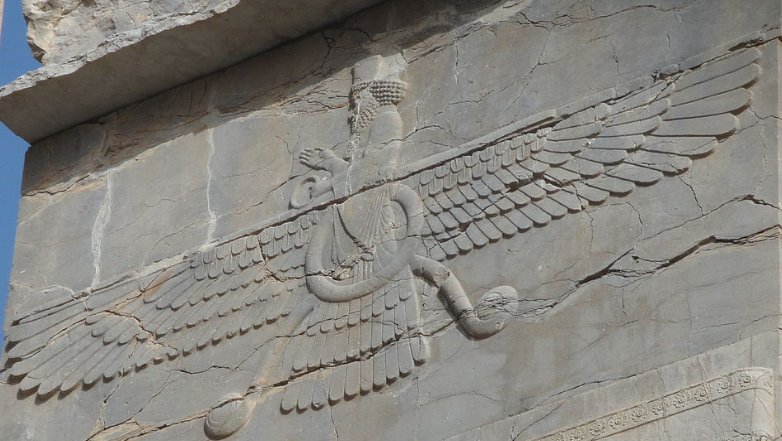
Farvahar (the "visual aspect of Ahura Mazda") i Persepolis, during the times of Zoroastrian Persia. Source
The pharaoh Akhenaten tried to eliminate all other deities and introduce the worship of the sun disk alone, personified, naturally, by himself. His attempts failed. Ancient Egypt's polytheistic system of beliefs did not accept Akhenaten's ideas and visions and erased his name from stelae.
The sun disk became the main symbol of the chief heaven god, known and worshiped under several names in Egypt. Traditionally, the sun disc was carved over doorways on many Egyptian tombs and temples.
In the Levant, Mesopotamia, and Asia Minor, the winged sun disk appeared about 2000 BC.
Assyrian rulers considered it a symbol of royalty. Its importance was expressed in words: SOL SUUS (in Latin, literally, "his own self, the Sun", i.e., "His Majesty").
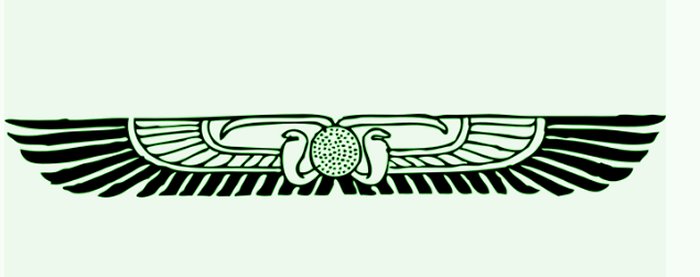
Winged sun disk. Source
In the 8th century BC, the winged solar disk appeared on Hebrew seals associated with the royal house of the Kingdom of Judah, especially the symbol (together with the inscription l'melekh ("belonging to the king") was found on jars and seals from the reign of Hezekiah (715 to about 686 BC), the 13th successor of David as king of Judah at Jerusalem. Hezekiah's royal seals were decorated with six rays emanating from the central sun disk and two downward-pointing wings.
In Zoroastrianism, the winged sun disk was known as 'The Faravahar' (the "visual aspect of Ahura Mazda") during the times of Zoroastrian Persia, and some seals were found flanked on either side with the Egyptian ankh ("key of life") symbol.
The last of the Old Testament prophets, Malachi lived c. 420 BC and is considered the author of "The book of Malachi". It is the last book of the Christian Old Testament. The book of Malachi ends with God's promise to send Elijah. Jews and Christians generally agree that Elijah will return before the Messiah.
In this book, Malachi 4:2, refers to a winged "Sun of righteousness," But unto you that fear my name shall the Sun of righteousness arise with healing in his wings... "(KJV)
Updated on May 31, 2022
Written by – A. Sutherland - AncientPages.com Senior Staff Writer
Copyright © AncientPages.com All rights reserved. This material may not be published, broadcast, rewritten or redistributed in whole or part without the express written permission of AncientPages.com
Expand for referencesReferences:
Florence Nightingale on Mysticism and Eastern Religions
Alexander, Robert L. "A Hittite Cylinder Seal in the Fitzwilliam Museum." Anatolian Studies 25 (1975): 111-17. doi:10.2307/3642578.
Whitley, John B. "עיפה in Amos 4:13: New Evidence for the Yahwistic Incorporation of Ancient Near Eastern Solar Imagery." Journal of Biblical Literature 134, no. 1 (2015): 127-38. doi:10.15699/jbl.1341.2015.2633.
More From Ancient Pages
-
 Naglfar Nail-Ship Carries Demonic Forces To Ragnarok In Norse Beliefs
-
 Lost Since 1362: Researchers Discover The Church Of Rungholt – A Sunken Medieval Trading Place
-
 Timur: Brutal Military Leader And His Desire To Conquer But Not To Rule
-
 Enormous And Impressive Derawar Fort, Bahawalpur, Pakistan Will Be Restored
-
 Maya Storm God Huracán Taught That When We Damage Nature, We Damage Ourselves
-
 Climate Played A Crucial Role In Human Migration From Africa – New Study
-
 Prehistoric Dispilio: Accurately Dating Ancient Site To 5259 BC Using Cosmic Rays
-
 Well-Known Powerful Yin Yang Symbol Dates Back To Ancient China
-
 Gigantic Neolithic Newgrange Monument: A Temple, Astronomical Observatory Or Ancient Tomb?
-
 Edfu Texts Reveal Secrets Of Predynastic Egypt And Zep Tepi
-
 Ancient Human Remains A The Sima De Los Huesos Site Investigated
-
 Major Discovery Of A Complete Ancient Roman City In Luxor, Egypt
-
 Obscure History Of Atlantean Statues In Ancient Toltecs’ City Of Tula
-
 Radiocarbon Dating Method Needs Adjustments – Researchers Say
-
 On This Day In History: Western Roman Emperor Severus II Died – On Sep 16, 307
-
 7,000-Year-Old Native American Underwater Burial Site Discovered Off The Coast Of Florida
-
 Three Grave Steles Unearthed At Istanbul’s 1,500-Year-Old St. Polyeuktos Church
-
 Mystery Of Europe’s Bog Body Phenomenon Solved By Scientists
-
 The Boomerang Was Used 20,000 Years Ago By Stone Age People
-
 DNA Analysis Of Human Remains In Early Medieval Alemannic Graveyard

