
Gengen Wer – Goose God Who Guarded The Celestial Egg Containing The Life Force In Egyptian Beliefs
A. Sutherland - AncientPages.com - The primeval goose shares a close relation with certain deities from ancient Egyptian mythology. Among these is Gengen-Wer, an archaic Egyptian god represented by a goose.
This deity was seen as an embodiment of creative energy and was linked to the myths surrounding the creation of the world in ancient times.
 Facsimile Painting of Geese, Tomb of Nefermaat and Itet ca. 2575–2551 BC at Meidum. The above facsimile was once part of a larger scene discovered on the north wall in the tomb chapel of Itet, the wife of the vizier Nefermaat, and likely the daughter-in-law of King Snefru. The original of this artwork is now in the Egyptian Museum, Cairo. Image source.
In the mythology of ancient Egypt, the goose held a revered status. It was perceived as an emblem representing the soul of those who had passed away. This symbolism is often evident in the tomb paintings and reliefs from this historical period in Egypt.
This bird was linked with the goddess Isis, the goddess of motherhood, fertility and magic, but also with god Gengen-Wer, once revered figure in Egyptian mythology but has since faded into obscurity.
Gengen-Werwas renowned for symbolizing the potent force of creation, an attribute depicted through the emblematic carrying of an egg - a universal symbol for the genesis of life.
The god's name originates from "honker" (gengen) and "great" (wer), so he is Gengen-Wer, also called "Cackler."
The goose was also closely associated with the earth god Geb, often called the "great cackler." The goose was Geb's sacred animal and symbol, and in this form, Geb was the one who laid the first egg from which the sum emerged as the Benu bird, an ancient Egyptian deity linked with the sun, creation, and rebirth.
According to Egyptian mythology, the Bennu was a self-created being that played a significant role in creating the world. It was said to be the ba of Ra, which enabled Atum's creative actions. Besides, the hieroglyph for the name "Geb" was a goose, so this god was often symbolically assigned the head of a goose when depicted.
In this appearance, he symbolizes the source of the worldwide concept about the goose that laid the egg from which the world was hatched.
The goose also symbolized other deities, including the god Harpokrates Harpa-Khruti (Horus the Child), known by the Greeks as the god of silence, and Hapi (Hapy), the early Egyptian god of the Nile River, fertility, life, and abundance.
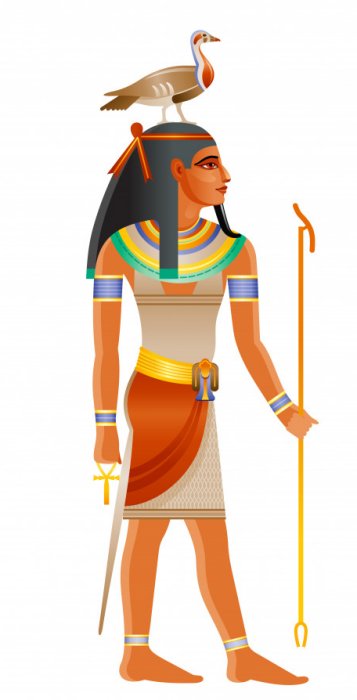
Egyptian Goose God Gengen Wer. Credit: Adobe Stock - Olga Che
The deities of ancient Egypt were frequently linked with narratives of creation and beliefs about the afterlife. These elements held substantial significance in the lives of the ancient Egyptians.
Therefore, Gengen-Wer is mentioned in descriptions of the underworld, death, and the afterlife in which the deceased is said to be the god's egg or guard it.
In the "Pyramid Texts," the deceased flies to heaven as a goose.
Various species of geese are displayed in Egyptian art, and the god Gengen-Wer can be one of their representations. Traditionally, the goose also represented Amun, the god of the air and one of the eight primordial Egyptian deities. Amun's name first appeared in the Pyramid Texts of Dynasty V and the Old Kingdom creation myth known as the Ogdoad of Hermopolis as one of the eight deities closely associated with the concept of the world's creation. In the Ogdoad's creation activities, a (blue) lotus flower immediately transforms into Nefertum.
Amun ('the hidden one') can appear as a creator god and is connected with the goose, which is sacred to him. However, his identity in the Egyptian religion has changed much over the centuries.
In one version of the creation myth, an egg was laid on the original mound of creation by the celestial goose ('the great cackler'), out of which emerged the sun god Ra, the first of the gods.
This creative aspect remained a part of Amun's nature.
However, during the Amarna Period and Akhenaten's reign, the Amun's image had no right to exist, and the worship of Amun was replaced with that of Aton.
In Egyptian religion, a goose was frequently an offering –food to the gods and the deceased. According to tradition, the goose was a ritually offered symbol of the gods' enemies. Several animals like cats, baboons, ibises, crocodiles, dogs, and serpents (to name a few) were sacred to many gods in the Egyptian pantheon, but the goose was not.
However, goose worship was prevalent in specific locations, like Karnak, where a flock of sacred geese was kept on the temple lake in Amun's Great Temple.
Written by – A. Sutherland - AncientPages.com Senior Staff Writer
Updated on February 8, 2024
Copyright © AncientPages.com All rights reserved. This material may not be published, broadcast, rewritten or redistributed in whole or part without the express written permission of AncientPages.com
Expand for referencesReferences:
Richard H. Wilkinson: The world of the gods in ancient Egypt
Wilkinson, R. The complete temples of Ancient Egypt
More From Ancient Pages
-
 Excavations Revealed Evidence That Early Humans Lived In Britain More Than 700,000 Years Ago
-
 First Roman Military Amphitheater Unearthed Near Megiddo
-
 Ancient Graffiti On Sacred Mountain Reveals Secrets Of North Korea
-
 Biblical City Of Gezer: Important Ancient City Mentioned In The Amarna Letters
-
 Modern Humans Traveled Across The Eurasian Steppe 45,000 Years Ago
-
 Skull Of Biblical Giant Goliath Is Buried On The Hill Golgotha In Jerusalem – New Claim
-
 Looking Into The Secrets Of Parthenon’s Illumination That Enhanced The Sense of Awe And Religious Experience
-
 A 200-Year-Old Swedish Mystery Remains Unsolved
-
 Untouched 1,300-Year-Old Grave Of Merovingian Warrior With Complete Armor Found In Ingelheim, Germany
-
 Curtana – Sword Of Mercy Once Belonged To The Anglo-Saxon King Edward The Confessor And Perhaps Even The Arthurian Hero Tristan
-
 Legendary Bladud: The Flying King And Historical Founder Of Bath, England
-
 Secrets Of The Spiral Symbol Left By Ancient Civilizations
-
 Hidden Text Of Medical Book By Doctor Galen Read For The First Time In 1000 Years
-
 Egypt Calls On Christie’s Auction House In London To Stop Sale Of Tutankhamun Statue Head
-
 Ethical Ancient DNA Research Must Involve Descendant Communities – Researchers Say
-
 Secrets Of The Chephren Pyramid And Its Unknown Mysterious Force
-
 Mystery Of Viking Ship Burials In Hjarnø, Denmark And Their Unusual Design
-
 Skilled Neanderthal Hand Engraved Ancient Stone And Hashtag Symbol
-
 Steamship SS Mesaba Sent Warning To RMS Titanic In 1912 – Her Wreck is Now Identified
-
 Honey-Collecting In Prehistoric West Africa From 3500 Years Ago – Pottery Examined

