
Ur – One Of The Largest And Most Important Cities Of Ancient Mesopotamia
A. Sutherland - AncientPages.com - Today, all we know about the ancient city of Ur comes from the written documents unearthed at Ur. The people of Mesopotamia, which Ur was part of, used the cuneiform system written on clay tablets, often broken and unreadable. Scholars have worked hard to decipher them.
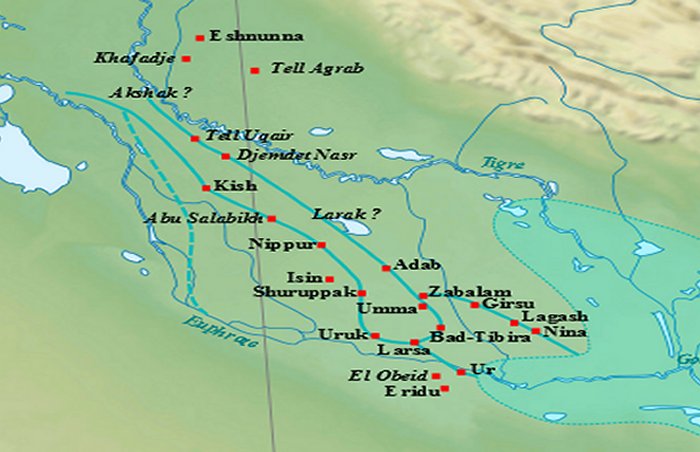
Map of the main cities of Lower Mesopotamia during the Early Dynastic period, with the approximate course of the rivers and the ancient shoreline of the Gulf. Image credit: Zunkir - CC BY-SA 3.0
This historical material is undoubtedly the essential source of our knowledge about Ur. The city's monuments have not survived until today, mainly because of the test of time. Built of mud brick - not as resilient building material as stone, widely used in ancient Egypt – the Sumerian structures could not survive.
The city of Ur was once a large, wealthy, busy, and prosperous port located close to the mouth of the Euphrates River on the Persian Gulf, and much of Sumerian history is linked to this city.
The geographical location of Ur (now Tell el-Muqayyar, Iraq) in the vicinity of the river and the sea contributed to the city's dominant role in foreign trade, using ancient Dilmun as a transit harbor.
Prophet Abraham Traveled To The West From Ur
The Bible mentions this city as Ur of the Chaldeans, where Prophet Abraham was born, and from there, he traveled to the west around 2000 BC.
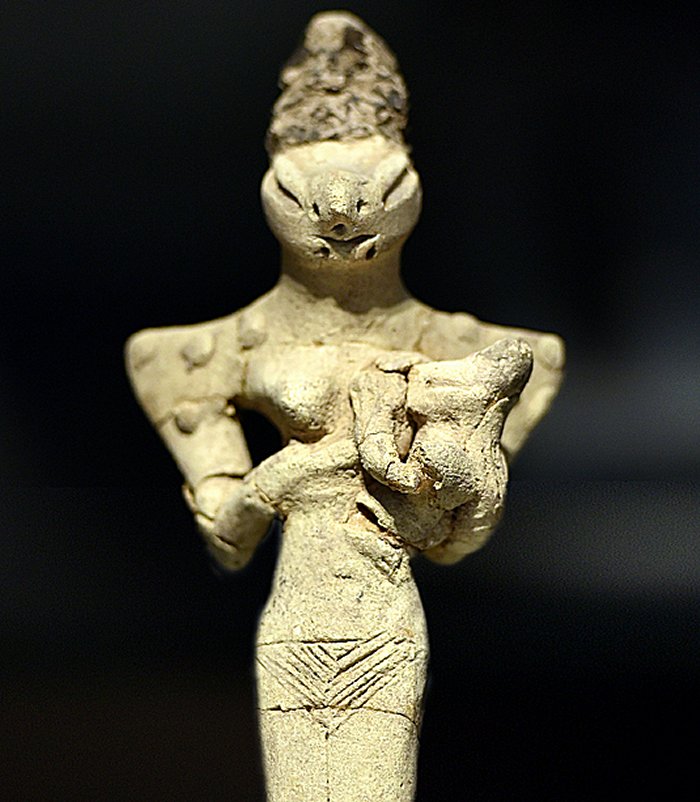 Lizard-headed nude woman nursing a child, from Ur, Ubaid period, 4500-4000 BCE; Iraq Museum. Image credit: Osama Shukir Muhammed Amin FRCP(Glasg) - CC BY-SA 4.0
Then the LORD told him, "I am the LORD who brought you out of Ur of the Chaldeans to give you this land as your possession." (Genesis 15:7)
Ur is among the first Sumerian city-states, and the largest of them were Ur, Uruk, Lagash, Kish, and Nippur, but the first, as Sumerian tradition has it, was Eridu.
As for Ur, the city was agricultural and started modestly, with hunters and fishermen. Historically, Ur was first mentioned in records dated back to the 26th century BC. Based on the Sumerian King's List, Mesannepada (or Mesh-Ane-Pada) was the first ruler of the First Dynasty of Ur, confirmed by inscriptions and insignia of several kings never mentioned in the King's List.
Other documents, unearthed in the royal cemetery of Ur confirm Mesannepada as one of these kings.
Little is known about the city during the period of the First and Second Dynasties of Ur. After Sargon the Great conquered most of the Sumerian city-states, establishing Akkadian dominion over them, Ur still played an essential role in the region. Sargon and his successors considered the city's religious and cultural significance.
Later, despite the collapse of the state of the III Dynasty of Ur, the city still had its high status regarding culture, economy, and religion for about 2000 years.
The arts and literature flourished in Third Dynasty Ur, with veritable libraries popping up within the temples. More and more children were learning how to write cuneiform in the "scribal school" known as the Eduba. Mainly, these pupils were boys, though there were scarce examples of female scribes.

Excavations in Ur - aerial photography of the station (March 1927). Source
"Poems of various genres would be written, mostly dealing with the religion of Sumerians and the many myths surrounding their gods, heroes, and even animals and inanimate objects. Most of the scribes came from wealthy families. Children who misbehaved in school would be "caned" or beaten with a stick, whereas parents would merely berate them for taking their privilege of learning for granted." 1
The city's most prominent rulers of the 3rd Dynasty (c. 2112-2004 BC) were Ur-Nammu, with his oldest known law code, and his son Shulgi.
During his long (48-year) reign, he strengthened and expanded the state created by his father. He reorganized the existing system and strengthened its international prestige, making it a real power.
These two kings of the famed Third Dynasty of Ur and the prosperous Ur III Period helped the city regain control over most of Sumer and even Mesopotamia.
Thanks to skilled rulers with a well-maintained army and well-organized bureaucracy, it was possible. The city Ur's diplomats and religious ideas influenced the areas that were not under its direct control.
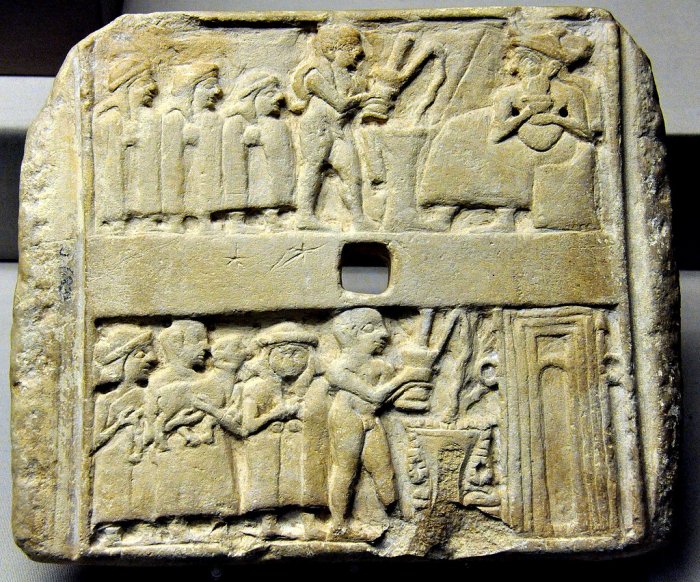 Wall plaque from Ur, 2500 BCE; the British Museum. image credit:
This flourishing period in Ur's history was considered the last great Sumerian Renaissance (2100 BC-2000 BC), attested by several construction and restoration projects, the development of literature, and the famous Code of Ur-Nammu.
During this time, the famous Ziggurat of Ur was built, the most distinguishing landmark of the city. The patron deity of Ur was the moon god Nanna, who had his temple within the Ziggurat of Ur. When it flourished, Ur had a population of approximately 65,000 people. Even after the Amorite conquest, Ur was a prominent place until it was abandoned at about 500 BC.
An Italian traveler, Pietro Della Valle, was the first European to reach Ur in 1625 who recorded ancient bricks stamped with strange symbols and inscribed pieces of black marble that looked like seals.
In 1922-1934, a British archaeologist, Sir Leonard Woolley (1880 – 1960), unearthed huge areas of Ur, including the royal tombs with treasures untouched, never seen by looters since ancient times. Among many valuable artifacts, Wooley unearthed an approximately 4,500 years old artifact dubbed the Standard of Ur and the gold helmet of King Meskalamdug (Mes-Kalam-Dug), an early Sumerian king of the First Dynasty of Ur in the 26th century BC.
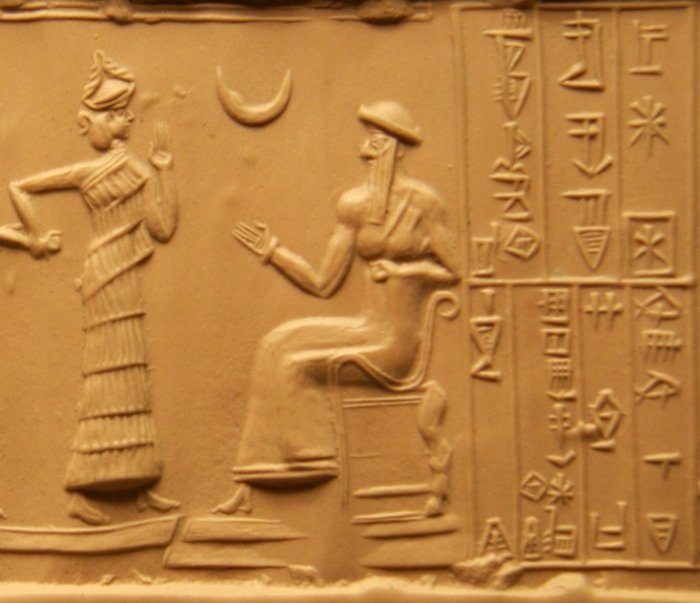 King Ur-Nammu. Image credit: Steve Harris - CC BY-SA 2.0
Irrigation System Of Great Importance
Mesopotamia, located between the Euphrates and the Tigris, was very fertile. Still, it required irrigation for almost eight months a year, there was no rain, and the heavy spring rains came too late to influence the harvest in April.
Drought in the summer and the flooding of the river were also problems. The construction of an irrigation system was necessary under these conditions, and strong leadership and administration could only carry out such a task.
One of the royal duties was maintaining good conditions and repairing the city's irrigation network of canals, ditches, flood dams, and irrigation furrows. Everything (plants and animals) needed water. Animals like sheep were raised, from which wool was used for clothing production.
"The farmers used the water for their fields, where they would grow date trees, wheat, lentils, onions, chickpeas, garlic, lettuce, leek, or mustard.
They would have already domesticated sheep, oxen, donkeys, and pigs, herding them for meat and other products such as wool or using them for transportation or as beasts of burden. Hunters were also prominent in Ur, hunting gazelles and fowl. Some farmers were employed to work the fields of the temple." 1
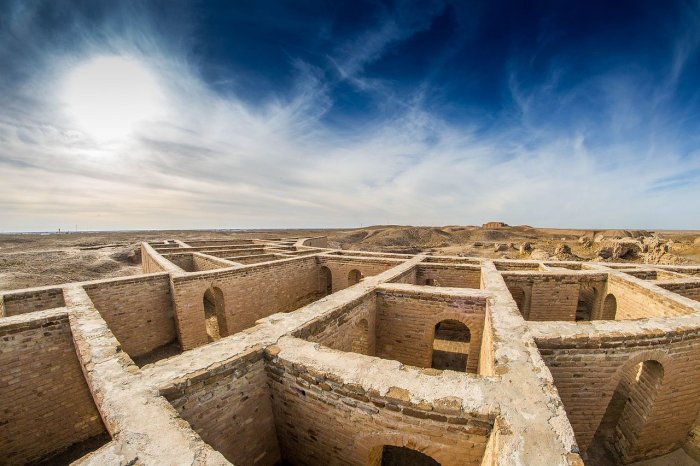
The alleged Abraham house in Ur city, Dhi Qar, southern Iraq. Credit: Aziz1005 - CC BY 4.0
Ur-Nammu was only responsible for the work of the canals near Ur. Otherwise, the citizens believed that the blessed gift of water always came from the gods, making the earth fertile. The canals also provided drinking water for washing, bathing, and cleaning. The drainage system of buildings and terraces was based on a network of clay pipes and cables.
Up To 65.000 Inhabitants Lived In Ur
Foreigners, merchants, and wealthy elites lived outside the city of Ur. At its height, about 65 thousand people lived in Ur, the richest in Sumer. Other suburbs were populated by peasants, shepherds, and other people related to agricultural activities. Public buildings, temples, baths, schools, palaces, inns, shops, workshops, and hotels and apartments for the natives were situated inside the city.
Although the city was crowded, it still had enough space for city squares, often used by people as meeting places.
Defensive System Almost Protected Ur
The town had a defensive system built by Ur-Nammu. The dried brick wall had an external façade, was eight meters above the ground, and was topped at the top by a platform with a width of 25 to 35 meters. Some elements of the walls were built of baked brick. The walls did not surround the city precisely as some buildings were erected directly on the ramparts, probably as part of the defense system.
The Euphrates River reinforced the fortifications, which flowed just outside the western walls, while an artificial canal surrounded the eastern walls or a moat. However, the defensive walls from the south needed to prepare for an enemy attack, and this part of the Ur's defensive system was indeed vulnerable.
Written by – A. Sutherland - AncientPages.com Senior Staff Writer
Updated on Oct 6, 2023
Copyright © AncientPages.com All rights reserved. This material may not be published, broadcast, rewritten or redistributed in whole or part without the express written permission of AncientPages.com
Expand for references- History, Captivating. Ur: A Captivating Guide to One of the Most Important Sumerian City-States in Ancient Mesopotamia
Kramer, Samuel Noah. "Shulgi of Ur: A Royal Hymn and a Divine Blessing." The Jewish Quarterly Review 57 (1967): 369-80.
Macleod, Kezip- Legends of Sumer
Kramer N. S. In the World of Sumer
Freeman, H. Sumerians
More From Ancient Pages
-
 Earliest Evidence For Domestic Yak – Revealed By Ancient DNA And Archaeology
-
 Mysterious Disappearance Of The Eilean Mor Lighthouse Keepers Remains Unsolved
-
 Anglo-Saxon Previously Unknown Monastic Or Trading Center – Discovered
-
 Two 19th Dynasty Royal Statues Unearthed At Ancient Site Of Heliopolis, Cairo, Egypt
-
 Resourceful Pre-Hispanic Society In Bolivia Had Flourishing Agriculture Despite Harsh Environment Of The Andes
-
 Tahpanhes – Biblical City Where Prophet Jeremiah And King Zedekiah’s Daughters Hid From The Babylonians
-
 Invasion Of Mysterious Sea People – Enigmatic 3,200-Year-Old Luwian Hieroglyphic Inscription Sheds New Light On Ancient Puzzle
-
 The Hittites, Mysterious People Of A Thousand Gods – Collapse Of The Hittite Empire
-
 Jelling Stone And Legendary Harald ‘Bluetooth’ King Of Denmark – ‘Who Made The Danes Christian’
-
 On This Day In History: Battle of Salamis Was Fought – On Sep 22, 480 BC
-
 Mystery Of Gilmerton Cove: Underground Maze Of Caves, Passages And Tunnels
-
 Unearthing South Australia’s Oldest Known Shipwreck: The Bark South Australian (1837)
-
 Ancient Mysteries Of Wisconsin – Great Forgotten Prehistoric Events Shed New Light On History Of North America
-
 Mjölnir: Thor’s Terrible Axe-Hammer And Its Magical Powers In Norse Mythology
-
 Ancient Village Of Zalipie Where Flowers Are Painted On All Houses
-
 Silver Offers Evidence Viking Age Started Much Earlier Than Previously Thought – Archaeologist Says
-
 Never-Before-Seen Ancient Texts Hidden In Saint Catherine’s Monastery In Sinai Are Now Available Online
-
 Story Of David And Goliath Linked To Horvat Qeiyafa In The Valley Of Elah, Israel
-
 2,000-Year-Old Altar Depicting Snake Figure Unearthed In Lycian City Of Patara
-
 LIDAR Technology Reveals Secrets Of Ancient Maya Civilization

