
Björketorp Runestone With Frightening Message Is Still Untouched In Blekinge, Sweden
A. Sutherland - AncientPages.com - The Björketorp Runestone in Blekinge, Sweden, is part of a burial ground with menhirs standing alone and forming stone circles.
Dated to about 400-700 AD, the standing stone has never been moved, so it remains in its original place.
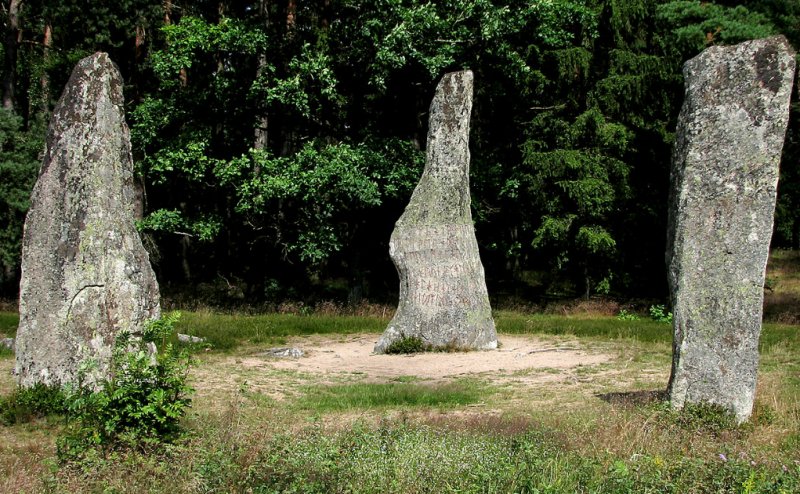
Björketorp Runestone in Blekinge, Sweden. Image credit: Joachim Bowin - CC BY-SA 3.0
Perhaps it is not so strange that the Björketorp Stone remains in its original place.
Who dares to move a stone where there is a curse engraved with runes?
Rune-magic formulas were common in the Viking Age. The curse formula on the Björketorp Runestone says that ' "whosoever breaks down or in any way 'disturbs the holy site is cursed unto death by the deceptive power of the runemaster." The magical means were used by the unknown runemaster to record on this stone the death sentence and to warn.
The runestone stands in the forest clearing on the edge of a vast, old burial ground, and is accompanied by two other slightly lower menhirs with no inscriptions. No doubt, the three of them form Sweden's impressive landmark.
A burial ground - consisting of eleven clearly visible ancient remains - dates to the Iron Age. In addition, nearby, there are also two-judge rings, a round and a four-sided stone setting, and seven lower raised stones. The site is located at the intersection of three villages Listerby, Björketorp, and Leråkra.
The curse-like inscription covers one of the world's tallest runestones, measuring 4.2 m. One can say the stone is not only the tallest but also mysterious because of the text it tries to convey.
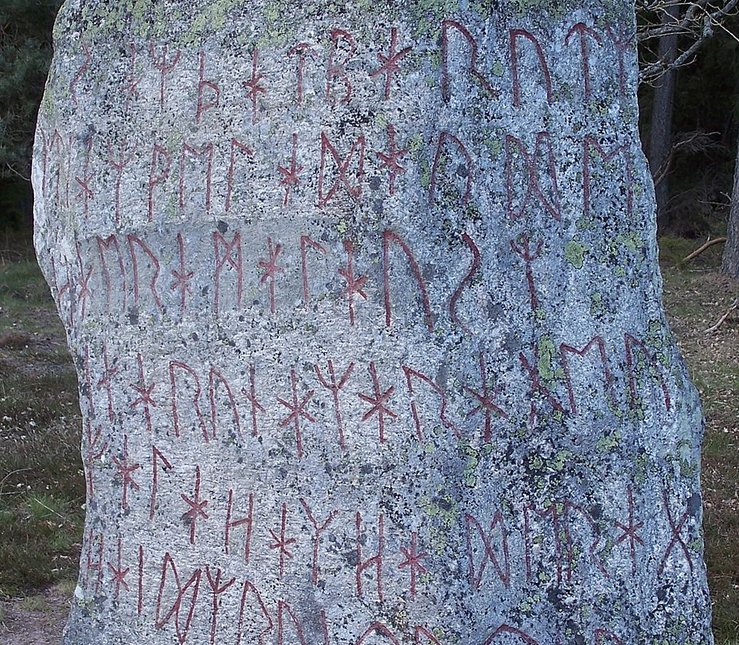
Björketorpsstenen (Björketorp Stone) at Björketorp, in Ronneby, Blekinge, Sweden - Image credit: - CC BY-SA 3.0
The runestone and the two others were already mentioned in the 15th century. They namely served as a boundary mark between the three parishes of Edestad, Listerby, and Hjortsberga. At that time, they were called" Galta Stene."
It's worth mentioning that the three menhirs we talk about are the so-called "bautastenarna" (Bauta Stones). Bauta (in prehistoric (Old Norse) means upright memorial stone without inscription. The word is no longer an archaeological term, but today means 'upright stone.'
Only one of the three bauta stones bears a runic inscription created from runes belonging to the older Runic row. In Blekinge, at least five such ancient runestones are known and are dated to the 5th - 6th AD. The inscription on the Björketorp Runestone has no personal name.
Unknown Author Of Curse-Liked Inscription
An unknown prehistoric artisan covered the stone with an inscription, using the oldest form of the runic alphabet, the Elder Futhark (150 - 800 AD), with 24 runes.
The Elder Futhark Runic alphabet was a writing system used by Germanic people for Northwest Germanic dialects during the Migration Period (300–800 AD) or even later. From the 2nd to the 10th centuries, inscriptions were found on various ancient artifacts, including amulets, jewelry, weapons, tools, and runestones in Scandinavia.
The Runestone of Björketorp also contains a mysterious "curse," which does not promise well for an individual who has problems in his mind.
The stone was probably intended to safeguard the burial ground from grave robbers.
The inscription reads: Obverse: hAidz * runo • ronu • fAlAhAk • hAiderA • ginArunAz • ArAgeu • hAerAmAlAusz •utiAz • welAdAude • sAz • þAt • bArutz Obverse: uþArAbA * sbA
It translates as follows:" Mysterious, powerful runes I carved here. Powerful runes. Eternal anger should torment The One who desecrates this monument. He is to die a homesick death. I speak his doom."
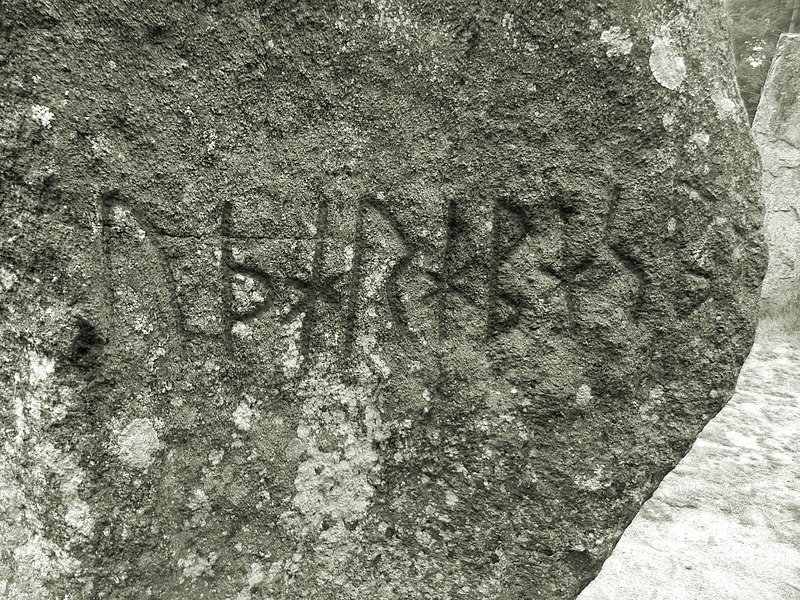
The Runestone stands on a burial ground in Björketorp, Listerby Parish, Ronneby municipality, Blekinge, Sweden. Image credit: Achird - CC BY-SA 3.0
Another little different translation is:
"The secret of mighty runes I hid here, powerful runes. Whoever breaks this memorial will be constantly tormented by anger. Treacherous death should hit him. I trace corruption..."
On the back of the stone is written::
"Sinister prophecy" (or" Ominous prophecy."
It is an old curse that was once called "galder."
The purpose of this runic inscription has long been debated. Scholars are not in agreement on the purpose of the Runestone.
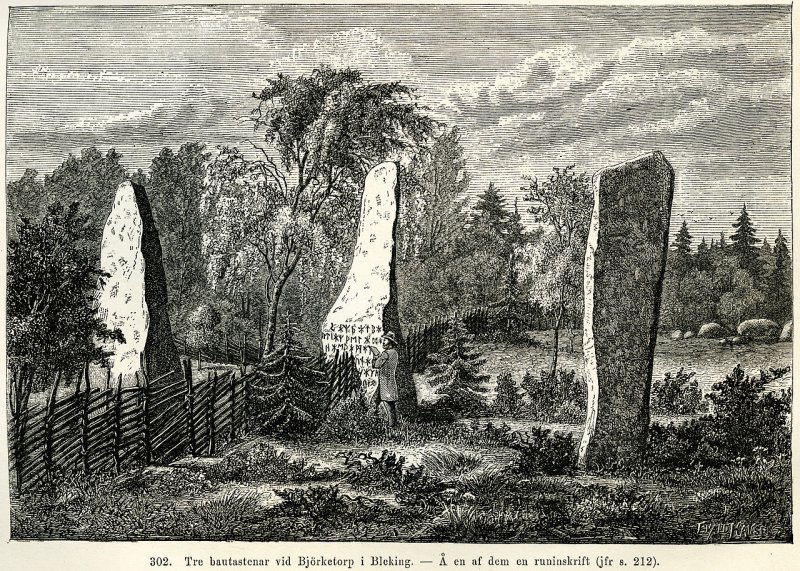
The Björketorp runestone (DR 360) in Listerby parish, Ronneby municipality, Blekinge, Sweden. Woodcut by Evald Hansen (1840–1920), figure 302 on Page 211 of Sweden's hednatid (1877) by Oscar Montelius. Public Domain
It has been suggested that the Runestone is grave and that the curse is intended to protect it. However, in 1914, archaeological excavations did not present any finds connected with the runestone or neighboring stone circle. Also doubtful is whether the Björketorp Stone is a grave or a so-called Cenotaph, i.e., a burial facility for a person whose remains have been lost or buried elsewhere.
One theory is that the Björketorp Stones in Blekinge stand on an old cult site from the 600s dedicated to the god Odin (or fertility). Another possibility is that the standing stone once marked a border between the Swedes and the Danes.
Even today, we know little about the Björketorp Stone in Blekinge.
Additionally, we can add that On the ridge further north in the area, there are many ancient remains from both the Bronze and Iron Ages. These findings attest to a rich ancient settlement. In a gravel pit directly east of the burial ground, archaeologists found a funerary urn next to a remnant stone. The dead man was burned, and his bones were placed in the urn.
A sword, spear, and knife were found next to him in his tomb.
Written by – A. Sutherland - AncientPages.com Senior Staff Writer
Updated on January 21, 2024
Copyright © AncientPages.com All rights reserved. This material may not be published, broadcast, rewritten or redistributed in whole or part without the express written permission of AncientPages.com
Expand for referencesReferences:
Hofberg Herman, Genom Sveriges bygderKarlén, L. Runstenar i Sverige
The Swedish National Heritage Board (Swedish: Riksantikvarieämbetet; RAÄ)
Barddal, Jóhanna: Björketorpstenens "utiar weladaude". Sydsvenska ortnamnssällskapets årsskrift 1998
More From Ancient Pages
-
 Capoeira: Ancient Martial Art Disguised As A Dance Became A Symbol Of Resistance To Oppression
-
 Mysterious Havering Hoard – Largest Ever Bronze Age Hoard Discovered In London
-
 400-Year-Old Shipwreck Found Off The Coast Of Portugal Labeled ‘Discovery Of A Decade’
-
 Khopesh Sword – Symbolic Weapon Of The Pharaohs And Emblem OF Egyptian Deities
-
 What Is A Mural Of Tepoztēcatl, Aztec Rabbit God Of Alcohol Doing In A Mexican Church?
-
 Number ‘Seven’: Mystical Number Of The Universe And One Of The Most Sacred Numbers
-
 Beautiful Neolithic Ornate Necklace With Over 2,500 Stones Found In A Child’s Grave
-
 Rare Early Bronze Age Axe Discovered In Slovakia
-
 16 Meters Long Ancient Papyrus With Spells From The Book Of The Dead Found In Saqqara
-
 Mysterious Royston Cave And Its Unexplained Carvings Still Puzzle Scientists
-
 Extraordinary Discovery Of 2,000-Year-Old Bronze Statue Rewrites Etruscan-Roman History
-
 Ruins Of A Roman-Era Bath And A Floor Mosaic Discovered In Central Anatolia
-
 Diet And Social Changes In Central Europe Around 1500 BC
-
 On This Day In History: Vädersol Painting Depicting ‘Sun Dog’ Phenomenon Observed Over Stockholm – On Apr 20, 1535
-
 Matches Were Invented In Ancient China
-
 Fascinating Artificial Caves Of Ventanillas de Otuzco And Its Secret Passageways – Pre-Inca Necropolis Of The Cajamarca Culture
-
 Unique 1,800-Year-Old Stone Sarcophagus Exposed In Ashkelon Building Site
-
 Mystery Of The Ancient Sitovo Inscription: Undeciphered Script Or Just A Natural Rock Formation?
-
 The Controversial History Of Moses – Who Was He Really?
-
 Prehistoric Artifacts Out Of Nowhere -Their Origin And Purpose Are Totally Unknown

