
Legendary Minamoto No Tametomo – First Samurai To Commit Seppuku
A. Sutherland - AncientPages.com - The ancient history of Seppuku is obscure, and it's difficult to trace the beginnings of the suicide ritual. However, it seems that the first recorded accounts of Seppuku occurred on a battlefield as a means of escape.

Left: Minamoto no Tametomo - Credit: koei.wikia.com - Right: Hogen no ran battle screen - Credit: Public domain
Captured by their enemy, ancient Japanese warriors preferred to commit suicide instead of being executed by beheading or crucifixion.
The first samurai who committed suicide by slicing his abdomen was Minamoto no Tametomo (1139-1170). Famous for being a mighty archer who once sunk an entire Taira ship with just one arrow, legendary Samurai Tametomo chose to commit Seppuku.
As Ancient Pages previously discussed in another article, Seppuku is a ritual form of committing suicide in Japanese society.
Many people in the Western world believe it is a horrible and barbaric act. According to the Japanese way of thinking, however, the Seppuku ("cutting the belly") meant an honorable death, which was more desirable than a useless life in shame.
A samurai was expected to show reckless courage, fairness, reverence for the gods, and generosity toward those weaker. At the heart of all Samurai, training was the 'Bushido Code,' a strict creed – 'Way of the Warrior.'
Dying an honorable death was judged more important than living a long life. By ancient Japanese standards, there was nothing cowardly about committing suicide.
Still, historians think ancient Japanese learned about Seppuku from the Chinese. Since Seppuku requires a sword and sword manufacture did not start in Japan until the second century BC, it is unlikely that indigenous Jomon people practiced this type of suicide ritual. The Jomon Period is the earliest era of Japanese history which began around 14,500 BC.
Ancient Chinese sources such as, for example, The Annals of Lu Buwei, a digest of Chinese history written in the third century BC contain many stories describing people who committed suicide by the sword.
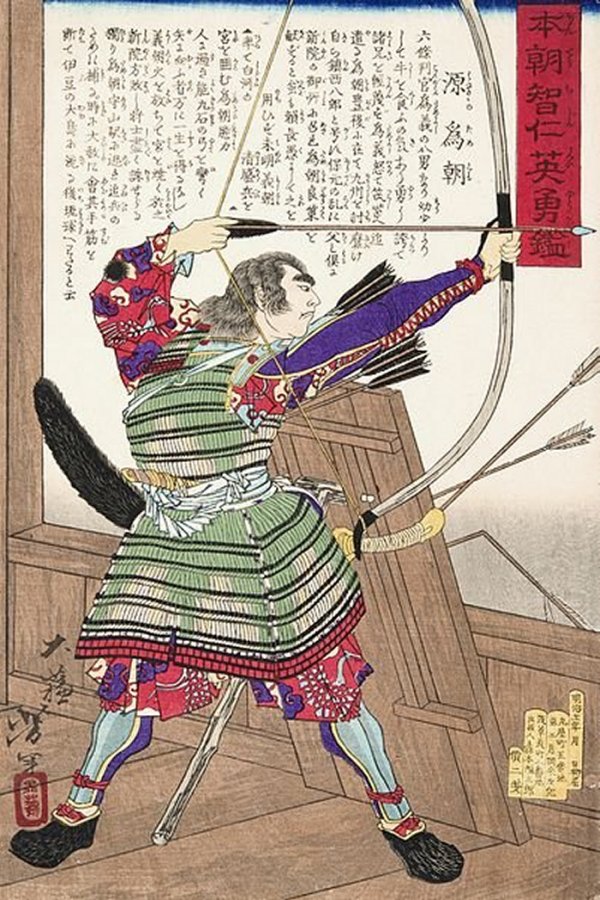
Samurai Minamoto no Tametomo with a bow. Credit: Public domain
One ancient Chinese text describes some of the first known accounts of stomach-cutting:
"The Di army arrived and found Duke Yi at Rongze, where they killed him. They ate all his flesh, saving only his liver. When he arrived home, Hong Yan reported on his mission … he had finished, he cried out to Heaven and sobbed stopping only after all the sadness had drained out from him. Then saying, 'Your servant requests that he serve as your outer garment,' he killed himself by cutting open his belly and putting Duke Yi's liver inside him." (The Annals of Lu Buwei)
The knowledge of Seppuku spread, and ancient Japanese adopted the suicide ritual. Minamoto no Tametomo served on the side of ex-emperor Sutoku during the Hogen Rebellion (July 28 - August 16, 1156), a conflict between the Sutoku and his younger brother, reigning Emperor Go-Shirakawa. Samurai Minamoto no Tametomo suggested the strategy of an attack on Emperor Go-Shirakawa's army.
Unfortunately, Sutoku ignored this plan, and the rebellion failed. The winning side's punishments were brutal, and all Minamoto rebels were executed by decapitation.
Samurai Minamoto no Tametomo was punished by having the sinews in his bow arm severed. His enemies spared his life, and he was sent into exile. A few years later, a revengeful Minamoto no Tametomo reencountered his enemy in northern Honshu and fired an arrow that destroyed the Taira ship.
In his book, The Samurai: Swords, Shoguns and Seppuku, author Ben Hubbard writes that "this particularly well-aimed and probably painful last shot would pass through two sides of a boatload of Taira samurai and sink it. In the end, though, the Taira trapped Tametomo in a house, where he would famously cut open his stomach while standing with his back against a pillar. While this gave Tametomo the dubious legacy of the first recorded seppuku suicide, more would occur in the Genpei War which followed. "
In modern times, there are still cases reported of people committing Seppuku. In an earlier article, Ancient Pages wrote that Seppuku's latest and widely known case is from November 1970.
Yukio Mishima (1925-1970), a Japanese author, playwright, actor, film director, and founder of the Shield Society ('Tatenokai'), a private militia in Japan dedicated to traditional Japanese values and veneration of the Emperor, decided to commit suicide."
The female version of Seppuku is called Jigai, and it's a suicide ritual for wives of Samurai.
Written by – A. Sutherland - AncientPages.com Senior Staff Writer
Updated on Aug 6, 2023
Copyright © AncientPages.com All rights reserved. This material may not be published, broadcast, rewritten or redistributed in whole or part without the express written permission of AncientPages.com
Expand for referencesReferences:
Turnbull, Stephen: “The Samurai Sourcebook”
George H. Kerr. Okinawa: the History of an Island People
More From Ancient Pages
-
 Dangerous Anomaly Inside Mysterious European Mountain Remains Unexplained – Unusual Ancient Connections – Part 1
-
 Lady Of Drunkenness And How God Ra Wanted To Teach Humans A Lesson
-
 5,000-Year-Old Mystery: Decoration Of Eggs Predates Our Easter Tradition
-
 Mystery Of Hizir – One Of The Most Enigmatic And Extraordinary Ancient People
-
 Denisovans In The Altai Mountains: A Hominin Group That Interbred With Modern Humans
-
 Stunning 2,400-Year-Old Mask Of God Dionysus Unearthed In Ancient City Of Daskyleion
-
 Did Crassus, Ancient Rome’s Wealthiest Man Really Die From Drinking Molten Gold?
-
 Maximilien de Robespierre: A True Revolutionary Man Or A Madman?
-
 Why Did We Abandon Roman Numerals?
-
 Reconstruction Of Five-Story Patara Lighthouse Built By Roman Emperor Nero – Begins
-
 Ancient DNA Reveals The World’s Oldest Family Tree
-
 From A Modest Town Jerusalem Has Evolved Into A Grand Metropolis
-
 500-Year-Old Shiva Temple Constructed On Rock Without Foundation Pits Needs Repairs
-
 Painted Tikal Altar Unlocks The Ancient Secrets Of A Mysterious Maya Period
-
 Incredible Roman Necropolis With Dressed Skeletons Buried In Ornate Tombs Discovered Close To The Ancient City Of Tarquinia
-
 Legend Of The Immortal Wandering Jew Cursed By Jesus
-
 Baba Yaga Lego Created By Russian Artist Brings Classic Slavic Mythological Figures To Life
-
 Modern Humans Carrying The Neanderthal Variant Have Less Protection Against Oxidative Stress
-
 More Than 2,500 Years Old Gallic Tombs Unearthed In Nîmes, Southern France
-
 Archaeologists Have Discovered A Mummy Wrapped In Gold – Here’s What It Tells Us About Ancient Egyptian Beliefs

