
Khufu Boat And Unique Boat-Building Technique Of Ancient Egyptians
A. Sutherland - AncientPages.com - More than sixty years ago, two ancient wooden boats were discovered in separate carved stone pits next to Giza's Great Pyramid in Egypt.
Until now, it is still debated over whether these boats were symbolic solar barks for the king to use in his afterlife or funeral boats used to transport Khufu’s funerary equipment to his pyramid.
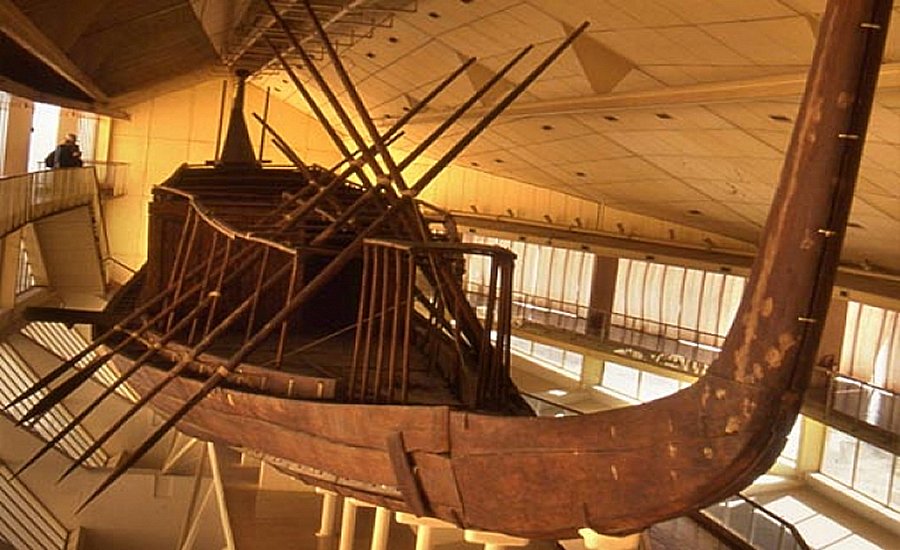
Over the years, the pharaoh’s boat was variously called as the "Khufu Boat", the "Solar Barque" or simply the Pharaoh Ship
According to some Egyptologists, the ship was a Solar Barque, a boat to carry the dead king of Egypt, resurrected and floating with the Sun-god on his eternal journey across the sky. Others proposed that it was a pilgrimage boat used by Khufu during his lifetime. In fact, archaeologists who investigated the boat's remains found evidence of rope markings clearly showing that the boat had been used in the water.
Additionally, the boat did not fit into the pit whole but had to be dismantled, which means that the stone pit was not constructed specifically for the boat.

The boat did not fit into the pit whole, but had to be dismantled first, which means that the stone pit was not constructed specifically for the boat. Image source
It seems that the Khufu Boat had nothing to do with religious use; no ritual objects or inscriptions were discovered in the pit. The dismantled boat was entombed about 2500 BC.
Over the years, the pharaoh’s boat was variously called the "Khufu Boat," the "Solar Barque," or simply the Pharaoh Ship."
Experts say it is the largest ancient royal vessel ever found in Egypt and one of the oldest planked vessels in the world. It was built for Khufu (Cheops), the second pharaoh of the Fourth Dynasty of Egypt's Old Kingdom, who was the ruler of Upper and Lower Egypt around the middle of the third millennium BC.
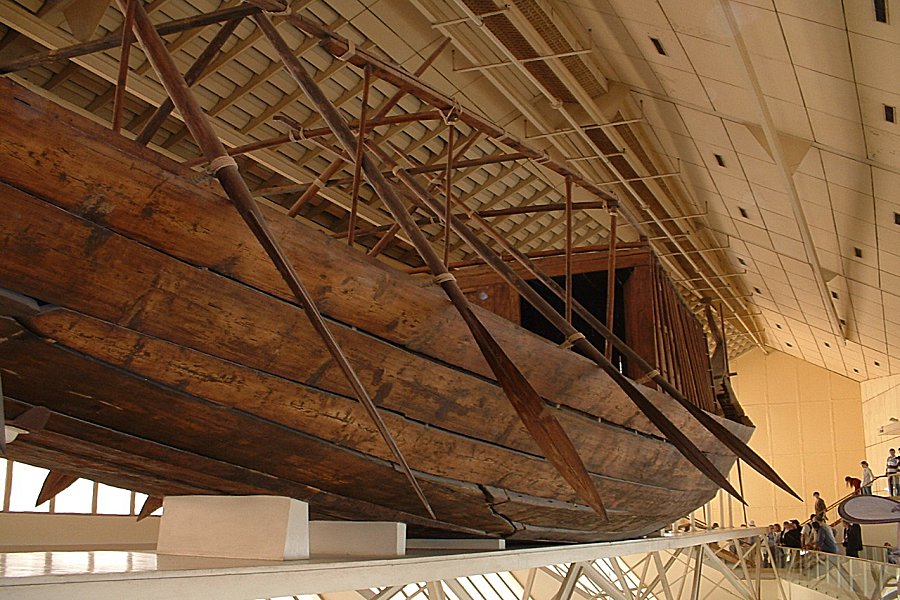
Khufu Ship -an intact full-size boat from Ancient Egypt .
The earliest representations of Egyptian Nile vessels were only very simple images that date back to 4500 BC.
An important and sensational discovery came in 1991.
Researchers led by David O’Connor, then assistant curator of Egyptology at the museum of the University of Pennsylvania, discovered in the ancient city of Abydos twelve parallel burials of fifty-to sixty-foot boats dating to Dynasty I or II, that is roughly one thousand years before the Khufu Boat.
The team unearthed one of the boats, which gave evidence of an ancient Egyptian boat-building.
Interestingly, "the Abydos boats were likely used rather than built only as funerary vehicles…. They were also “sewn” like the construction of the thousand-year-later Khufu Boat…” (Gordon S. A History of the World in Sixteen Shipwrecks).
Returning to the Khufu Boat, we learn that after 13 years of painstaking reconstruction works, as many as 1224 pieces of the ship were assembled together. The boat, built of cedar trees from the mountains of Lebanon, is forty-five meters long from stem to stern and 5.9 m (19.5 ft) wide.
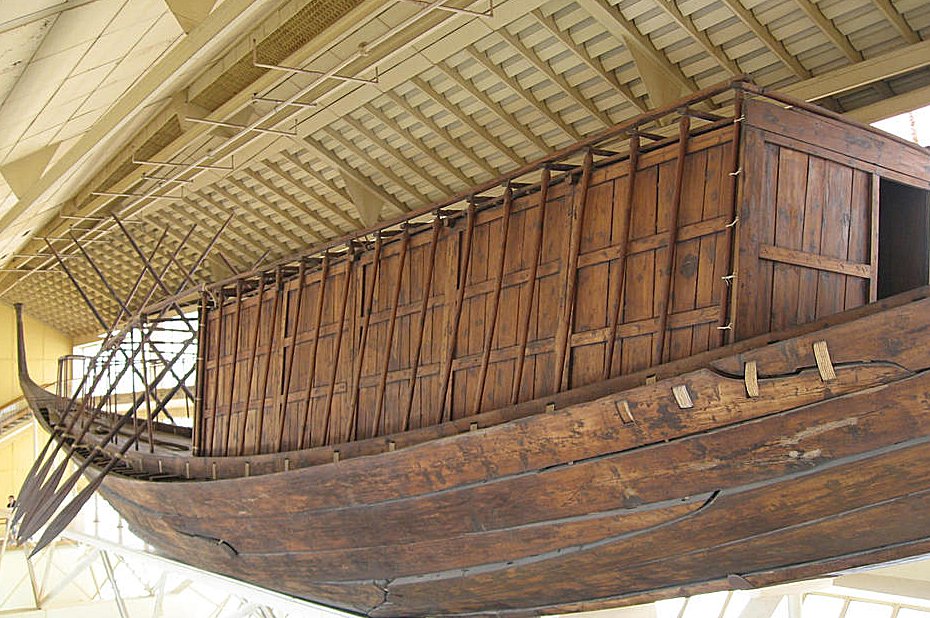
As a part of grave goods intended for use in the afterlife, the Khufu Boat contained no bodies, unlike northern European ship burials, for example, those of the Vikings. The Viking chiefs who held high status were given ship burial and were either burned or buried along with their ship.
Ancient Egyptians had a long boat-building tradition, but they used different techniques than the Vikings, who nailed their ships together with iron nails. The Khufu Boat and other Egyptian boats were not nailed.
Along with the puzzle-piece joggling, its builders connected neighboring planks with mortise-and-tenon joints, a kind of peg-in-hole technique. They also lashed the hull planks together with rope made from a grass called halfa. They didn't wrap the rope around or through the hull planks, which might have promoted leaks. Rather, they worked it through thousands of V-shaped channels they laboriously carved into the inside faces of planks.
It was their unique, at least 4,500 -year-long technique to build a ship. They sewed the ship together.
Written by – A. Sutherland AncientPages.com Staff Writer
Copyright © AncientPages.com All rights reserved. This material may not be published, broadcast, rewritten or redistributed in whole or part without the express written permission of AncientPages.com
Expand for referencesGordon S. A History of the World in Sixteen Shipwrecks
More From Ancient Pages
-
 1,000-Year-Old Paintings Unearthed In Sudan – Documented By The Polish Researcher
-
 Extraordinary 6,500-Year-Old “Noah” Skeleton Re-Discovered – A Survivor Of The Great Flood Hidden In Museum
-
 Traditional Viking-Age Crafts: Glass Beadmakers And Their Secrets
-
 Excavations At Trou Al’Wesse Reveal Traces Of The First Homo Sapiens In Northwestern Europe Around 40,000 Years Ago
-
 ‘Face Of First European’ – Oldest Fossil Of European Human Ancestor Found At Spain’s Atapuerca Archaeological Site
-
 Ancient City Of Gordium, Gordian Knot And Skeleton In Tumulus Of King Midas
-
 Neanderthals Were Morning People – A New Study Says
-
 Why Have The Leibniz Keks 52 Teeth And Are Named After Philosopher Gottfried Wilhelm Leibniz?
-
 13th-Century Wooden Structures Found In Nicolaus Copernicus House In Toruń, Poland
-
 On This Day In History: Captain James Cook Spotted The East Coast Of Australia – On Apr 19, 1770
-
 Radiocarbon Dating Sheds Light On Historical Events In The Ancient City Of Gezer
-
 Decoding A Lost English Legend, Solving A Chaucerian Mystery, And Revealing A Medieval Preacher’s Meme
-
 Oldest Case of Decapitation In the New World – Lapa do Santo, East-Central Brazil
-
 Naqsh-e Rostam: Spectacular Tomb Complex With Rock Reliefs From Elamite To Sasanian Times
-
 Parthians: Their Great Empire And Skilled Horse Archers
-
 Radar Discovers Mysterious Tunnels Under Sforza Castle As Depicted In Leonardo da Vinci’s Sketches
-
 Amrita: Potion Of Immortality Consumed By Gods To Make Them Strong And Immortal
-
 Hyksos: Foreign Rulers Of Avaris Who Founded The Fifteenth Dynasty Of Egypt
-
 Early Human Communication May Have Been Influenced By Changing African Landscape – Anthropologists Say
-
 Baffling North American Ancient Skulls Contradict Historical Timelines And Mainstream Theories

