
Makhunik – 5,000-Year-Old City Of Dwarfs Who Hoped To Return One Day
A. Sutherland - AncientPages.com - Shahdad's dwarfs covered the doors of their homes with mud and never returned. Why did they do it? Will we ever know?
Welcome to the city of Makhunik, the home of the Little People, or as it has now been called the City of the Dwarf.
 The story of Makhunik brings to mind the image of 'Liliput City (Court of Lilliput)' described in Jonathan Swift's famous novel, Gulliver's Travels, or perhaps even the world of Hobbits in J. R. R. Tolkien's book and movie Lord of the Rings.
However, this story is not a fantasy. It is a really fascinating archaeological discovery.
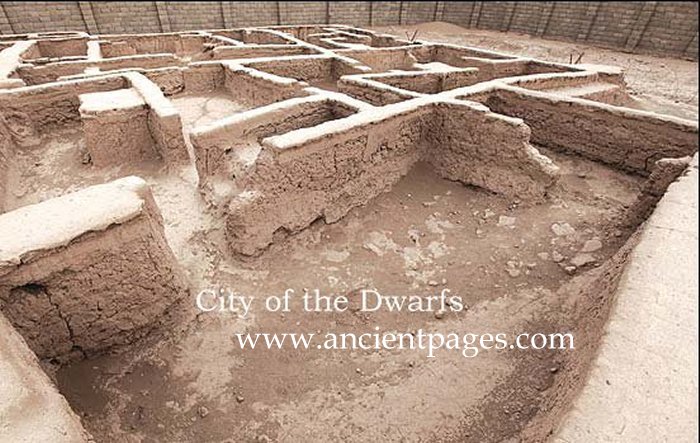
Makhunik is an ancient Iranian city unearthed in Shahdad, Kerman province, where dwarfs lived 5,000 years ago. It is known as Shahr-e Kotouleha (City of Dwarfs).
According to Iran Daily, "nobody thought an ancient civilization could exist in this desert until 1946.
However, following studies conducted by the Geography Faculty of Tehran University in 1946, potteries were discovered in Shahdad as evidence of a civilization that flourished in the Lut Desert.
Given the importance of the issue, a group of archeologists visited the area and conducted studies that led to the discovery of civilizations belonging to prehistoric times (end of 4th millennium BC and beginning of 3rd millennium BC).
Scientific and archeological excavations were conducted in this region during 1948-56. Cemeteries belonging to the 2nd and 3rd millennium BC and copper furnaces were discovered during eight excavation phases. Relics discovered in Shahdad's cemeteries included numerous potteries and brassware.
Shahdad's ancient region is spread over 60 kilometers in the heart of the Lut Desert.
The city includes workshops, residential districts, and cemeteries. Archeological studies in the residential district known as the City of Dwarfs revealed the presence of sub-districts in which jewelers, craftsmen, and farmers lived. Over 800 ancient graves have been excavated during the excavation phases.
Archeological surveys in the City of Dwarfs indicate that the inhabitants abandoned the area due to drought 5,000 years ago and never returned. Mir-Abedin Kaboli, who oversees Shahdad's archeological excavations, said, "Following the latest excavations, we noticed that inhabitants of Shahdad had left many of their belongings at homes and covered the doors with mud.
 He said this shows that they were hopeful of returning one day. Kaboli attributes the departure of Shahdad people to the phenomenon of drought.
A significant aspect of Shahdad is its strange architecture of the houses, alleys, and equipment found at the site.
The walls, ceiling, furnaces, shelves, and all the equipment could only be used by dwarfs. After discovering the City of Dwarfs in Shahdad and stories about peoples who lived there, rumors circulated about the discovery of a dwarf's remains.
The latest case pertained to the discovery of a dwarf mummy with a height of 25 cm. The smugglers wanted to sell it at 80 billion rials in Germany.
The news of the arrest of two smugglers and the discovery of a strange mummy spread fast across Kerman province. Subsequently, Kerman Cultural Heritage Department and police officials sat down to clarify the condition of the mummy that reportedly belongs to a 17-year-old person."
Some archaeologists are cautious and even deny the city of Makhunik was once inhabited by ancient dwarfs.

"Since forensic studies could not determine the sexuality of the corpse, we can not rely on them to talk about the height and the age of the body, and more anthropological studies are still needed to find out the details about the discovery," says Javadi, archeologist of the Cultural Heritage and Tourism Organization of Kerman province.
"Even if it is proved that the corpse belongs to a dwarf, we can not say for sure that the region of its discovery in Kerman province was the city of dwarfs. This is a very old region, which has been buried due to geographical changes. Besides, technology was not so developed at that time so people may not have been able to build high walls for their houses," he adds.
"Regarding the fact that in none of the periods in the history of Iran, we have had mummies, it is not accepted at all that this corpse is mummified. If this corpse is found to belong to Iran, it would be a fake one. Due to the minerals existing in the soil of this region, all of the skeletons here are decayed and no intact skeleton has been found so far. On the other hand, the 38-year archeological excavations in Shahdad city deny any dwarf city in the region.

The remained houses in which their walls are 80 centimeters high were originally 190 centimeters. Some of the remained walls are 5 centimeters high, therefore should we claim that the people who live in these houses were 5 centimeters tall?" says Mirabedin Kaboli, head of archaeological excavations in Shahdad city."
Yet, stories of the Little People have been part of the folklore of many cultures in human history. Physical remains of tiny people have been reported found in various locations, for example, in the western United States, particularly Montana and Wyoming. So why couldn't these beings have existed in ancient Iran?

Makhunik. Credit: Mohammad Nesaei - CC BY 4.0
Interestingly, research in the area revealed that even some years ago, the height of people in Makhunik seldom reached 150 cm, but now they have about normal size. After a lapse of 5,000 years since the departure of dwarfs from the city, a large swathe of this prehistoric region lies buried in soil, and the migration of Shahdad's dwarfs remains a mystery.
Written by – A. Sutherland - AncientPages.com Senior Staff Writer
Updated on July 19, 2021
Copyright © AncientPages.com All rights reserved. This material may not be published, broadcast, rewritten or redistributed in whole or part without the express written permission of AncientPages.com
More From Ancient Pages
-
 Hidden 2,000-Year-Old Roman Road Uncovered In Worcestershire Could Be Of ‘Global Importance’
-
 Mystery Of Arthur’s Stone In UK – Solved?
-
 On This Day In History: Sweden’s Greatest Defeat: Battle Of Kirchholm Was Fought – On Sep 27, 1605
-
 Cappadocia And Huge Unique Selime Cathedral
-
 Emperor Caligula’s Ancient Garden Found Under Piazza Pia In Rome, Italy
-
 Ancient Textile Mystery: King Canute Enshrined In His Own Clothes But Found In His Brother’s
-
 Sobek: A 2,500-Year-Old Mummified Nile Crocodile – On Display At The British Museum
-
 Mountain Meadows Massacre: Real Burial Sites Are Far From The LDS Monument’s Location
-
 Mary Boleyn – King Henry VIII’s Other Woman And Sister Of Anne Boleyn
-
 10th Century Sculpture Of Sun God Surya Accidentally Found In Farmland In Andhra Pradesh
-
 Unique Purbeck Marble Found On England’s Oldest Historic Shipwreck
-
 Ancient City Of Carchemish Will Soon Be Ready To Show Its Historical Treasures
-
 Mysterious El Caracol At Chichen Itza: What Did Maya Astronomer-Priests Observe In The Sky?
-
 In Ancient California Matriarchal Society, Daughters Breastfed Longer And Women Accumulated Greater Wealth
-
 Three Roman Shipwrecks Discovered Off Tunisian Coast – One Is 2,000-Year-Old
-
 Czech Neolithic Well Is Oldest Wooden Structure In The World
-
 Largest Figurine Workshop Yet Discovered In The Maya World
-
 Long-Lost Island Documented On Ancient Maps – Erased From History Or Misidentified?
-
 Legend Of Milky Way’s Celestial Portal And The Star City From The Bowuzhi By Zhang Hua
-
 Fearsome Koa Warriors Fought For Spiritual Energy And Mana, The Life-Force

