
Mystery Of The Silver Hands Discovered In An Etruscan Tomb Full Of Secrets
A. Sutherland - AncientPages.com - Italy's famous City Park of Vulci (Vulci Archaeological Naturalistic Park) north of Rome has its ancient secrets but at the same time gives the opportunity to travel through time in order to reach the Etruscans - one of the most enigmatic civilizations in Europe.
In the park - one of the most important centers of Ancient Etruria in central Italy - located about 75 miles northwest of Rome, there is an Etruscan and Ancient Roman city, and necropolis of Vulci, Osteria.
One the recent diggings revealed an Etruscan tomb that dates from the late 7th century BC.
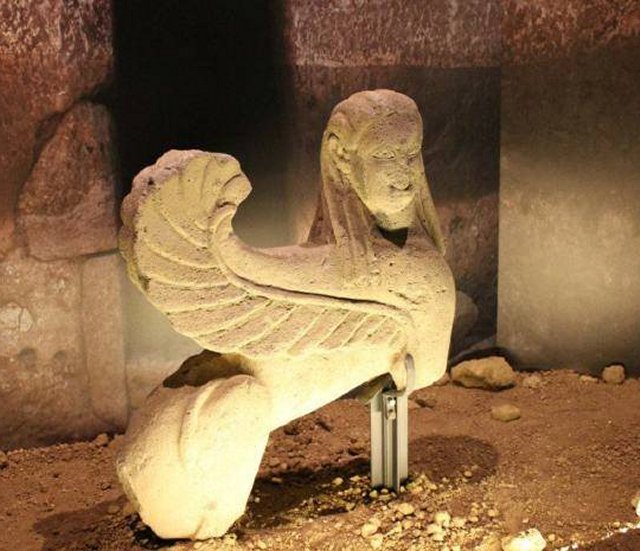
The Tomb of The Sphinx, Park at Vulci, Italy.
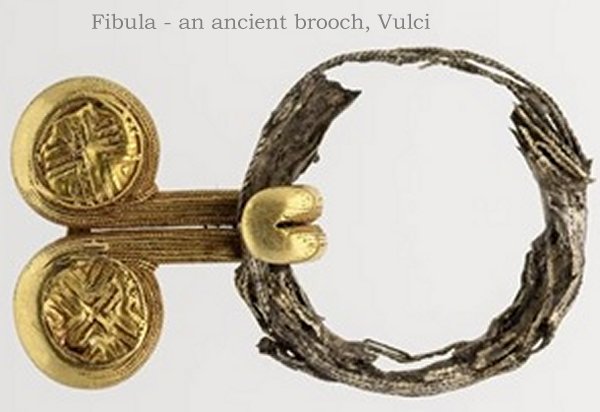
The tomb is believed to have been that of a woman. The grave goods buried with the body are all intact. Archaeologists discovered painted beads, an iron fibula ancient brooch, jars and a bucchero in a Corinthian style – a bucchero is a type of ceramic black pot with a glossy surface made by the Etruscans," reported Italy Magazine in spring 2013.
Archaeologists also unearthed an Egyptian scarab at the site. The scarab depicts the falcon-headed Egyptian god Horus and is thought to date from 746 BC to 525 BC.
Several important discoveries have been made at Vulci. The necropolis, already known from the nineteenth century to the extraordinary funerary complexes brought to light, such as the "Tomb of the Sun and the Moon," the "Panathenaic", "Carved Ceilings" and a monumental burial, the "Tomb of the Sphinx", dating from the sixth century BC and unearthed at the end of the excavation.

The magnificent sculpture in nenfro depicting a sphinx, probably placed at the entrance of the tomb in order to protect the deceased and accompany them in the Hereafter.
The head of a second sphinx, from another tomb in the necropolis, an initial restoration has allowed us to identify traces of the original red color.
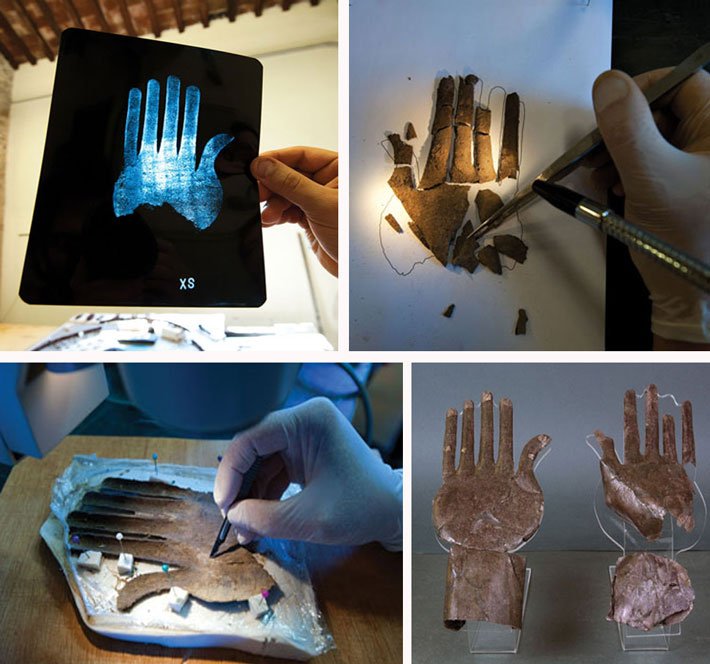
(Marco Merola)The silver hands were taken to a nearby laboratory. There (top row, left to right) researchers X-rayed them, fit the pieces of the right hand back together, and (bottom row, left to right) carefully cleaned the more intact left hand. The result: two completely restored and conserved hands.(Archaeology.org)
Archaeologist Carlo Casi, who manages the Vulci archaeological park on behalf of the local archaeological superintendency of Etruria Meridionale said:
"Tomb of the Sun and the Moon" was the most important funerary complex in the area, and we know the area was open for visitors until the middle of the nineteenth century."
"But since then it has literally been swallowed up by nature." Three years ago, Casi and his team set out to rediscover the "Tomb of the Sun and the Moon" using topographic maps of the area, some of which were drawn in the nineteenth century.
"Unfortunately, we weren't able to find the tomb again, probably because the people who drew the maps of the area made some errors in locating it."
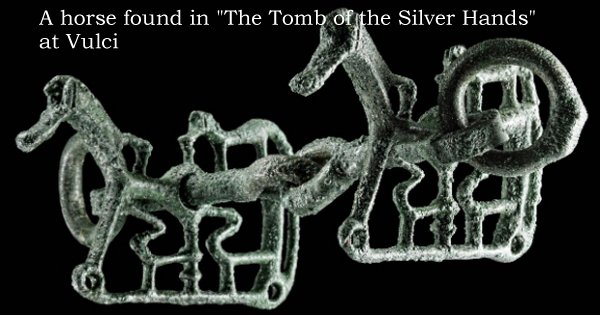
However, yet another archaeologists extraordinary discovery was made when scientists encountered a most spectacular place, namely, "The Tomb of the Silver Hands", a monumental place, with a long corridor with an atrium open to the sky and leading to three burial chambers that contained the remains of at least three individuals.
This tomb must have belonged to high-ranking members of the Etruscan society regardless of their gender.
A freelance journalist Marco Merola wrote in his article:
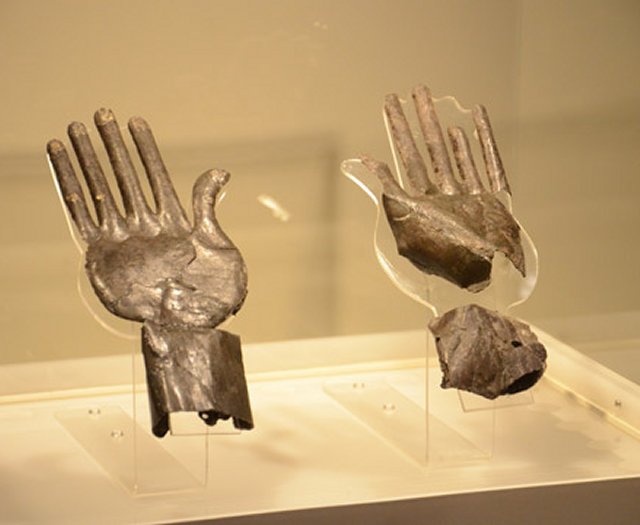
"While excavating Chamber A, Casi noticed something unusual lying on the ground among a variety of artifacts—two well-preserved silver hands with traces of gold on the fingers and gold-plated fingernails,"
“I knew immediately that these hands had once been part of a sphyrelaton, a kind of wooden funerary dummy that represented the dead and guarded his or her soul after the body had been cremated,” says Casi. Most often the dummy represented a warrior or a nobleman, but in this case the figure was probably a woman."
The rare and fragile "Silver Hands" gave their name to the tomb, made with a foil of an alloy of silver and copper embossed with a slight gold leaf applied on the nails of three fingers.
Near the hands on the ground, the archaeologists also recovered some purple threads that they believe were used to tie gold studs to a brightly colored garment that once clothed the dummy.
They also found iron and bronze fibulae, little gold balls, pieces of faience, and amber and bone beads that likely were once part of several very fancy necklaces..."
Written by – A. Sutherland AncientPages.com Senior Staff Writer
Copyright © AncientPages.com. All rights reserved. This material may not be published, broadcast, rewritten or redistributed in whole or part without the express written permission of AncientPages.com
More From Ancient Pages
-
 Yunxian 2 Skull Reveals Homo Sapiens Emerged One Million Years Ago – 400,000 Years Earlier Than Previously Thought
-
 America’s First Casino Was Created By The Promontory Culture 700 Years Ago
-
 Ancient Astronomical Symbols At Göbekli Tepe Confirm A Comet Swarm Struck The Earth 11,000 B.C.
-
 Mystery Of Ancient Carved Shiva Lingas In India And Cambodia
-
 Giant Spider Yokai Tsuchigumo Confronts Minamoto No Yorimitsu And Something Strange Happens
-
 Parthian Jar Burial Dated To 247 BC – 224 CE Unearthed In Iran’s Kurdistan Province
-
 King Lud – Mysterious Founder Of London And His Connection To The Tuatha De Danann
-
 The Long And Satisfying 28,000-Year History Of The Dildo
-
 DNA Reveals Poland’s First Kings May Have Scottish Origin – New Study Challenges Existing Myths
-
 Why Did Neolithic Make Us Taller And More Intelligent But More Prune To Heart Disease?
-
 2700-Year-Old Farmhouse, Byzantine Monastery With Silver Coins And Colorful Mosaics Unearthed In Rosh Ha-‘Ayin, Israel
-
 Hundreds Of 19th-Century Skulls Collected In The Name Of Medical Science Tell A Story Of Who Mattered And Who Didn’t
-
 Bryggen Inscriptions Reveal Viking Runes Were Used As Modern SMS – Short Message Service In The Norse World Was Popular
-
 Remarkable Historical Treasure Recovered From Shipwrecks Off Florida’s Coast
-
 Rare Discovery: Giant Stone Artifacts Found On Ice Age Site In Kent
-
 Norse God Hermod’s Meeting With The Finnish Magician Rostioff Who Revealed The Prophecy Of Vali
-
 Undiscovered Neanderthal Artifacts From The Ice Age Are Submerged Below The Waves Of The English Channel
-
 3.2 Million-Year-Old ‘Lucy’ Could Walk On Two Legs – First Hominin Muscle Reconstruction
-
 Barrels With Unique Intact Cargo Found On The Osmundvraket (Osmond Wreck)
-
 On This Day In History: Independence Of Greece Is Recognized By The Treaty Of London – On May 7, 1832

