
Deadly Ancient Secrets Of Queen Hatshepsut’s Flacon
Ellen Lloyd - AncientPages.com - If the ancient Egyptian Queen Hatshepsut knew how deadly her flacon was, she wouldn’t have touched it. But she did and this may have caused her death.
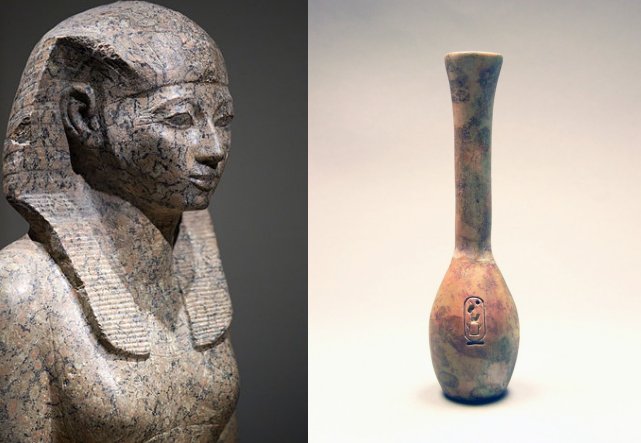
Pharaoh Hatshepsut was a remarkable female who was just as successful as strong and perhaps this was the reason why she was deliberately forgotten and erased from history.
Hatshepsut was the fifth pharaoh of the Eighteenth dynasty of Egypt. Hatshepsut came to the throne of Egypt in 1478 BC. Officially, she ruled jointly with Thutmose III who had ascended to the throne as a child one year earlier.
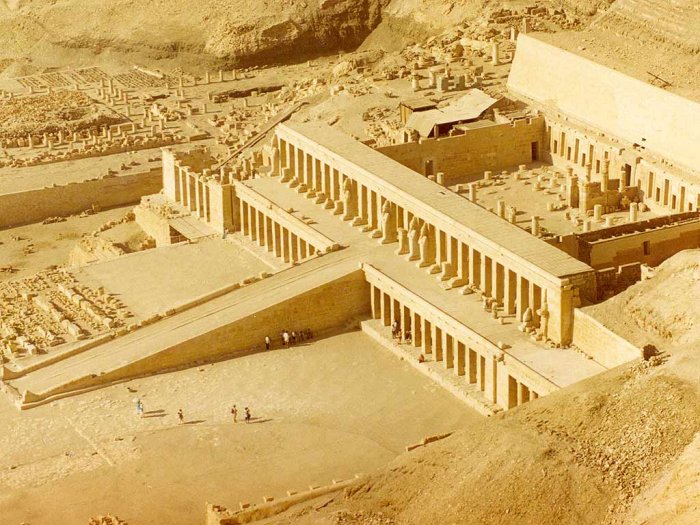
Deir el-Bahari with temples of Hatshepsut, Thutmosis III and Mentuhotep II, Luxor, Egypt. Image credit: Wikipedia Commons
During her reign there were no were no assassinations, but only prosperity in ancient Egypt. She built more structures than any king previous to her and she was interested in spreading wealth.
Her reign saw one of Ancient Egypt’s most prolific building periods, but pharaoh Hatshepsut was ill. She suffered from cancer that eventually killed her.
See also:
Pharaoh Hatshepsut: Skillful And Efficient Female Ruler Who Brought Prosperity To Ancient Egypt
Why Was Pharaoh Hatshepsut’s Reign Virtually Erased From History?
Solar Cult Complex In The Temple Of Hatshepsut In Deir El-Bahari Reconstructed
For many years, the flacon of Queen Hatshepsut lay unexplored. It was believed to be a perfume flask, until Michael Höveler-Müller, head of the permanent collection at the Egyptian Museum at the University of Bonn, and Dr Helmut Weidenfeld from the university’s pharmacology unit, examined it more closely.
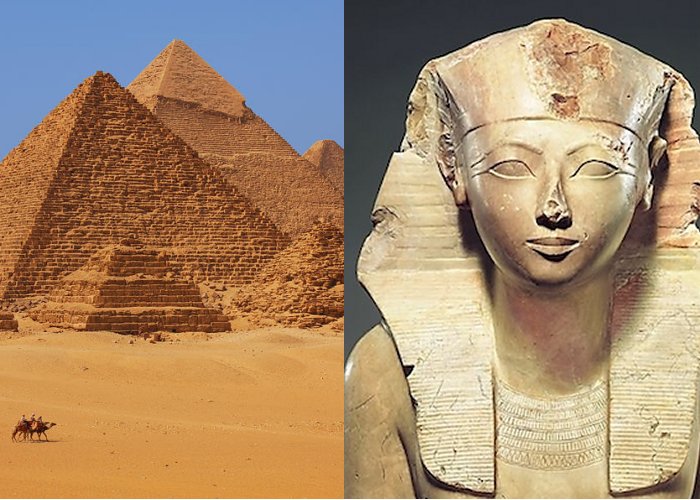
Hatshepsut was a very strong and determined pharaoh.
When scientists examined the contents of the flacon, they discovered a deadly ancient secret. The flacon did not contain perfume at all. The flacon of Hatshepsut held a skin care lotion made of palm and nutmeg apple oil. It was used as medication for a monarch suffering from eczema.
In addition, the pharmacologists found a strongly carcinogenic substance that is still being used to this day to treat skin conditions, but banned from cosmetics because it is carcinogenic. A carcinogen is any substance that has the potential to cause cancer in living tissues.
This has made historians wonder if perhaps Hatshepsut was killed by her own medicine.
According to Dr. Helmut Wiedenfeld from the University of Boon, it is very likely that Queen Hatshepsut who had a chronic skin disease may have exposed herself to a great risk over the years by using the dangerous substance.
Written by Ellen Lloyd – AncientPages.com
Copyright © AncientPages.com All rights reserved. This material may not be published, broadcast, rewritten or redistributed in whole or part without the express written permission of AncientPages.com
Expand for referencesMore From Ancient Pages
-
 Ancient DNA Reveals Bronze Age Women Altered Genetic Landscape Of Orkney
-
 LIDAR Discovery Of Ancient City With 10,000 Mounds On The Pacific Island Of Tongatapu
-
 Early Humans Reached Northwest Europe 45,000 Years Ago – New Research Shows
-
 Horned Serpent – Unusual Ancient Creature Encountered Worldwide – Can Archaeological Finds Confirm Thousand-Year-Old Myths Again?
-
 Michelangelo Inserted Hidden Pagan Symbols Associated With Female Anatomy In His Works Of Art
-
 Longest European Burial Mound Pre-Dating The Egyptian Pyramids Discovered In Czechia
-
 Cyprus’s Copper Deposits Created One Of The Most Important Trade Hubs Of The Bronze Age
-
 A Millennium-Old Gilded Bible Seized In Tokat, Turkey
-
 Biblical Event Verified By Study Of Earth’s Magnetic Field?
-
 Plutonium: Dangerous Pluto’s Gate Was An Ancient Gateway To Hell At Hierapolis That Was Real
-
 Huge Ancient Sarayini Underground City Is Twice As Large As Previously Thought
-
 On This Day In History: Chaldean Account Of The Deluge Translated And Presented For The First Time – On Dec 3, 1872
-
 Goddess Xi Wangmu (Xiwangmu) Who Controlled Life, Death, Creation And Talked Directly To Humans In Chinese Mythology
-
 Constantine The Great – Did First Roman Christian Emperor Use Faith For His Own Agenda?
-
 3,500-Year-Old Stone Inscribed With A Curse Against The City’s Governor Discovered In Jerusalem
-
 Mysterious Jade Cong – Perplexing Ancient Chinese Artifact
-
 On This Day In History: Berlin Victory Parade Took Place – On September 7, 1945
-
 Children’s Toys Among Roman-Era Artifacts Unearthed At Ancient City Of Beçin Turkey
-
 Vindelev Treasure – Surprising Evidence Of Nordic Connection With The European Iron Age Elite
-
 3,000-Year-Old Geoglyphs May Depict The Heavens

