
The Tuli Mummy: Botswana’s Only Ancient Mummified Human Body Discovered So Far
AncientPages.com - The mummification process was well-known and practiced by many ancient civilizations. Various mummification techniques were used and ancient people wanted to preserve the body of the deceased for a variety of reason, depending on their religious beliefs.

Ancient mummies have been discovered in several parts of the world, but there are also places where we almost never encounter a mummified ancient body.
One such place is South Africa where thousands of human graves spanning from the Holocene to present have been reported and yet only a handful of them are mummified.
In Botswana only one mummified human body has been found so far. Discovered by pure chance, the ancient body has been named the Tuli Mummy. The Tuli mummy was found alone in a shallow grave at the base of the Cut Line Rock.

Tuli mummy remains from Cut Line Rock, Loensa Propert.
The process of mummification can occur naturally or through intentional embalming of the body. In this case, researchers were quickly able to tell the Tuli remains were not intentionally mummified. The body had been mummified by accident.
The dry conditions led to the drying out, or dessication, of the remains. This contributed to the mummification or preservation of soft tissues such as skin and tendons.
See also:
Egyptian Blue: World’s Oldest Artificial Pigment
Copper: First Metal Used By Ancient Man More Than 10,000 Years Ago
More Fascinating Ancient History Facts
When scientists conducted CT (computerised tomography) scans and DNA analysis on the Tuli remains, they could reveal this body belonged to a black man who was older than 50 when he died. He lived during the Iron Age or, more specifically, the Late Iron Age, and suffered from degenerative disease, especially of the spine.
The Tuli man had been placed in a horizontally flexed position with the head oriented to the east.
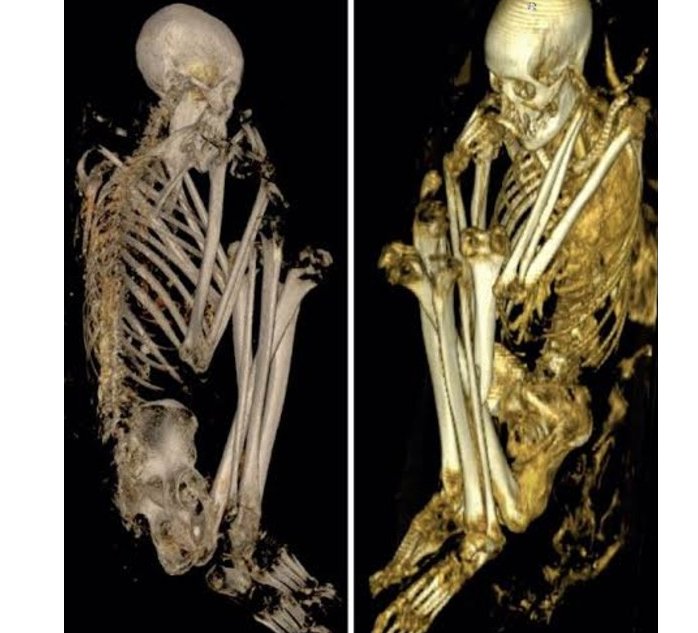
The Tuli mummy. Credit: SA Journal of Science
The body had been wrapped in a black/brown animal skin, most probably a cow skin (Fig. 4). A long plant fibre was then used to tie the remains into what might have been deemed a portable bundle for burial. The animal skin had been turned inside-out so that the fur part was in direct contact with the human body. Though torn off and lost in some portions, the animal skin was also very well preserved.
Except for the right femur and some phalanges which were evidently removed by scavenging animals, the skeleton was complete.
Examination of the mummy’s teeth showed show signs of moderate dental wear.
We may never know the true identity of the Tuli man, but we do know he had been mummified by accident and he is the fist and only one ancient mummy found in Botswana until now.
Copyright © AncientPages.com All rights reserved. This material may not be published, broadcast, rewritten or redistributed in whole or part without the express written permission of AncientPages.com
More From Ancient Pages
-
 Headless remains related to Huns or Sarmatians puzzle archaeologists in Kazakhstan
-
 Mysterious Ancient Remains Of The Lady In The Well – An Archaeological Detective Story
-
 Rare Medieval Seal Matrix Found By 10-Year-Old Boy In UK
-
 Why Didn’t Alexander The Great’s Body Show Signs Of Decomposition For Several Days? A Never-Before Suggested Explanation – From Scientists
-
 Discovery Of Chromosomes Offers Evidence Of Ancient Humans Living In South America Over 18,000 Years Ago
-
 2,000-Year-Old Stela And ‘Laboratory’ Of Early Maya Writing Found In Guatemala
-
 Mysteries Of Lake Llyn Y Dywarchen: A Portal To Fairyland
-
 Pancho Villa: Mexico’s Robin Hood – A Ruthless Bandit Or A Hero?
-
 Red And Black Ink Used In Egyptian Papyri Reveal Ancient Writing Practices
-
 Mystery Of The Brave Viking Chief Buried On The Gokstad Ship
-
 Tomb Of Pharaoh Ramesses II Treasurer Ptah-M-Wia Discovered In Saqqara
-
 Adorable Village Of The Little People In Connecticut
-
 Why Did Ancient Romans Destroy The Town Of Fregellae?
-
 142,000-Year-Old Shell Beads Found In A Cave Are The Oldest Known Evidence Of Human Communication
-
 On This Day In History: Napoleon Bonaparte Dies In Exile – On May 5, 1821
-
 Cats Were Rare And Expensive During The Viking Age – Spectacular Discovery Reveals Why
-
 On This Day In History: Terrible Day In Moscow Engulfed By Fire – On June 21, 1547
-
 What Was The Agriculture Like In Southeast China In The Late Neolithic?
-
 First Insight Into 3,500-Year-Old Cuisine Of The Enigmatic Nok Culture
-
 Cueva de Ardales – Rock Art Cave In Spain Was Used By Ancient Humans For More Than 50,000 Years

