
Shengavit Of Kura Araxes Culture: One Of Armenia’s Historical Sites Inhabited Since At Least 3200 BC
A. Sutherland - AncientPages.com - One of the most prominent historical sites of Kura Araxes (Uraxes) culture, dating from 3400 BC to 2000 BC, is the Shengavit settlement, located just beyond the suburbs of the city of Yerevan, Armenia.

The Kura-Araxes culture (3400-2000 BCE). Although the Kura-Araxes people were less aggressive and more sedentary, they also underwent a significant expansion, first west to Anatolia, south to the Fertile Crescent, and east toward the Iranian plateau to Pakistan, where they would have influenced the Indus Valley Civilisation.
The area of modern-day Shengavit has been inhabited since at least 3200 BC, probably, late Neolithic 3500-3000 BC). The site was excavated and relatively well studied by archaeologists who revealed findings attributed to many cultures that existed during the very long time from 4,000 to 2,000 BC.
People had developed agriculture, ranching, cattle breeding industry, reprocessed agricultural produce, and possessed equipment for corn milling. The city had unique food storage and depository of wheat, housing 4 tons of crops.

The excavations at the ancient Shengavit revealed a large set of tools and bronze artifacts, which confirm that Shengavit was a town with prospering agriculture and well-developed craft, including spinning looms, bone spindle whorls, looms, seals, marble, and onyx scepters.
People also worked as craftsmen creating pottery and skilled metalworkers. It is believed that copper smelting may have taken place in ancient Shengavit.
The settlement's highly developed architecture included defensive, economic, administrative, residential, and spiritual buildings.

One example is a rectangular semi-subterranean temple-like building, a temple with a low altar with a hole that may have held a wooden figurine and terracotta hearths, and a place for keeping the sacred fire during rituals.

Square M5 room with ritual emplacement and symbols buried near it. Source
The ruins of the city area, located on an irregular-oval platform built on a slope, are approximately 6 ha and are still surrounded by a wall with cyclopean towers constructed of vast and uncut stones from basalt without mortar. Under the northern part of the wall is an underground passage leading directly to the river Hrazdan and on the south side, there are traces of a filled moat.
When Shengavit was a flourishing center, it had the best defensive system.

People lived in round (sometimes rectangular) dwellings about 6 to meters in diameter and built at a distance of 7.3 meters from each other. Still, they were connected with the last wall of the adjacent buildings.
Their walls had a stone base, on which raw brickwork increased. A round, decorated clay fireplace - usually located in the house's center–had an essential economic and ritual role.
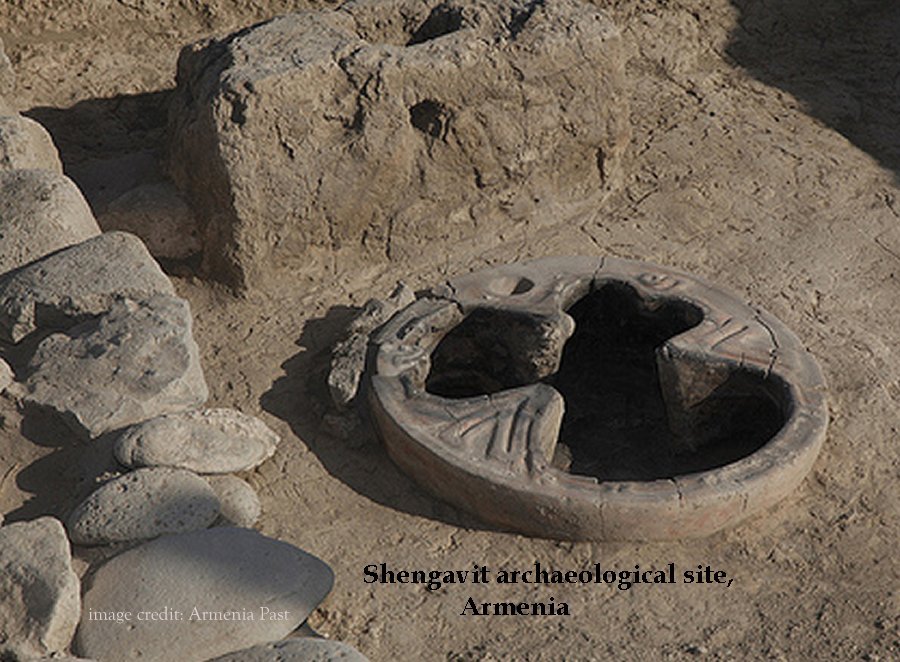
The walls of both round dwellings and rectangular buildings from inside and outside were plastered with clay. The round homes - covered with rubbles - had a corridor entrance opened from the east side.
Shengavit's ancient burial places were found outside the walls of the city. Each unearthed tomb had a place for 10-12 people, burial property, tools, goods, black clay pots, flint and obsidian, copper armlets, earrings, and beads.
According to one theory, Shengavit's burial area was once inside the walled city. Later, for unknown reasons, the city was confined to a smaller place within the walls, and the abandoned area became a burial place dated 3,000 BC.
Written by – A. Sutherland AncientPages.com Staff Writer
Updated on October 29, 2022
Copyright © AncientPages.com All rights reserved. This material may not be published, broadcast, rewritten or redistributed in whole or part without the express written permission of AncientPages.com
Expand for referencesMore From Ancient Pages
-
 On This Day In History: Battle of Stirling Bridge Took Place – On Sep 11, 1297
-
 Ancient Grammatical Puzzle Solved After 2,500 Years
-
 2,000 Years Ago Mysterious Foreigner With Unique Ancestry Traveled To Cambridgeshire – Who Was He?
-
 Great Wall Of Gorgan: One Of The World’s Most Sophisticated Frontier Walls Ever Built Is Now Examined
-
 The Boomerang Was Used 20,000 Years Ago By Stone Age People
-
 Prince John’s Plot Against King Richard The Lionheart
-
 Mysterious Sumerian Star Tablet And Strange Divine Omens – Sacred Knowledge Of The Gods – Part 1
-
 More Than 1,000 Prehistoric Burial Mounds Discovered In The Netherlands
-
 Struggle To Get Mail On Time Has Lasted More Than 5,000 Years – Part 3
-
 Oldest Footprints In Europe Belonged To A Mysterious 950,000-Year-Old Ancestor
-
 Anqa: “Forgotten Twin” Of Dura-Europos Where Time Stood Still
-
 Spectacular Ancient Gold Treasure Found In Denmark – Was It A Gift To Please Angry Gods?
-
 Mysterious Ancient Giant Jars Made By An Unknown Civilization Discovered In India
-
 How Did The Early Rapa Nui People Put Huge Hats On Giant Statues Of Easter Island?
-
 Did Climate Change End The Akkadian Empire?
-
 Legendary Minamoto No Tametomo – First Samurai To Commit Seppuku
-
 Mountain Meadows Massacre: Real Burial Sites Are Far From The LDS Monument’s Location
-
 New Massive Duck-Billed Dinosaur Species Identified
-
 Ancient Wooden Slips Inform About China’s First Emperor’s Search For Mysterious Elixir Of Immortality
-
 A Pioneering Study Provides New Insights Into Pregnancy During The Viking Age

