
Yakhchals: Ingenious Ancient ‘Refrigerators’ Could Store Ice In The Hot Desert
A. Sutherland - AncientPages.com - These ancient structures, called yakhchals should not be confused with pyramids or ziggurats.
The yakhchals (‘yakh’ means ‘ice’ and ‘chal’ means ‘pit’) are in fact ancient “refrigerators” used to store ice and other food items.
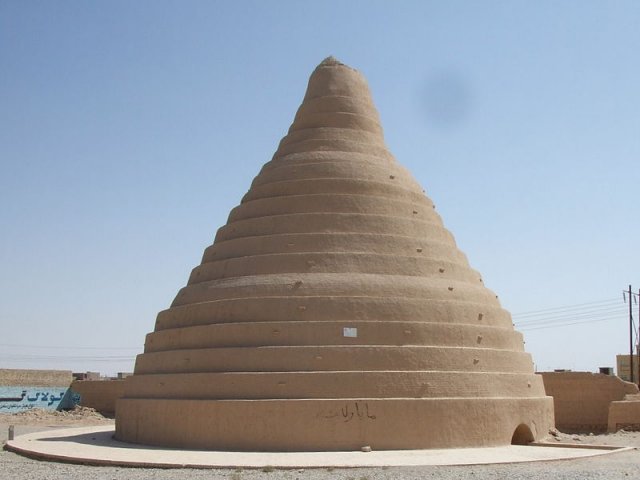
Yakhchal in Yazd Province
Modern refrigerators and freezers that we possess today, are by no means new inventions. Ancient people had their technological ideas and they were similar to ours.
The yakhchals were mostly used in Persia about 400 BC. Ancient Persian engineers mastered the technique of storing ice in the middle of summer in the desert. People harvested ice and snow even much earlier, in 1000 BC. There is also written evidence that ancient Chinese, Jews, Greeks, and Romans had a similar tradition.
But what people that lived in deserts did? Some of them, like Persians, built yakhchals, a type of evaporative cooler, which cooled the air through the evaporation of water. The yakhchals were made of a special mortar called sārooj, composed of sand, clay, egg whites, lime, goat hair, and ash which acts as an insulator. Above ground, a yakhchal is in a shape of a dome, and it has an underground storage space, which is used to keep ice or less often - food.
Ancient people got the ice from the icy river in the winter and stored it. Many of the yakhchals - although they were built hundreds of years ago - they survived to the present day.
The twin ice-pits on Sirjan, Kerman Province, are surrounded by high walls and were constructed with mud-brick.

The twin ice-pits on Sirjan, Kerman Province, are surrounded by high walls and were constructed 108 years ago with mud-brick, the ice-pits are surrounded by high walls.
Another way to keep the temperature low was to use the wall made on the north side of the yakhchal. The water channeled along the wall would freeze faster on a winter day thus producing more ice.
The ice produced and stored was kept in large underground pits. In most yakhchals, the ice was created by itself during the cold months of the year. The water is channeled from the qanat (Iranian aqueduct) to the yakhchal and it freezes upon resting inside the structure.

The yakhchals were constructed with up to two meters thick walls made of a special mortar composed of sand, clay, egg whites, lime, goat hair, and ash in specific proportions.
These remarkable structures were not only resistant to heat transfer but also completely water impenetrable.
The yakhchals have not been forgotten and erased from history. Even today, Iranians still call the modern fridges and freezers “yakhchals”. One of the yakhchals that still stands today is in Kerman, the capital city of Kerman Province, Iran. It is about eighteen meters high, and one of the rare surviving yakhchals.
Sometimes, the ingenious ‘refrigerators’ were equipped with a system of windcatchers or wind towers that could easily regulate temperatures inside the yakhchals, especially during very hot summer days.
Written by – A. Sutherland AncientPages.com Staff Writer
Copyright © AncientPages.com All rights reserved. This material may not be published, broadcast, rewritten or redistributed in whole or part without the express written permission of AncientPages.com
Expand for referencesReferences:
More From Ancient Pages
-
 Curious Ancient Copper Plates And The Mystery Of Indus Valley
-
 Epi-Olmec: Undeciphered Isthmian Script Of Mesoamerica
-
 Sutton Hoo Ship Burial And Famous Helmet That Could Belong To Raedwald, King Of All The Kings Of Britain
-
 Is An Ancient Temple Dedicated To The Lioness Goddess Repit Hidden In The Cliffs Of Athribis?
-
 Extraordinary Bronze Age Jewelry Hoard Discovered In A Carrot Field In Switzerland
-
 Mysterious Valkyrie Eir Remains An Enigma In Norse Mythology
-
 First Kisses May Have Helped Spread Oral Herpes 5,000 Years Ago – Scientists Say
-
 12,000-Year-Old Archaeological Evidence Of Human-Dog Friendship In Alaska
-
 Maya Storm God Huracán Taught That When We Damage Nature, We Damage Ourselves
-
 Chagyrskaya Female Neandertal That Lived 60,000-80,000 Years Ago – Studied
-
 Nicholas Owen ‘Little John’ Who Paid Highest Price For His Ingenious, Camouflaged Places To Hide
-
 How Many Ice Ages Has The Earth Had, And Could Humans Live Through One?
-
 Old Babylonian Residential Building In Ur Dated To 1835 BC – Investigated
-
 Will Ancient DNA Unravel History Of The Scythians From Central Asian Steppe?
-
 Search For A Viking Cemetery Near Truso Settlement In Janow, Poland – Continues
-
 Beautiful Ancient City Of Polonnaruwa With Hundred Of Tombs, Temples And Statues
-
 Sophisticated Masonry In Anasazi Dwelling Ruins At Mesa Verde National Park, Colorado, USA
-
 Madame de Pompadour – Powerful And Hated Mistress – Sex, Manipulation And Intrigue In Versailles
-
 What Is The Codex Mendoza?
-
 525-Million-Year-Old Fossil Defies Textbook Explanation For Brain Evolution

