
Mysterious Shasu – Bandit Canaanites Or Israelites?
David Tee - AncientPages.com - When the Egyptians enshrined the name Shasu on the Merenptah war scenes at Karnak, they knew exactly whom they were talking about. After all, they were contemporaries. Now some approx. 33 centuries later, the identity of the Shasu is not well known.
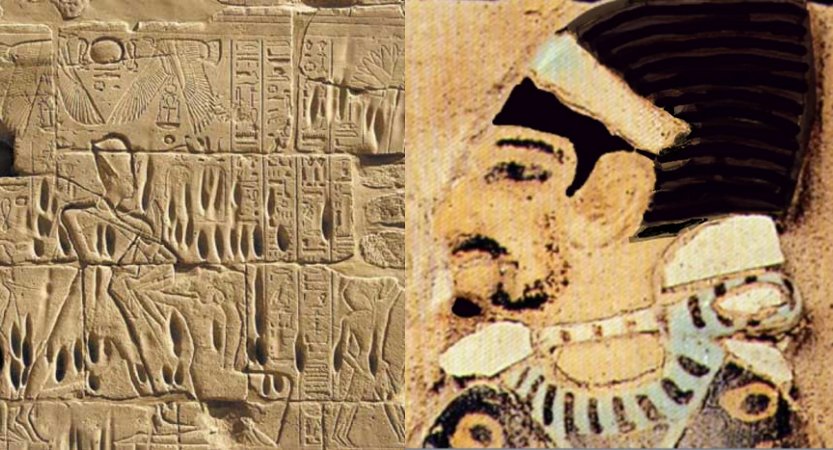
Left: Pharaoh Merneptah's Canaanite battle reliefs in the Karnak Temple. Scene 8, Shasu captives. Credit: biblearchaeology.org Right: Shasu relief. Credit: Israel United Wiki
Some scholars have said that the Egyptians were talking about the Israelites who had recently conquered their Promised Land. Other scholars disagree mainly because those same war scenes present the Israelites as different people than the Shasu.
The different clothing is the first and foremost clue to the separate identities of the two peoples.
Who Were The Shasu?
Some scholars thought the Israelites were these bandits who roamed the countryside looking for easy prey. But with the different clothing used to depict each group of people, that theory cannot stand.
Part of the problem was that the Egyptians often grouped different ancient nations under one title. The Edomites, Ammonites, Moabites, Amalekites, Midianites, Kenites, and Hapiru as Shasu. This is not an exhaustive list.
The term shasu describes a group of people who did wander. This means that the Shasu may have been an independent society that sometimes moved about. Still, another ancient Egyptian word also referred to a certain geographical area of Canaan as the land of.
The Papyrus Anastasi I used the term Shasu to refer to a society of giants who happened to live in one corner of Canaan. Some scholars speculate that these giants were the ones the Israelites met during their Exodus to the Promised Land.
To Add To The Confusion
There are two Egyptian hieroglyphic mentions in the New Kingdom that contain the words- the land of the Shasu of Yahweh. The name Yahweh is strictly associated with the Hebrews. These references could mean that the Shasu, while not Hebrews, probably lived in the land of the Hebrews. It made them harder to identify.
It may also add to their nomadic lifestyle in that the Shasu moved wherever they found good grazing land or refuge from the Egyptian armies.
Were The Shasu Bandits?
It is highly possible that they were living on the wrong side of the law, especially since Egypt ruled most of the Levant at the time. In Egyptian eyes, the Shasu were common criminals meant to be rounded up, defeated, or executed.
The reason for this attitude was that the Shasu rarely let the Egyptians control them and sided with their enemies on numerous occasions. One such event was when the Hittites battled Rameses II.
One theory has it that the Egyptians considered the Shasu bandits because they gave these semi-nomadic people a name that meant plunderer. In other words, the Egyptians may have considered them bandits and given them an appropriate name.
It is also possible that the Shasu were trying to protect their land from the Egyptian conquerors. They used any means necessary, including being bandits.
The Limited Existence Of The Shasu
The term Shasu is mainly used in Egyptian military records and almost always from the New Kingdom era. This indicates that the Shasu enjoyed a limited existence as a nation. Or that the interaction between the Egyptians and the Shasu was not very extensive.

Egyptians beating Shasu spies. Detail from the Battle of Kadesh wall-carving. Credit: Public Domain
It is hard to say, as pastoral life is also tough to retrace archaeologically. James Hoffmeier, in his book Israel in Sinai, quotes Israel Finkelstein as saying that the nomadic life in the Levant is virtually invisible.
In other words, it is hard to find any trace of nomads using archaeological methods. David Hopkins echoes this conclusion in his article Pastoralists in Late Bronze Age Palestine: Which Way Did They Go?
What is known is that the Egyptians did depict their capture of the Shasu on different occasions in their monuments. One monument dates to the Old Kingdom, but scholars caution that the Old Kingdom is not very reliable for factual history.
This may have led to the short lifespan enjoyed by the Shasu people, who are often identified as Syro-Palestinian residents.
Whoever the Shasu were, they were certainly a thorn in the Egyptian's side for many decades. They probably used the bandit lifestyle to help them survive the harsh environments of the Sinai desert.
Updated on November 20, 2022
Written by – David Tee - AncientPages.com Staff Writer
Copyright © AncientPages.com All rights reserved. This material may not be published, broadcast, rewritten or redistributed in whole or part without the express written permission of AncientPages.com
Expand for referencesPastoralists in Late Bronze Age Palestine: Which Way Did They Go? By David Hopkins (2001). Biblical Archaeologist: Volume 56 1-4, (electronic ed.).
Israel in Sinai by James Hoffmeier
(2005). Bible and Spade, 18(3), 72.
(1988). Biblical Archaeologist, 51.
Shanks, H. (Ed.). (1990). BAR 16:05 (Sep/Oct 1990).
More From Ancient Pages
-
 New Cosmic Ray Bombardment Of The Great Pyramid – Search For The Hidden Chamber Continues
-
 Gashadokuro: A Terrifying Nocturnal Ghost Yokai With Voracious Appetite For Human Blood
-
 Unique Gold Votive Plaque Found At Fort Apsaros Reveals Evidence Of A Mysterious Roman Sect
-
 Spectacular Statue Of Sea God Triton Found In Roman Mausoleum In Kent
-
 Unexplained Phenomena In Arkansas – Old Mysteries Still Puzzling The Modern World
-
 Fenja And Menja: Two Giant Sisters, Magical Grotte Mill And Why The Sea Is Salt
-
 Rhodogune Of Parthia Refused To Bath And Comb Her Hair Until She Subdued The Rebels
-
 Rare Intact Etruscan Tomb With Remains Of Four Individuals Resting On Carved Stone Beds
-
 Surprisingly Complex History Of Crocodiles – New Study
-
 2,300-Year-Old Roman Lead Weight In Assos Is The Largest Ever Discovered
-
 Did Richard The Lionheart Order Assassins To Kill Conrad Of Montferrat, King Of Jerusalem?
-
 Secrets Of The Bible: Codex Zacynthius – Hidden Text In New Testament May Soon Be Uncovered
-
 Europe’s Largest Predatory Dinosaur Unearthed On The Isle Of Wight
-
 Change Of Burial Tradition Among The People of Early Medieval Europe
-
 Hypatia Of Alexandria – Brilliant, Controversial Scientist And Her Dramatic End
-
 3,000-Year-Old Geoglyphs May Depict The Heavens
-
 Secrets Of Lake Huron – Mysterious Disappearance Of Long-Lost Steamship Solved
-
 Lady Fu Hao: Brave Warrior Skilled Strategist And China’s First Female General
-
 Nearly 7,000 Years Ago, Dortmund Airport’s Area Was Inhabited By Early Farming Society For Centuries
-
 Timur: Brutal Military Leader And His Desire To Conquer But Not To Rule

