
Senegambia’s Circles: Largest Cluster Of Megalithic Structures Of Lost Civilization On Earth
A. Sutherland - AncientPages.com - There are still many ancient places on our planet that remain unknown or very little known to most people.
One such place is Senegambia’s ancient site, which is located in the western part of West Africa, between the River Gambia and the River Senegal. The site has the largest and most extraordinary concentration of megalithic complexes in the world.

The monuments, which were first explored by 1903, are the long-standing mystery because until now, no one has been able to determine the exact date of their origin. However, it is generally believed that megalithic structures began to form from the 3rd century BC before the 16th century AD.
These gigantic monuments – with more than 1,000 stone circles and related tumuli - are divided into four main areas: Wanar and Sinus Ngayene in Senegal and Wassu and Kerbatch in the central Gambia, and cover an approximate area of 100 km wide and 350 km in length, along the River Gambia. The region contains circa 29,000 stones, 17,000 monuments, and 2,000 individual sites.
Megalithic monuments and burial practices vary in time and space, in a time frame known to range from 200 BC to AD 1500. The monuments are partitioned into monoliths circles, stone circles, earthen tumuli, and stone tumuli.
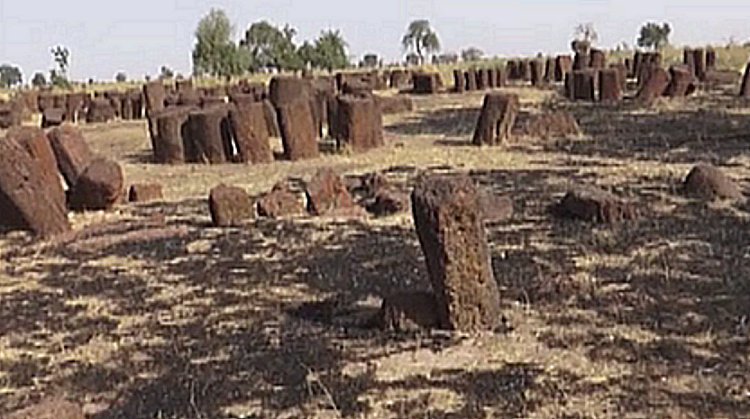
Their frequency and patterns of distribution vary from site to site.
For example, in Wassu – with the highest stones of the area - there are eleven stone circles composed of a dozen to twenty pairs of reddish brownstones and their associated frontal stones. The more recent excavations conducted on these megalithic circles date to the Anglo-Gambian campaign led by Evans and Ozanne in 1964 and 1965.
Based on the finds of burials, it has been determined that these monuments date back between 927 and 1305 AD. The Kerbatch complex, on the other hand, consists of 9 single circles, including one double.
See also:
Unsolved Mystery Of Gedi Ruins – Kenya
Enigmatic Ancient Kingdom Of Thulamela Created By Mysterious Shona People
Tracing Footsteps Of Giants In Africa – Obscure Past Of Mzoura Stones
The intriguing megalithic monuments from the Senegambia were visited from the end of the19th century. The largest monolith - included in a circle with ten more stones - is located in Wassu, Gambia, and has a height of 2,59 meters. Sine Ngayene in Senegal has 52 circles, one of which has double stone circles and a total of 1102 stones. It is the biggest concentration of loops in this ancient site.
It is not known who built these circles or what their purpose was. There are many other similar archaeological sites throughout Senegambia, and the verses are mostly from the second half of the first millennium AD.
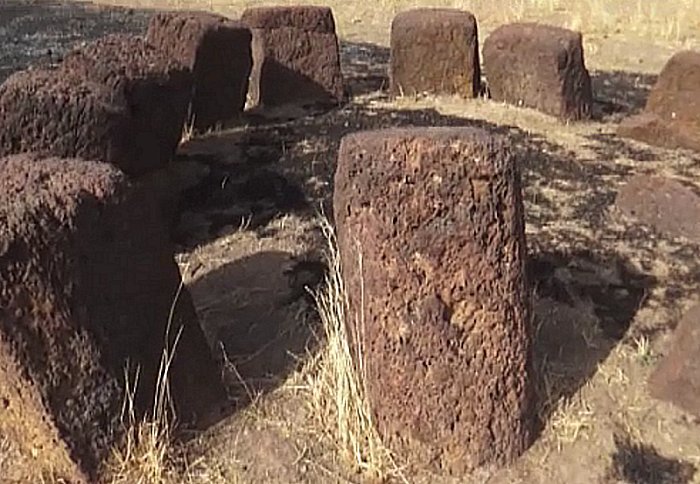
It is also unclear if and how these graves relate to stone circles.
“Archeological exploration of these impressive sites is incomplete. Preliminary dating makes the Senegambian Complex over 1,000 years old. The functions of this vast array of megalithic sites are unknown, although it is not obviously astronomical…” according to Matthew H. Hill; "The Senegambian Monument Complex: Current Status and Prospects for Research.”)
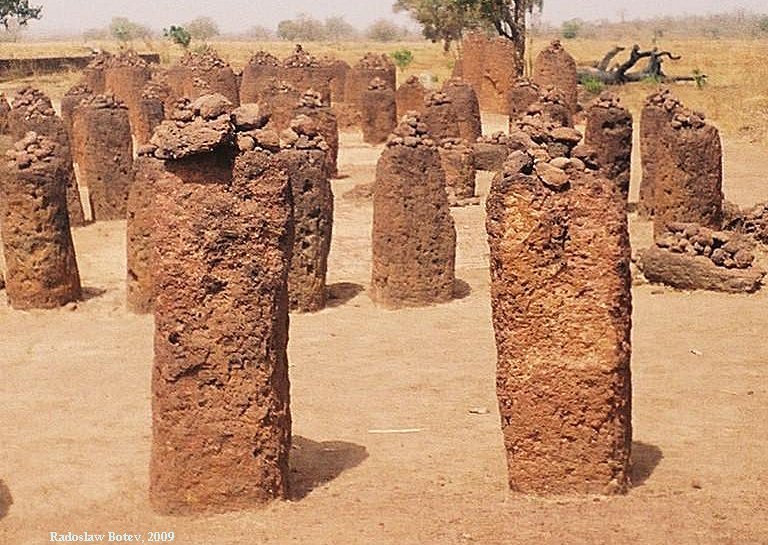
The stones forming the circles were extracted from nearby the so-called ‘laterite quarries’ with soil layer that is rich in iron oxide and derived from rocks weathering in hot and wet tropical areas. This building material was skillfully cut in almost identical columns of either cylindrical or polygonal shape, using iron tools. The columns are 2 meters high on average and weigh up to 7 tons.
Each circle has between 8 and 14 stones standing for a diameter of 4 to 6 m.
Unknown Well-Organized Ancient Culture
The four listed megalithic sites are evidence of a highly organized and prosperous society whose traditions of building stone circles, associated with burials, seem to have persisted in some areas for at least one thousand years.
The megalithic circles were made by skilled builders who used a few quarries, located in the vicinity of monuments.
The ordinary red volcanic "ironstone", of which the stone circles were built, is common in Senegambia and the builders did not need to go more than only a few hundred yards for their material.
It’s worth noting that the construction of the massive structures in Senegambia could not be attributed to the cultures of the then area.
According to local legends, the circles were formed around the tombs that belonged to the kings of the ancient Kingdom of Ghana. The stones of the inner rings are arranged into an approximately D-shaped form, but the most intriguing pillars are V- or Y-shaped with crossbars.
The natives living in the vicinity of the megalithic complexes have no idea for what purpose of by whom these stony blocks were arranged in this way. They do not admire or feel fear looking at this ancient work, which, according to them, the old ones did.
Archaeological research conducted in 2002 revealed that some graves were older than the megalithic circles. However, we still don't know who build them, how the massive stone blocks were moved, and for what purpose.
Written by – A. Sutherland - AncientPages.com Senior Staff Writer
Copyright © AncientPages.com All rights reserved. This material may not be published, broadcast, rewritten or redistributed in whole or part without the express written permission of AncientPages.com
Expand for referencesReferences:
Matthew H. Hill; "The Senegambian Monument Complex: Current Status and Prospects for Research
More From Ancient Pages
-
 Enigma Of The Mysterious Ancient Shining Twins – The Cosmos Connection – Part 2
-
 Newly Described Species Of Dome-Headed Dinosaur May Have Sported Bristly Headgear
-
 DNA From Mysterious Hominin In China Suggests Native Americans’ East Asian Roots
-
 Ancient Town Pontefract, England Reveals Some Of Its Secrets
-
 Amazing Margate Shell Grotto – Kent’s Greatest Mystery
-
 Ancient Warfare And Continuous Rise In Global Population – Is There A Connection?
-
 Prometheus ‘Fire Bringer’ – Hero Stealing Fire From Gods Giving It To Mortals
-
 16 Dead Sea Scrolls Fragments Are Forgeries – U.S. Bible Museum Says
-
 Lady Fu Hao: Brave Warrior Skilled Strategist And China’s First Female General
-
 Pre-Clovis, Paisley Caves: Archaeologists Identified The Earliest Population Of North America
-
 Mysterious Undeciphered Ripley Scroll And Its Connection To The Philosopher’s Stone
-
 On This Day In History: King John Of England Died – On Oct 19, 1216
-
 Prehistoric Humans Recycled Old Stone Tools To Preserve The Memory Of Their Ancestors
-
 Buccaneers And Privateers Were Pirates – But What’s The Difference Between Them?
-
 Long-Lost Viking Waterway Leading To Orkney, The Great Norse Empire – Discovered
-
 6,000-Year-Old Vast Settlement With Tools And Granite Structures Unearthed In Sotta, Corsica In France
-
 Armenians’ Origin Theory By Herodotus Debunked By New DNA Study
-
 Samurai Swords: Katana And Wakizashi And Their Long Tradition
-
 Ancient People Possessed Far Greater Knowledge Of Astronomy Than Previously Believed – Researchers Say
-
 The Cyclades And Their Advanced And Mysterious Society Lost In Time

