
Mama Cocha – Inca Goddess Of The Sea With Strong Connection To Lake Titicaca, Peru
A. Sutherland - AncientPages.com - In one of our latest articles, we presented Mama Ocllo, an important deity in the ancient beliefs of Inca people.
Today we write about Mama Cocha, known as ‘Sea Mother', Mother of the Waters’ (‘Laguna Madre’), whose powers were derived from the water.
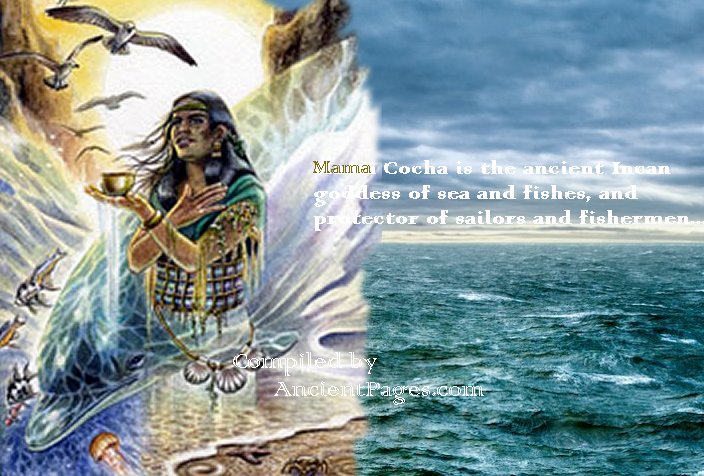
In the Inca beliefs, Mama Cocha is one of the four elemental, divine mothers; the others are Mama Nina, the goddess of fire, Pachamama, the goddess of the earth and fertility, who presides over planting and harvesting and can cause earthquakes. The latter is Mama Waira, who teaches the Inca the art of spinning. These four deities were worshiped as mothers of life because they ruled everything that was considered natural elements such as land, fire, air, and water.
All rivers, lakes, mountains, animals, plants, and meteorological phenomena possess such a spirit, according to the Inca. The word ‘mama’ added to the name of any animal, is used to designate a gigantic prototype of the species or closely associated with them.
Mama Cocha is the ancient Incan goddess of sea and fishes, and protector of sailors and fishermen exposed to dangers at sea. She is also responsible for providing plenty of fish, preventing storms, and calming the waters for their safety.
She is the wife of Viracocha, the God of Heaven, and mother of Mama Quilla, goddess of the moon and fertility and Inti (Inti Tayta), the Sun god. This powerful goddess has even unlimited power over all bodies of water, including rivers, lagoons and lakes, tides, and the ocean.
See also:
Catequil – Cultural Hero And Inca God Of Thunder And Lightning
Gluskap: Mythical Hero Who Defeated Evil Sorcerers And Demon Followers
Story Of Atahualpa: The Last Emperor Of The Inca Empire
Still, first of all, she has a unique relationship with the Andean sacred lake, Lake Titicaca, which is central to the Inca creation stories. Its waters are said to be the tears of the Creator, and from this sacred lake emerged the sun and the moon, Inkari, and Collari, who were the first mother and father of the Inka Nation.
Mama Cocha has always been particularly important to people living alongside the coastal regions due to proximity and daily dependence upon the sea.
As it was centuries ago and today, throughout the entire coastal territory of Peru, Ecuador, Colombia, and northern Chile, an ancient belief in the Inca goddess Mama Cocha remains in force in these places where fishing is essential for the economy and well-being of its inhabitants. That is why Mama Cocha is worshiped and esteemed with great devotion, hoping she can provide a good fortune in fishing, and give sufficient protection of coastal towns against devastating tsunamis.
Even the farmers have to worship and make offerings to Mama Cocha because she controls annual rainfall that affects crop health, and is beneficial for agriculture.
Worship Of Mama Cocha
Rites of Mama Cocha have to be performed by women since this goddess gives relevance to her own gender, that is, to the feminine. The ceremony is organized every 8th of September and includes dances, music, and serving of food.
According to an old tradition, one way to worship the goddess of the sea is to bathe in its waters at midnight. The women who did it asked for health, beauty, strength, and fertility. Another tradition is held on the banks of lagoons and rivers, where believers bow to all the gods in order to invoke the great Mama Cocha.
This kind of ancient Inca rituals has survived to this day, being a source of inspiration for many new rites of this ancient culture.
Written by – A. Sutherland - AncientPages.com Senior Staff Writer
Copyright © AncientPages.com All rights reserved. This material may not be published, broadcast, rewritten or redistributed in whole or part without the express written permission of AncientPages.com
More From Ancient Pages
-
 Stone Tools In Lapa do Picareiro Cave Reveal Modern Humans Reached Western Parts Of Europe 5,000 Years Earlier Than Previously Thought
-
 Ponce De Leon’s Quest For The Fountain Of Youth In Florida
-
 Cremation In The Near East Dates Back To 7,000 B.C.
-
 Mysterious Toaleans – Remains Of Unknown Humans Who Lived 8,000 Years Ago Discovered In The Leang Panninge Cave
-
 Mysterious Books With Dangerous Secret Knowledge Deliberately Hidden From Public View
-
 On This Day In History: Treaty Of Seville Signed – On Nov 9, 1729
-
 Unsolved Mystery Of The Anomalous Underwater Structures Discovered In Minnesota
-
 Archaeological Site Along The Nile Reveals The Nubian Civilization That Flourished In Ancient Sudan
-
 How Did Climate Change Impact European Ice Age Humans?
-
 7.2-Million-Year-Old Pre-Human Remains Suggest Our First Ancestor Came From Europe Not Africa
-
 California’s Mysterious Ancient Wisdom Teacher And His Puzzling Connection To The Stars
-
 Unique Headstones Of Kela Mazin Cemetery In Kurdistan Are Probably 3,000 Years Old Or Much More
-
 Naupa Huaca: The Enigmatic Stone Temple In A Cave In Peru
-
 Ancient Pottery Reveal How Peru’s First Great Empire Wari Functioned
-
 3,000-Year-Old Twisted Gold Torc Discovered In Essex
-
 Ancient Greeks Reached Iceland Before The Vikings – New Theory Suggests
-
 Curious Alien-Looking Slit Gongs Figures From Vanuatu Allowed Villagers To Communicate
-
 Giant Meteorite Impacts Created The Continents – Evidence Found
-
 Mysterious Advanced Underground Civilization And A Secret Society – Technology, History, Language And Goals – Part 2
-
 Last Fragment Of Early Christian Christogram Found In Ancient City Of Parthicopolis, Bulgaria

