
Ancestors Of The Irish And Scots Came From Biblical Lands And Ancient Egypt – Myths, History And DNA
Ellen Lloyd - AncientPages.com - It has been suggested that the Irish and Scots are related to people from Biblical lands and ancient Egypt.
It is an exciting and thought-provoking theory, but is there any evidence supporting these claims?
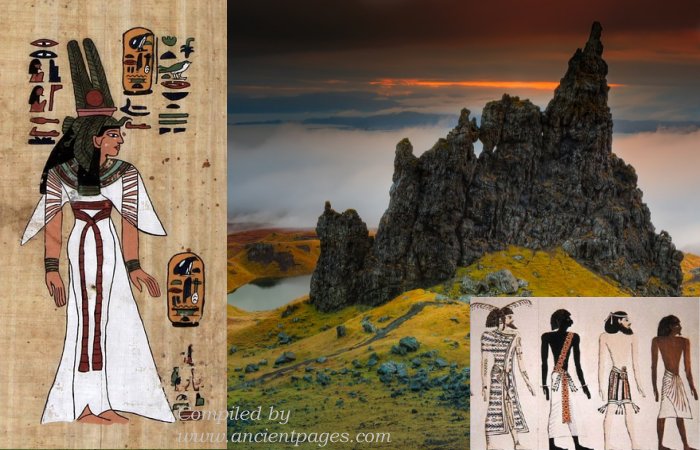
Can examining mythological and historical sources and genetic data shed more light on this long-standing ancient mystery?
Did Pharaoh's Daughter Scota Visit Scotland And Ireland?
One part of this theory is based on old references to Scota, a daughter of an Egyptian pharaoh.
The Scots had long claimed that, before Brutus had come from Tory, Pharaoh's daughter Scota had come to the land she had given her name to.
The first mentions of Scota have been traced to the Irish chronicle Book of Leinster and a passage discovered in the Historia Brittonum. These works were created in the 12th and 11th centuries, and they briefly relate to how Scota married Geytholos (Goídel Glas), the founder of the Scots and Gaels, after being exiled from Egypt.
Whether Geytholos came from ancient Greece, Iberia, or Scythia is still unclear. Various ancient manuscripts connect him with different land making it difficult to understand where he came from.
The entire subject gets even more complicated because we are told there from the book Lebor Gabála Érenn (literally "The Book of the Taking of Ireland"), known in English as The Book of Invasions, was a second Scota who was married to a man named Niul.
An ancient Irish legend tells Niul was originally a Babylonian. He left his land after the destruction of the Tower of Babel. A pharaoh invited Niul to Egypt, and there he met Scota, whom he married. Together they traveled to Europe. Whether they settled in Ireland or Scotland has never been agreed upon, not even by Medieval writers and historians. We only know that Scota and Niul had a son named Goídel Glas, who is by some considered the founder of the Gaelic language. The grave of Scota (or Scotia's Grave) allegedly lies in a valley south of Tralee Town, Co. Kerry, Ireland.
It brings us to the next question – Why would ancient Egyptians visit Ireland or Scotland?
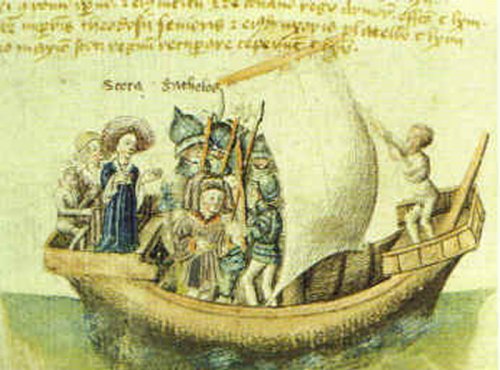
Scota (left) with Goídel Glas voyaging from Egypt, as depicted in a 15th-century manuscript of the Scotichronicon of Walter Bower; in this version, Scota and Goídel Glas (Latinized as Gaythelos) are wife and husband. Credit: Public Domain
"According to the most learned men among the Scotti, Ireland was desert and uninhibited when the children of Israel crossed the Red Sea, in which, as we read in the Book of the Law, the Egyptians who followed them were drowned.
At the time, there lived among his people, with numerous families, a Scythian of noble birth who did not pursue the people of God. The Egyptians who were left, seeing the destruction of the men of their nation, and fearing lest he should possess their territory, took counsel together and expelled him. At this point, in a gloss in several manuscripts of the Historia Brittonum, Scota – indeed the "dark lady" – for the name means in Greek shadow or darkness is encountered for the first time.
It is stated that the Scythian was the son-in-law of Pharaoh and the husband of Scythia. The account goes on to relate how the exile wandered for forty-two years in Africa, the land of the Philistines, and by way of Rusicada and Syria, the River Malva, and Mauritania to the Pillars of Hercules and Spain. One thousand and two years after the Egyptians were drowned in the Red Sea, his descendants crossed from Spain to Ireland and the district of Dalriada. At the time, Brutus rules over Romans." 1
Can these ancient historical accounts be genuine, or do we have reasons such events took place in the distant past?
Genetic And Archaeological Evidence Of Unknown People In Scotland And Ireland?
Some years ago, a ground-breaking study suggested that Scots are descendants of long-lost tribes from the Sahara. The same survey also revealed that Scots are closely related to Napoleon Bonaparte!
As previously reported, the results of the "Scotland's DNA" project "reveal the Scots to be much more diverse than was thought."
Several exciting groups were found. After testing DNA samples from almost 1,000 scots, researchers found that 1 percent of all Scots are descended from the Berber and Tuareg tribe members of the Sahara. Another 1% have a recent origin in Iberia, their ancestors having probably reached Britain via the trade in tin.

The study is based on research conducted by geneticist Dr. Jim Wilson and his team at Edinburgh University.
It may not be considered much evidence, but the results of the DNA study should not be dismissed without further investigations.
Another curious announcement was made in more recent years. Scientists announced ancient DNA reveals Irish are not Celts because Irish ancestors came from Biblical Lands.
Three ancient bodies discovered on Rathlin Island off Antrim were investigated, and the results were startling. Scientists said this particular discovery could completely rewrite the history of ancient Ireland.
Scientists examined the remains of these ancient people in Ireland and Britain. DNA results show the ancestors of modern Irish people predate the Celts' arrival on Irish shores by around 1,000 years.
Irish DNA existed in Ireland before the Celts ever set foot on the island.
"The genomes of the contemporary people in Ireland are older — much older — than we previously thought," Dan Bradley, a genetics professor at Trinity College, said.
On the other hand, in 2017, scientists presented the first genetic map of the people of Ireland. According to this genetic information, very subtle genetic DNA differences exist between people across the island.
"We find evidence of a west-Norwegian-like ancestry that we believe is a signature of the Norse Vikings. We also observe the impact of historical events such as the Ulster Plantations on the DNA of the people of Ireland," Edmund Gilbert (RCSI), first author of the paper, said.
The study does not mention any connection between Ireland and the Middle East, but this doesn't necessarily imply this ancient connection never took place.
One must remember that this genetic map was based on DNA samples taken from 196 Irish individuals with four generations of ancestry linked to specific areas across Ireland.
In other words, one cannot exclude the possibility that the Scots and Irish are distantly related to those who came from Biblical lands, and maybe the daughter of the Pharaoh did play a much more historical role in this part of the world than we have previously thought.
Written by - Ellen Lloyd – AncientPages.com
Updated on April 8, 2023
Copyright © AncientPages.com All rights reserved. This material may not be published, broadcast, rewritten or redistributed in whole or part without the express written permission of AncientPages.com
Expand for references- Cowan, Edward J. "Myth and Identity in Early Medieval Scotland." The Scottish Historical Review63, no. 176 (1984): 111-35.
- Matthews, "The Egyptians in Scotland: the Political History of a Myth”
More From Ancient Pages
-
 Trajan’s Column – A Roman Triumphal Column In Ancient Rome
-
 Beer Was Used As Medicine And Payment In Ancient Egypt
-
 New Evidence Of Roman And Medieval Leicester
-
 5,000-Year-Old Tavern With Food Remains Discovered In The Ancient Mesopotamian City Lagash
-
 Mada’in Saleh: Magnificent Timeless Rock-Cut Tombs And Monuments In The Desert
-
 Evidence Of Early Metalworking In Arctic Canada – European Technologies Involved
-
 Who Said ‘Eureka’ First And Why?
-
 Ale Conner: Unpleasant And Dangerous Profession In Medieval England
-
 Legend Of Marguerite de Bressieux: Brave Noblewoman Who Sought Revenge For Sexual Assault
-
 Adorable Village Of The Little People In Connecticut
-
 Surprising Discovery: Massive Cemetery Built 5,000 Years Ago Near Lake Turkana, Kenya
-
 Family Looking For Lost Gold Ring Finds Viking Age Artifacts In Their Garden On The Island Of Jomfruland
-
 Easter Island Secrets: Giant ‘Pukao’ Stone Hats Reveal That Rapa Nui People Were Not Warriors
-
 Mysterious Pyramid Of Menkaure Remains An Ancient Puzzle
-
 The Govan Stones – Treasures From The Viking Era In Britain
-
 Excavations Reveal New Artifacts That Change History Of Ancient City Of Pergamon
-
 Neanderthals Died Out 40,000 Years Ago, But There Has Never Been More Of Their DNA On Earth
-
 14th Century Murals With ‘Warrior Saints’ Found In Church Of Ancient City Cherven In Bulgaria
-
 Elusive Non-Binary Gender In Prehistoric Europe – A Forgotten Minority
-
 How Saul, A Farmer Boy Became The First King Of Israel

