
Legacy Of The Ancients: Cyrus The Great Cylinder – The Charter Of Human Rights
A. Sutherland - AncientPages.com - Cyrus the Great was “a worthy ruler and lawgiver” according to the Greeks, while the Persians called him "father" and the Jews regarded him as “the Lord’s anointed”.
Cyrus the Great is considered one of the most outstanding figures in human history. He was an intelligent ruler with diplomatic and military skills, who must be credited for his achievements in creating and maintaining the Achaemenid Persian Empire, the world's largest ancient empire.
 Persian Empire Map During King Cyrus The Great
The Cyrus Cylinder sometimes referred to as the first “bill of human rights,” traces its origins to the Persian king Cyrus the Great’s conquest of Babylon in the sixth century B.C.
Almost 2,600 years later, its remarkable legacy continues to shape contemporary political debates, cultural rhetoric, and philosophy.
The Cyrus Cylinder is one of the most celebrated objects in world history. Its replica is kept at the United Nations Headquarters in New York.
“You could almost say that the Cyrus Cylinder is a history of the Middle East in one object, creating a link to a past that we all share and to a key moment in history that has shaped the world around us,” said Neil MacGregor, director of the British Museum.
“Objects are uniquely able to speak across time and space, and this object must be shared as widely as possible.”
The Cylinder—a football-sized, barrel-shaped clay object covered in Babylonian cuneiform, one of the earliest written languages—announced Cyrus’ victory and his intention to allow freedom of worship to communities displaced by the defeated ruler Nabonidus. At the time, such declarations were not uncommon, but Cyrus’ was unique in its nature and scope.

In this text, a clay cylinder now in the British Museum, Cyrus describes how he conquers the old city. Nabonidus is considered a tyrant with strange religious ideas, which causes the god Marduk to intervene. That Cyrus thought of himself as chosen by a supreme god, is confirmed by Second Isaiah; his claim that he entered the city without struggle corroborates the same statement in the Chronicle of Nabonidus.
When contextualized with other contemporary sources, such as the Bible’s Book of Ezra, it becomes evident that Cyrus allowed displaced Jews to return to Jerusalem. Under Cyrus (ca. 580–530 B.C.), the Persian Empire became the largest and most diverse the world had known to that point.
Next generations of rulers considered the Empire to be the ideal example of successful governance across multiple cultures, languages, and vast territories.
Cyrus’ declarations of tolerance, justice, and religious freedom provided inspiration for generations of philosophers and policymakers, from Ancient Greece to the Renaissance, and from the Founding Fathers to modern-day Iran, so much so that a copy now resides in the United Nations’ headquarters in New York.
The message of the Cylinder and the larger legacy of Cyrus’ leadership have been appropriated and reinterpreted over millennia, beginning with its creators. The Babylonian scribe who engraved the Cylinder attributed Cyrus’ victory to the Babylonian god Marduk, a stroke of what could be considered royal and religious propaganda.
In the fourth century B.C., the Greek historian Xenophon wrote Cyropaedia, a text that romanticizes the philosophies and education of Cyrus as the ideal ruler, which greatly influenced both Alexander the Great and, much later, Thomas Jefferson in his creation of the Declaration of Independence.
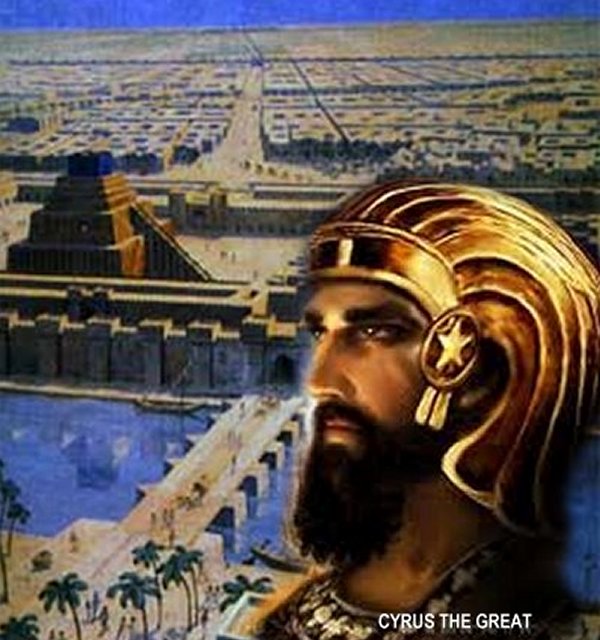
When the Cylinder was rediscovered in 1879, it immediately entered the fray of public debate as invaluable proof of the historical veracity of events described in biblical scripture. In the early 20th century, supporters of the creation of the state of Israel compared the actions of British King George V to those of Cyrus, allowing Jews to return to Jerusalem.
When the Cylinder was loaned to Iran in 2010, it was viewed by more than 1 million people, as one of the most visited exhibitions in the country’s history.
The biblical scholars have traditionally considered Cylinder's text as corroborative evidence of Cyrus' policy of the repatriation of the Jewish people following their Babylonian captivity. The Book of Ezra attributes this act to Cyrus because the text refers to the restoration of cult sanctuaries and the repatriation of deported peoples. The Book of Ezra is an important account of the Jews' regathering, and their struggle to survive and rebuild what had been destroyed.
However, this interpretation has been disputed, as the text identifies only Mesopotamian sanctuaries, and does not mention Jews, Jerusalem, or Judea.
Mohammad Reza Pahlavi, the last Shah of Iran referred to the Cylinder as the first declaration of universal human rights, but again Pahlavi's point of view was rejected by some historians as anachronistic and a misunderstanding of the Cylinder's generic nature. According to many scholars, the Cylinder represents a typical statement often made by new monarchs at the beginning of their reign.
There are historians, however, who accept that the Cyrus Cylinder is an early formulation of human rights, simply an attempt to solve a long-lasting problem regarding human rights.
Written by - A. Sutherland - AncientPages.com Senior Staff Writer
Copyright © AncientPages.com This material may not be published, broadcast, rewritten or redistributed in whole or part without the express written permission of AncientPages.com
More From Ancient Pages
-
 Mystery Of King Solomon’s Mines: An Unsolved Ancient Enigma
-
 Ancient DNA Reveals Hunter-Gatherers From Mexico Moved To California 5,200 Years Ago
-
 Giants Did Exist And Were A Part Of Earth’s Ancient History
-
 Native Americans’ Unexplained Encounter With A Strange Underground Humanoid 500 Years Ago – Who Was This Being?
-
 Ancient Manuscript In Museum Reveals Discovery Of Objects Unknown To Modern Science – Inside The Chamber – Part 1
-
 Thousands Of Spectacular Stolen Ancient Treasures Discovered Hidden In Major Bust
-
 Ancient Suda: Massive Anonymous Byzantine-Greek Lexicon Dated To 10th Century
-
 Mesopotamian City Jemdet Nasr Dated To 3100–2900 BC: Sophisticated Irrigation Techniques And Earliest Cylinder Seals
-
 Medieval Burial Mystery: Enigma Of Missing Bones Of The Venerable Bede
-
 Sumerian Clay Brick With Inscription In Honor Of God Enki Returns To Iraq
-
 Legend Of Tarenyawagon Who Came From The Heavens And Ascended To The Stars In His Fast Flying Shining Canoe
-
 Evidence Humans Used Fire 1 Million Years Ago In Israel Discovered By Artificial Intelligence
-
 Ancient Maya Drug Containers – Scientists Identified What’s Inside
-
 Archaeological Enigma On The Træna Islands – What Happened To The Local Community?
-
 LIDAR Discovery Of Valley Of Lost Cities In The Amazon
-
 Unique And Intriguing Myth Of Storm God Iškur’s Captivity In The Netherworld Recorded On Sumerian Tablet From Nippur
-
 Freemasons Secrets – American Democracy Is Part Of An Ancient Universal Plan – Secret Societies’ Role – Part 3
-
 Clapping To Show Appreciation Is An Ancient And Widespread Behavior
-
 Unique And Priceless Large Roman Sculptures Found At Carlisle Cricket Club
-
 Immigrants In Prehispanic Cancun Were Treated Just Like Maya Locals

