
Atomic Theory Was Invented 2,600 Years Ago By Acharya Kanad – A Genius Ahead Of His Time
A. Sutherland - AncientPages.com - The eminent historian, T.N. Colebrook has said, "Compared to the scientists of Europe, Acharya Kanad and other Indian scientists were the global masters of this field."
Our quest for lost ancient knowledge takes us this time to India where we encounter a very intelligent individual who was a great thinker far ahead of his time.
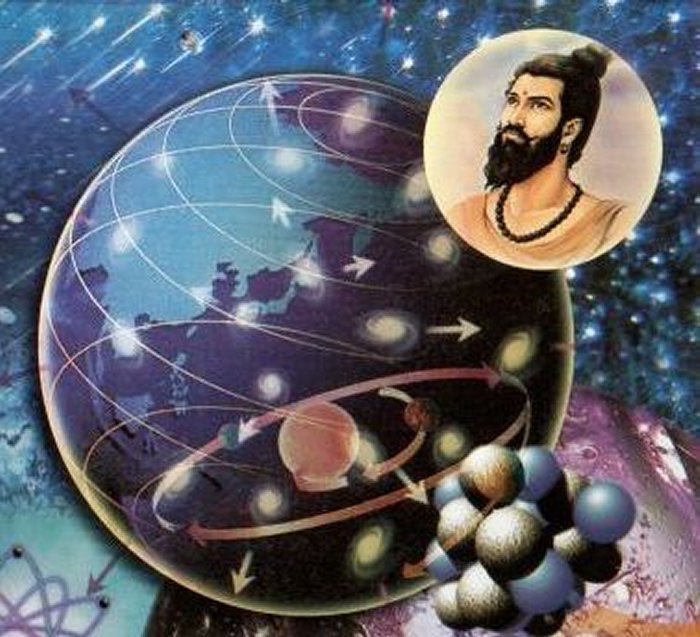
In 1803, during a lecture at the Royal Institution in London, John Dalton (1766-1844) an English chemist gave his first public account of the atomic theory. He proposed that atoms of different elements could be distinguished by differences in their weights. His theory was based on ideas that all matter is composed of atoms that cannot be made or destroyed and all atoms of the same element are identical.
He was also able to detect that different elements have different types of atoms and chemical reactions occur when atoms are rearranged.
In modern times, John Dalton has been credited as the inventor of the atomic theory.
However, he was not the first one to discover the concepts of atoms. About 2,600 years ago, Acharya Kanad, an Indian philosopher and a great thinker far ahead of his time, developed what we today call the atomic theory.
Born in in Prabhas Kshetra near Dwarika in Gujarat, India, Acharya Kanad expressed interest in tiny objects already as a small child.
Once, on his way to a Prayag on a pilgrimage, he saw thousands of pilgrims littered the town roads and the banks of river Ganga with flowers and rice grains which they offered at the temple.
To everyone's astonishment he started collecting the grains of rice.
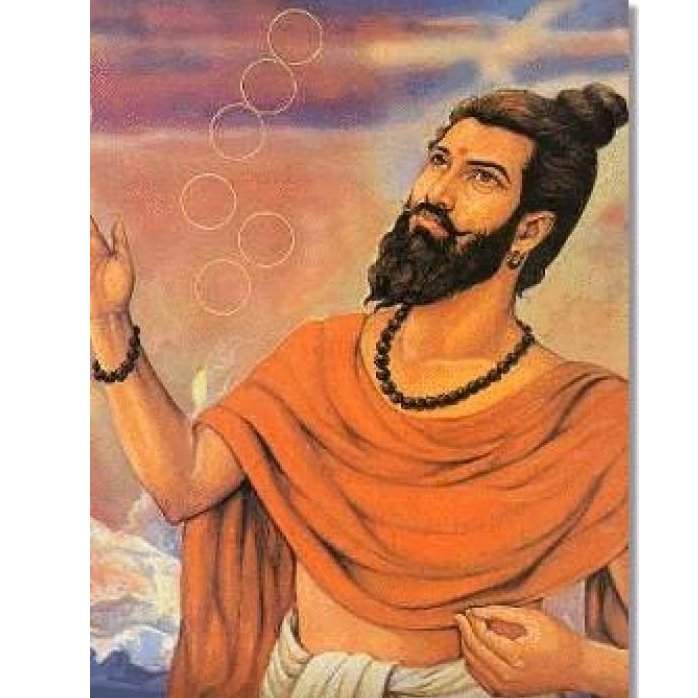
Acharya Kanad
Crowd gathered around him and one person asked him why he was collecting the grains even beggars wouldn't like to touch these.
He told them that no matter how small the object could be, it is still a part of the universe. Individual grain might seem useless but the collection could serve as someone's meal."
Since then people started calling him "Kanad", as "Kan" in Sanskrit means "smallest particle" like grains.
Acharya Kanad was the first person in the world to discuss atoms and molecules.
He said that "every object of creation is made of atoms which in turn connect with each other to form molecules."
He found out that the universe is made up of "kana" means atoms. He studied atomic theory and found the way atoms move and react with each other.
In time, people started to call him "Acharya- the teacher", hence the name Acharya Kanad.
Acharya Kanad should be considered "The Father of Atomic Theory."
Another Indian philosopher, Pakudha Katyayana who also lived in the 6th century B.C. and was a contemporary of Gautama Buddha, also propounded ideas about the atomic constitution of the material world.
"Ancient Indian theories were brilliant imaginative explanations of the physical structure of the world, and in a large measure, agreed with the discoveries of modern physics, "A.L. Basham, Australian Indologist said.
So, once again, we have seen that so many of our modern inventions and theories are simple re-inventions based on the knowledge our ancestors were familiar with thousands of years ago.
Written by – A. Sutherland - AncientPages.com Senior Staff Writer
Copyright © AncientPages.com All rights reserved. This material may not be published, broadcast, rewritten or redistributed in whole or part without the express written permission of AncientPages.com
More From Ancient Pages
-
 Huldra: Seductive Female Creature Living In Forest Or Mountains In Norse Beliefs
-
 Ancient Mosaic Floor Decorated With Colorful Floral Designs Re-Uncovered After 40 Years
-
 Archaeologists Dug For Evidence Of The Rosetta Stone’s Ancient Egyptian Rebellion – Here’s What They Found
-
 Mysterious Scrolls And Artifacts Discovered Inside Ancient Buddha Statuette
-
 Rare 1,850-Year-Old Bronze Zodiac Coin Discovered During Underwater Survey Off Israel’s Coast
-
 Mythical Place Where Gorgon Medusa Dwelled And Was Killed May Have Been Found By Archaeologists
-
 Ancient Sound Of Stones – Acoustics At Stonehenge Tested By Scientists
-
 Polycarp Of Smyrna: Burned At The Stake And Pierced With A Dagger
-
 10 Incredible And Bizarre Ancient Cases Of Mass Hysteria
-
 Never Before Seen 3D Images Of Noah’s Ark Finally Revealed To The Public
-
 Mystery Of The Second Gabriel Stone And The Man Resurrected By Archangel Gabriel
-
 Hunter-Gatherers Used Open Habitats Millennia Before Stonehenge Monuments Were Built
-
 New DNA Study Links Early Europeans’ Cultural And Genetic Development Over Several Thousand Years
-
 The 6th Century Byzantine Church Hidden Within Khirbet Tinshemet’s Woods – Discovered
-
 Ancient Stone Tools Found In India Suggest Humans Ancestors May Have Left Africa Much Earlier Than Previously Thought
-
 Ancient Andean People Had A Plant-Based Diet And Were Not Hunter-Gatherers
-
 Science Fiction Was Around In Medieval Times – Here’s What It Looked Like
-
 Secrets Of The Cathars – Mysterious Manuscript Of Jesus And His Pre-Flood Language
-
 Hidden Story Of The Sacred Wiradjuri Carved Trees Revealed
-
 Harem Conspiracy – Plot To Murder Ramesses III, The Last Great Warrior Pharaoh

