
Great Wall Of India: Massive Structure That Surrounds Ancient Fort Of Kumbhalgarh
A. Sutherland - AncientPages.com - This massive structure, called the Great Wall of India, surrounds the ancient Fort of Kumbhalgarh.
Kumbhalgarh - the second most important Fort of Rajasthan after Chittorgarh - is located in Rajasthan in western India. It is a World Heritage Site initially built in the 15th century by Rana Kumbha, ruler of Mewar, between 1433 and 1468 AD.

Walls of Kumbhalgarh fort in Rajasthan, India. iMAGE CREDIT: Shivam Chaturvedi – CC BY-SA 3.0
The massive wall at Kumbhalgarh took nearly a century to construct, making the Fort virtually impenetrable.
Located at a distance of 64 km from Udaipur in the Rajasmand district, Kumbhalgarh Fort is easily accessible from the city of Udaipur.
The massive wall at Kumbhalgarh took nearly a century to construct Built on a hilltop 1,100 m (3,600 ft) above sea level on the Aravalli range, the fort of Kumbhalgarh has perimeter walls that extend 36 km (22 mi), making it among the longest walls in the world. The frontal walls are fifteen feet thick.

Aerial view of a portion of the Kumbhalgarh wall. Image credit: - CC BY-SA 3.0
Kumbhalgarh Fort was built by Maharana Rana Kumbha, the ruler of Mewar, a state in western India, between 1433 AD and 1468 AD. This ruler was also a patron of art, music, and architecture.
The impregnable Fort has seven massive gates and seven ramparts folded with one another and equipped with designed walls toughened by curved bastions and huge watch towers. Thanks to its strong structure and solid foundation, the fort made unbeatable to date. The fort's walls are broad enough to stand eight horses side by side. There are not less than 360 temples inside the complex.
The Fort is also known for its famous palace - the Palace of Cloud ('Badal Mahal') - on top of the structure. This beautiful palace has beautiful rooms with a color combination of green, turquoise, and white, presenting a bright contrast to the earthy colors of the Fort. This place gives the appearance of wandering in the world of clouds. Cloud Palace also offers a fantastic panoramic vista of the downtown.
According to popular folklore, Maharana Kumbha used to burn massive lamps that consumed fifty kilograms of ghee – a special butter that originated in ancient India - and a hundred kilograms of cotton to provide light for the farmers who worked during the nights in the valley.
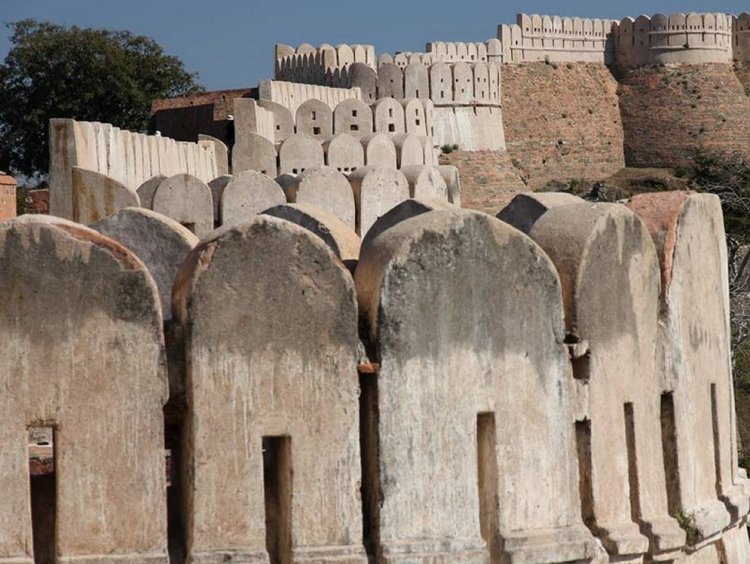 Great Wall, Kumbhalgarh, India. Photo credit: flickr.com/photos/kittell
The Fort is constructed on the topmost ridges around 1,914 meters above sea level. The fortifications extend to a length of 36 kilometers, which has made this Fort in the international records.
It is stated to be the second-longest wall in the world, after ''the Great Wall of China''. The complex of the Fort has numerous palaces, temples, and gardens making it more magnificent.

General view of the fort at night. Image credit: Kunal 3405 - CC BY-SA 3.0
The hefty walls of the Fort are broad enough to stand eight horses side by side. There are not less than 360 temples inside the Fort complex, including the Shiva Temple.
The robust structure and solid foundation of the Fort made it safe during times of battles and unbeatable.
Yet, despite its magnificence, it is still little known to the outside world.
Written by – A. Sutherland - AncientPages.com Senior Staff Writer
Updated on February 18, 2023
Copyright © AncientPages.com All rights reserved. This material may not be published, broadcast, rewritten or redistributed in whole or part without the express written permission of AncientPages.com
Expand for referencesMore From Ancient Pages
-
 ‘Collata Quipu’ May Explain Messages Hidden In Mysterious Writing Of Inca
-
 Blame The Neanderthals For Your Lower Back Pain – Scientists Say
-
 On this day in history: Li Shimin becomes Emperor Taizong of Tang, China – Sep 4, 626
-
 16 Meters Long Ancient Papyrus With Spells From The Book Of The Dead Found In Saqqara
-
 Discovered Near Arctic: Mysterious Lost Medieval Civilization And Puzzling Ancient Mummy
-
 Physical Violence In Ancient Mesopotamia Much Less Common Than Ancient Texts Suggest – New Study
-
 Apalala: Harsh Dragon Controlling Swat River Who Became Benevolent Naga King Helping People In Buddhist Tradition
-
 Long-Lost Mesopotamian Queen Hama Discovered By Student Just By Reading Books
-
 Evidence Of Sangam Age Settlement Unearthed At Nangur, Tamil Nadu
-
 Chilling Tale Of The Tailor And Odin’s Wild Hunt – Why The Norse God Warns Against Going Out On Christmas Eve
-
 Excavations At Urartu Fortress Will Shed Light On Mysteries Of Ancient Temple
-
 Ancient Cotton Fibers Dating Back 7,000 Years Discovered In NE Israel
-
 2,ooo-Year-Old Ancient Roman Treasure Found Underwater Of The Coast Of Portofino, Italy
-
 Ancient Roman Sarcophagus With A Female Skeleton And A Perfume Bottle Discovered In Turkey
-
 On This Day In History: ‘Battle On The Ice’ – Army Of Prince Nevsky Against Teutonic Knights Was Fought – On Apr 5, 1242
-
 New Fossil Link In Bird Evolution Discovered
-
 World’s Oldest Known Cave Painting – 45,000-Year-Old Depiction Of Wild Pig Discovered At Leang Tedongnge Cave
-
 Similarities And Differences Between Living Spaces Of Neanderthals And Homo Sapiens
-
 Genetic Evidence Retrieved From 800,000-Year-Old Human Tooth
-
 Was Biblical King David Unknowingly Part Of A Secret Master Plan?

