
Mnemosyne: Powerful Greek Goddess Of Memory, Bridge Between The Past And The Future
A. Sutherland - AncientPages.com - In ancient times, the art of memorization was of great importance to people in many cultures. Storytelling and creativity are necessary to cultivate memory that maintains cultural values.
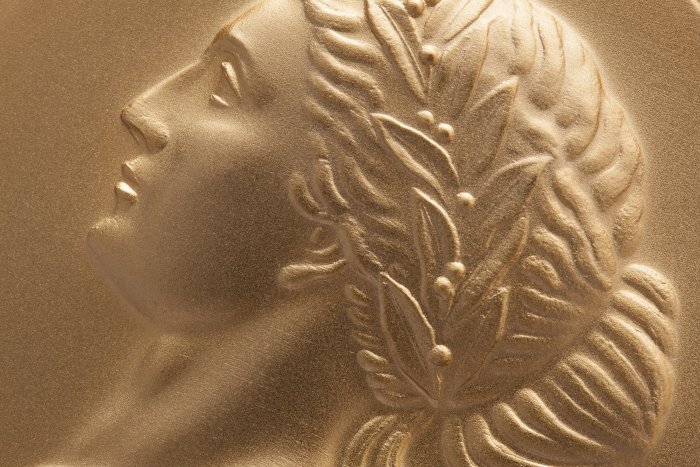 Credit: Adobe Stock - Paylessimages
We must develop reading, teaching, and understanding skills with memory.
It is no coincidence that much attention is paid to Mnemosyne, the goddess of speech and language, the symbol of memory, and the Mother of Inspiration in Greek mythology.
Zeus gave her the privilege of naming all the things on the earth.
With beautiful hair, often related to sensuality, Mnemosyne was the daughter of Uranus and Gaia and one of the Titans. Together with Zeus, she was the parent of the nine Muses. As such, she was also the goddess of time.
The poets and artists of Greece, Rome, and other parts of the world traditionally invoked these extraordinary divine individuals. The god of art, Apollo, was also "Muse Leader" (Musagetes), in addition to his many other titles. He loved all the nine muses for their very unique inspiration. However, he never gave an impression of favoring one over the others.
The Muses lived on Mount Helicon or Mount Parnassos. Each of them was associated with a particular art. For example, Calliope was the patroness of poetry, Clio was a patroness of history, Melpomene was a tragedy, and Euterpe was related to flute players, joy, and pleasure. Terpsichore was the patroness of choral dance and dramatic chorus. Urania was associated with astronomy and celestial forces, Thalia with comedy and pastoral poetry, Erato supported erotic poetry, and Polymnia was the goddess of music, song, and dance.
Mnemosyne was also the inventor of language and words. As closely associated with remembrance, Mnemosyne was a deity of great importance to ancient Greeks, who paid her much attention.
She is the one who allows people to "recognize themselves, others, and all the things of the world – and not just name them correctly. She makes connections between all people and things. She does not just bring the universe forward as in a quiet "show and tell. She reveals "cause and effect"; she organizes "before and after" and all time." 1
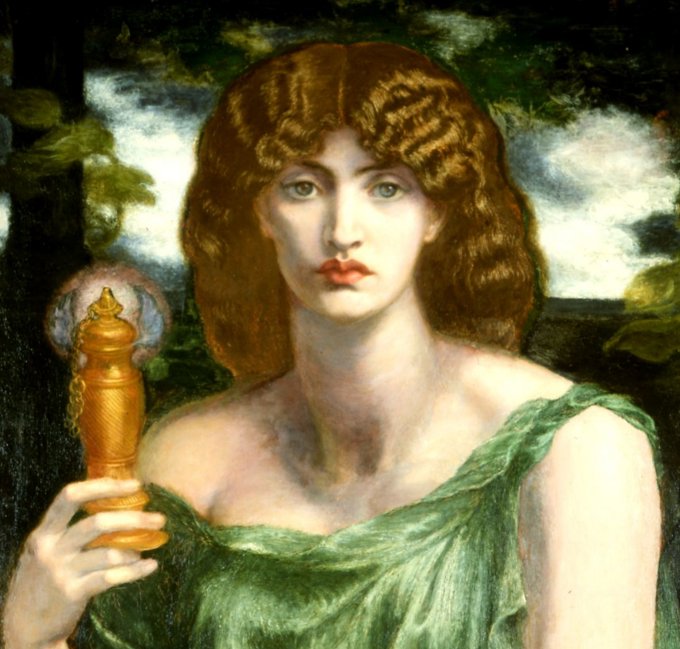
Mnemosyne (aka Lamp of Memory or Ricordanza) by Dante Gabriel Rossetti (c. 1876 to 1881) - Public Domain
Thanks to her, we can see differences and similarities that form the basis of all knowledge we can reach.
So, as we see, Mnemosyne is crucial for our existence, and we depend on her. She is the bridge between the past and the future.
Peter C. Orlando also says that "no society or person can survive without memory. Without memory, we are frozen in the present, like ice statues." 1
In ancient works of art, Mnemosyne was usually portrayed with her daughters – the Muses – but occasionally, she was depicted as a woman who supports her chin, giving an impression of meditating.
However, besides her association with her nine daughters, Mnemosyne was responsible for a pool in Hades.
According to a series of Greek tomb inscriptions from 300 BC, the pool was opposite the River Lethe, one of the five rivers of the underworld of Hades. The so-called Mnemosyne's Pool was known to have powers to restore or at least ensure the people's good memory, and occasionally, some Greeks were encouraged to drink from this source instead of the River Lethe.
On the other hand, the River Lethe caused dead souls who drank from it to forget their former lives when they reawakened into the world of the living.
Written by – A. Sutherland - AncientPages.com Senior Staff Writer
Updated on Feb 1, 2024
Copyright © AncientPages.com All rights reserved. This material may not be published, broadcast, rewritten or redistributed in whole or part without the express written permission of AncientPages.com
Expand for referencesOrlando, Peter C. "Mnemosyne: A Goddess for Storytelling, Creativity, and Reading Comprehension." Educational Horizons 84, no. 3 (2006): 151-56.
Leeming, D. The Oxford Companion to World Mythology
Tanner, R. Greek Mythology
More From Ancient Pages
-
 What Can The Fate Of Ancient Cities Teach Us About Surviving Climate Change
-
 Magnificent Virtual 3D Tour Of Famous Temples Of Baalbek – Now Available To Anyone
-
 Ancient DNA And Tombstones Lead Scientists To Black Death’s Source Strain
-
 A Magical Handbook For The Afterlife – Insights To Ancient Egyptian Religion, Magic And Secret Knowledge
-
 St. Swithin’s Day And The 40 Days’ Weather Prophecy
-
 Why Were Egyptian Pyramids Built Along Long-Lost Ahramat Branch Of The Nile?
-
 New DNA Study Of The Red Lady Of El Mirón Who Lived 19,000 Years Ago
-
 On This Day In History: Battle Of Naulochus Was Fought Off The Coast Of Sicily – On Sep 3, 36 BC
-
 What Are The Monumental Uratrian-Era Structures Unearthed At Garibin Tepe In Van?
-
 Herne The Hunter – The Horned God And Lord Of The Forest In British Mythology
-
 Why Are Statues Of Mythical Yeti Dividing People In The Himalayas?
-
 Legend Of The Eight Immortals Who Know The Secrets Of Nature
-
 12,000-Year-Old Human Face Depicted On The T-Shaped Pillar – Discovery At Karahantepe, Turkiye
-
 More Greek Gods’ Heads And A Life-Sized Statue Of A Man Unearthed In The Ancient City Of Aizanoi
-
 Deir el-Bahri – Sacred Resting Place For The Pharaohs
-
 On This Day In History: Battle of Salamis Was Fought – On Sep 22, 480 BC
-
 Keezhadi Excavations Reveal: Tamil-Brahmi Script Older Than Previously Thought
-
 Makara – Legendary Sea-Creature With Many Incarnations In Hindu Mythology
-
 World’s Oldest Dala Horse Discovered In Sweden
-
 Benin Bronze Sculpture Looted By British Soldiers In Nigeria – Returns Home

