
Shamash: Mesopotamian God Of Sun, Truth, Justice And Healing
Ellen Lloyd - AncientPages.com - Shamash was the Sun god in the mythology of the ancient Near East. He was associated with truth, justice, and healing and was one of the most active gods in the pantheons of ancient Sumer, Babylonia, and Assyria. In Sumer, he was worshipped as god Utu.
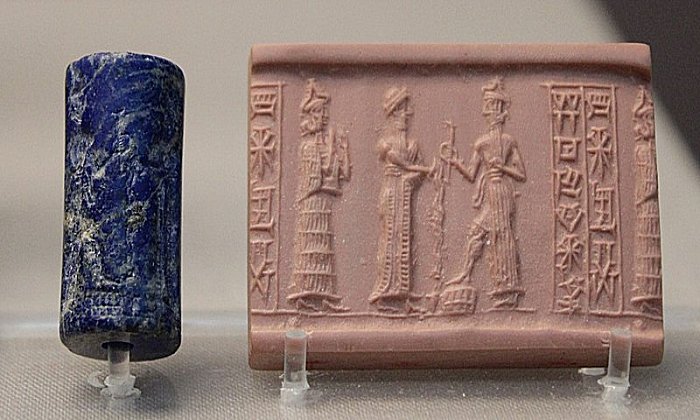
Lapis lazuli cylinder seal. A suppliant goddess (left, with necklace counterweight) stands behind the robed king (center) who pours libation before the ascending sun god who holds the rod and ring of justice and rests his foot on a rectangular chequer-board mountain. Bur-Dagan, son of Kurub-Adad, inscribed on the seal, is probably the name of the owner. From a tomb in Ur, dated c. 1900 BC. BM 121418. Image credit: Zunkir - CC BY-SA 4.0
Shamash was the judge of gods and men
As a powerful solar deity, Shamash, whose consort was the goddess Aya, exercised the power of light over darkness and evil. In this capacity, he became known as the god of justice and equity and was the judge of both gods and men. At night, Shamash became the judge of the underworld.

Mesopotamian limestone cylinder seal and impression: worship of the sun god, Shamash, (Louvre Museum). Image credit: Jastrow - Public domain
Shamash was also regarded as a god who released sufferers from the grasp of demons. The sick appealed to Shamash as the god who can be depended upon to help those who are suffering unjustly. This aspect of Shamash is vividly brought out in hymns addressed to him.
In some cases, Shamash was seen as governing the entire universe and was pictured as a king on his royal throne with his staff and signet ring.
According to legend, the Babylonian king Hammurabi received his code of laws from Shamash.
The Hammurabi codes are some of the earliest and most complete ancient legal codes proclaimed by the Babylonian king Hammurabi, who reigned from 1792 to 1750 BC.
Shamash is depicted as overcoming darkness and death. In the Epic of Gilgamesh, he assisted in the conquest of the monster Humbaba, guardian of the deep forests of Lebanon.
Shamash worship and temples
Shamash was widely worshipped in the ancient near East. The chief centers of his cult were at Larsa, represented by the modern Senkerah in Sumer, and at Sippar, represented by the mounds at Abu Habba in Akkad.
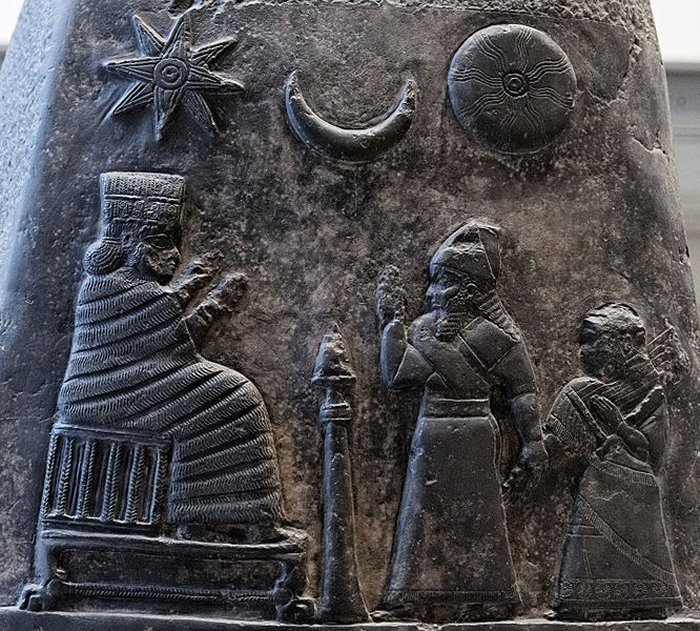
Kudurru (stele) of King Melishipak I (1186–1172 BC): the king presents his daughter to the goddess Nannaya. The crescent moon represents the god Sin, the sun the Shamash and the star the goddess Ishtar. Image credit: Jastrow - Public domain
Temples dedicated to Shamash were also erected in all large population centers, including Babylon, Ur, Mari, Nippur, and Nineveh. Shamash's major temples were located at Sippar and Larsa.
In Canaanite tradition, the Sun god was Shemesh, the "torch of the gods," but was described as female. The worship of Shemesh/Shamash was also practiced among the Israelites, although it was forbidden by the prophets and biblical writers.
Shamash journey through the heavens in his chariot
Shamash, who was the brother of the goddess Ishtar, is often pictured with a disk that symbolizes the Sun. Like the later Apollo, he made his daily journey through the heavens, either on horseback, in a chariot, or on a boat. Together with Sin and Ishtar, Shamash formed a triad of gods that completed the even older trinity of Anu, Enlil, and Ea, representing the heavens, earth, and water, respectively. The three powers of Sin, Shamash, and Ishtar symbolized three great forces of nature: The sun, the moon, and the morning star (or love and fertility).
Tablet of Shamash
Shamash's symbol appears on numerous artifacts found in the Near East, including jewelry, cylinder seals, and other objects. One famous example, dating to the 9th century BCE and known simply as the "Tablet of Shamash", is currently housed in the British Museum.
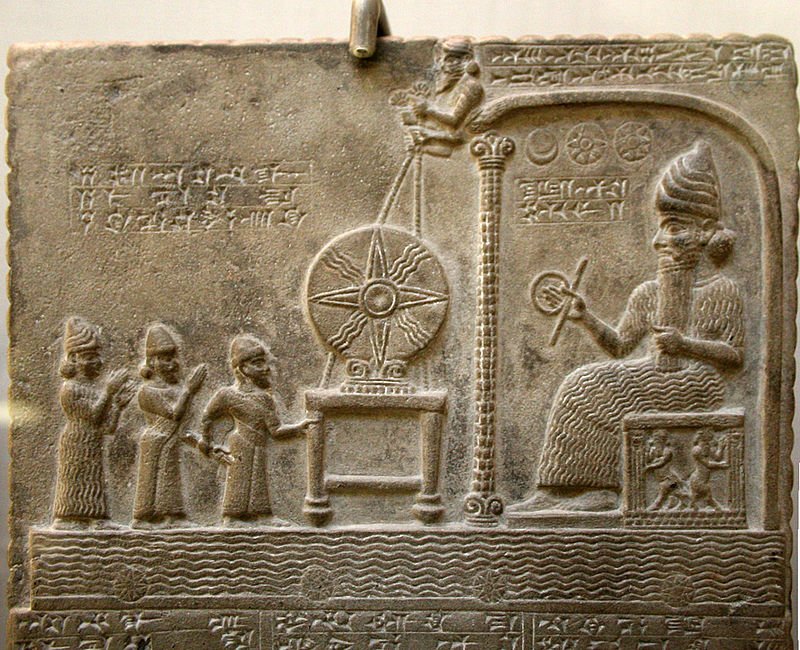
Relief image on the Tablet of Shamash, British Library room 55. Found in Sippar (Tell Abu Habbah), in Ancient Babylonia; it dates from the 9th century BC and shows the sun god Shamash on the throne, in front of the Babylonian king Nabu-apla-iddina (888-855 BC) between two interceding deities. The text tells how the king made a new cultic statue for the god and gave privileges to his temple. Image credit: Prioryman - source
The Tablet of Shamash is a stone tablet recovered from the ancient Babylonian city of Sippar in southern Iraq in 1881. The tablet has serrated edges like a saw, which was the symbol of both Shamash and Saint Simon Zelotes in later traditions. The bas-relief on the top of the obverse shows Shamash, the Sun God, beneath symbols of the Sun, Moon, and Venus. He is depicted seated in a shrine, holding forward a measuring rod and reel of the cord. There is another large sun disk in front of him on an altar, suspended from above by two figures.
There is no doubt that Shamash was a very important deity in the Near East.
Updated on March 29, 2024
Written by Ellen Lloyd - AncientPages.com
Copyright © AncientPages.com All rights reserved. This material may not be published, broadcast, rewritten or redistributed in whole or part without the express written permission of AncientPages.com
Expand for referencesMore From Ancient Pages
-
 What Is The Roman Silver Fragment Found In Norfolk? Experts Are Baffled
-
 John Hawkwood ‘John Sharp’: Feared, English Mercenary And His White Company In 14th Century Italy
-
 Five Ancient Mirror Frames, Ceramics Factory Found In Intriguing Roman Villa In Pavlikeni, Bulgaria
-
 Ancient Mayan City Filled With Palaces, Pyramids And Plazas Discovered On Construction Site In Mexico
-
 Evidence Of Dual Mass Extinctions 260 Million Years Ago – Found
-
 41,500-Year-Old Ivory Pendant Is The Oldest Evidence Of Humans Decorating Jewelery In Eurasia
-
 Tiny Tools And Skills Of Mysterious Toaleans People In Southernmost Sulawesi, Indonesia
-
 Ancient DNA Reveals How European Skin, Eye, And Hair Color Evolved Over The Past 45,000 Years
-
 Ancient Inventions Of Firefighting Vehicles
-
 Ancus Marcius: Semi-Legendary Fourth King Of Rome Obliged To Make War To Defend And Expend Territories
-
 Perfectly Preserved 10,500-Year-Old Basket Found In Muraba’at Cave
-
 Constantine The Great – Did First Roman Christian Emperor Use Faith For His Own Agenda?
-
 1,400-Year-Old Christian Chalice With Etched Symbols Found In Rubble At Vindolanda Fort, Britain
-
 The ‘Chinese Pyramids’ And The Pole Star
-
 Giant Blocks For Sphinx-Shaped King Amenhotep III Colossi Uncovered In Luxor, Egypt
-
 On This Day In History: Aviator Amelia Earhart Was The First Woman To Cross The Atlantic By Air – On June 18, 1928
-
 Puzzle Of The Bull Rock Cave – Ancient Mass Grave Remains Unexplained
-
 Sarcophagus Of Pharaoh Ramesses II Found In Abydos, Egypt
-
 Humans Carry DNA From An Ancient, Unidentified Ancestor – Scientists Say
-
 Cernunnos ‘Horned One’ – Powerful Continental God Preserved In Celtic Beliefs As Master Of Animals

