
Neanderthals: The Oldest Art In The World Wasn’t Made By Humans
AncientPages.com - One of the most hotly debated questions in the history of Neanderthal research has been whether they created art. In the past few years, the consensus has become that they did, sometimes. But, like their relations at either end of the hominoid evolutionary tree, chimpanzees and Homo sapiens, Neanderthals' behavior varied culturally from group to group and over time.

Maltravieso Cave replica with Neanderthal hand-prints, Caceres, Spain. Credit: Adobe Stock - WH_Pics
Their art was perhaps more abstract than the stereotypical figure and animal cave paintings Homo Sapiens made, after the Neanderthals disappeared about 30,000 years ago. But archaeologists are beginning to appreciate how creative Neanderthal art was in its own right.
Homo sapiens are thought to have evolved in Africa from at least 315,000 years ago. Neanderthal populations in Europe have been traced back at least 400,000 years.
As early as 250,000 years ago, Neanderthals were mixing minerals such as haematite (ochre) and manganese with fluids to make red and black paints—presumably to decorate the body and clothing.
It's human nature
Research by Paleolithic archaeologists in the 1990s radically changed the common view of Neanderthals as dullards. We now know that, far from trying to keep up with the Homo sapiens, they had a nuanced behavioral evolution of their own. Their large brains earned their evolutionary keep.
We know from finding remains in underground caves, including footprints and evidence of tool use and pigments in places where neanderthals had no obvious reason to be that they appear to have been inquisitive about their world.
Why were they straying from the world of light into the dangerous depths where there was no food or drinkable water? We can't say for sure, but as this sometimes involved creating art on cave walls it was probably meaningful in some way rather than just exploration.
Neanderthals lived in small, close-knit groups that were highly nomadic. When they traveled, they carried embers with them to light small fires at the rock shelters and river banks where they camped. They used tools to whittle their spears and butcher carcasses. We should think of them as family groups, held together by constant negotiations and competition between people. Although organized into small groups it was really a world of individuals.

Red pigment washed into the concavities of a bright stalactite drapery in Ardales Cave. Paul Pettitt and cave art dating team, Author provided
The evolution of Neanderthals' visual culture over time suggests their social structures were changing. They increasingly used pigments and ornaments to decorate their bodies. As I elaborate in my book, Homo Sapiens Rediscovered, Neanderthals adorned their bodies perhaps as competition for group leadership became more sophisticated. Colors and ornaments conveyed messages about strength and power, helping individuals convince their contemporaries of their strength and suitability to lead.
Then, at least 65,000 years ago, Neanderthals used red pigments to paint marks on the walls of deep caves in Spain. In Ardales cave near to Malaga in southern Spain they colored the concave sections of bright white stalactites.
In Maltravieso cave in Estremadura, western Spain, they drew around their hands. And in La Pasiega cave in Cantabria in the north, one Neanderthal made a rectangle by pressing pigment-covered fingertips repeatedly to the wall.
We can't guess the specific meaning of these marks, but they suggest that Neanderthal people were becoming more imaginative.
Later still, about 50,000 years ago, came personal ornaments to accessorize the body. These were restricted to animal body parts—pendants made of carnivore teeth, shells and bits of bone. These necklaces were similar to those worn around the same time by Homo sapiens, probably reflecting a simple shared communication that each group could understand.
Did Neanderthal visual culture differ from that of Homo sapiens? I think it probably did, although not in sophistication. They were producing non-figurative art tens of millennia before the arrival of Homo sapiens in Europe, showing that they had independently created it.
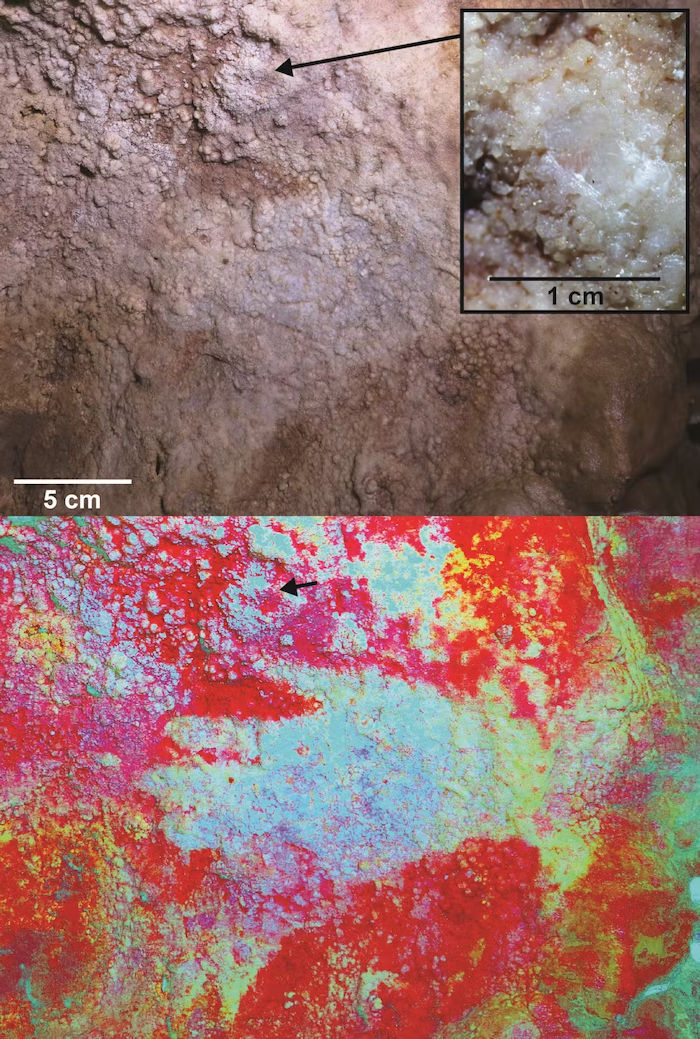
One of several dozen hand stencils left in Maltravieso Cave. In the case of this hand the Neanderthal who left it would have had to lie on the floor as it was created on a ceiling barely 30cm high. Paul Pettitt and cave art dating team, Author provided
But it differed. We have as yet no evidence that Neanderthals produced figurative art such as paintings of people or animals, which from at least 37,000 years ago was widely produced by the Homo sapiens groups that would eventually replace them in Eurasia.
Figurative art is not a badge of modernity, nor the lack of it an indication of primitiveness. Neanderthals used visual culture in a different way to their successors. Their colors and ornaments strengthened messages about each other through their own bodies rather than depictions of things.
It may be significant that our own species didn't produce images of animals or anything else until after the Neanderthals, Denisovans and other human groups had become extinct. Nobody had use for it in the biologically mixed Eurasia of 300,000 to 40,000 years ago.
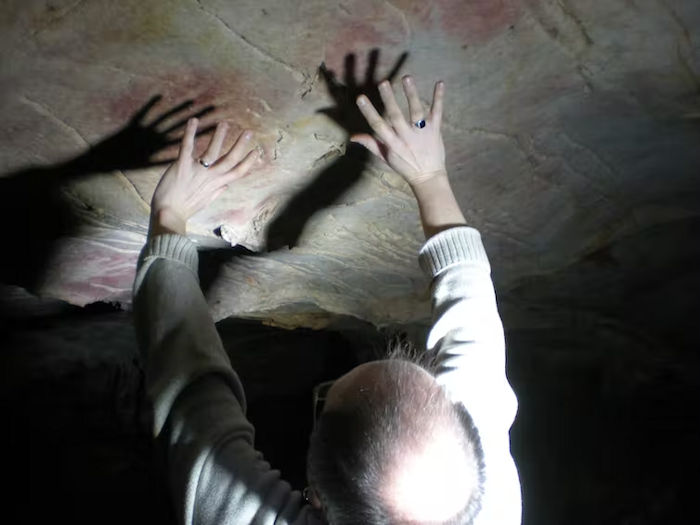
In many cases hand stencils were left on parts of cave walls and ceilings that were difficult to access, such as these in El Castillo cave, with Paul Pettitt showing the position of the hands. Paul Pettitt and cave art dating team, Author provided
But in Africa a variation on this theme was emerging. Our early ancestors were using their own pigments and non-figurative marks to begin referring to shared emblems of social groups such as repeated clusters of lines—specific patterns.
Their art appears to have been less about individuals and more about communities, using shared signs such as those engraved onto lumps of ochre in Blombos cave in South Africa, like tribal designs. Ethnicities were emerging, and groups—held together by social rules and conventions—would be the inheritors of Eurasia.
Written by Paul Pettitt, Professor in the Department of Archaeology, Durham University
Provided by The Conversation
This article is republished from The Conversation under a Creative Commons license. Read the original article.
More From Ancient Pages
-
 On This Day In History: Mathematician And Astronomer Simon Marius Independently Rediscovered Andromeda Galaxy – On Dec 15, 1612
-
 On This Day In History: Amelia Earhart’s First Solo Ocean Flight – On Jan 11, 1935
-
 Old Cannon Found At Construction Site
-
 Incredible Ancient Star Map Depicting Our Galaxy Is Hidden In Africa
-
 Why Did Modern Humans Replace The Neanderthals? The Key Might Lie In Our Social Structures
-
 Long-Lost Legendary Ancient Temple Discovered On San Miguel Hill In Mexico
-
 Viking Burial With An Unusual Box And Spectacular Grave Goods Found In Aarhus, Denmark
-
 Viking Women Were More Prominent Than Previously Thought – Archaeological Discoveries Reveal
-
 On This Day In History: Johannes Kepler ‘Father Of Modern Astronomy’ Was Born – On Dec 27, 1571
-
 Mysterious Shasu – Bandit Canaanites Or Israelites?
-
 Possible Viking Boat Burials Discovered On The Isle Of Mull
-
 Stonehenge Is Older Than Mankind – Archaeologist Suggests
-
 Fossilized Trilobite Amulet Found At The Roman Site In Spain Was Believed To Have Magical Or Protective Properties
-
 Smuggled 1,800-Year-Old Lydian Atonement Inscription Sent Back To Turkey By Italy
-
 How Gold Rushes Helped Make The Modern World
-
 Unknown Saxon Village And Bronze Age Artifacts Found Near Ely, Cambridgeshire
-
 Hyksos: Foreign Rulers Of Avaris Who Founded The Fifteenth Dynasty Of Egypt
-
 Medieval Music Wasn’t Only Supposed To Be Beautiful To Listen To – A New Study Suggests
-
 Rhodogune Of Parthia Refused To Bath And Comb Her Hair Until She Subdued The Rebels
-
 Deadly Catastrophe In Pompeii And An Overlooked Piece Of The Well-Researched Disaster

