
Riddle Of The Indo-European Language – Which Of The Two Hypotheses Is Correct?
AncientPages.com - The languages in the Indo-European family are spoken by almost half of the world's population. This group includes a huge number of languages, ranging from English and Spanish to Russian, Kurdish and Persian.
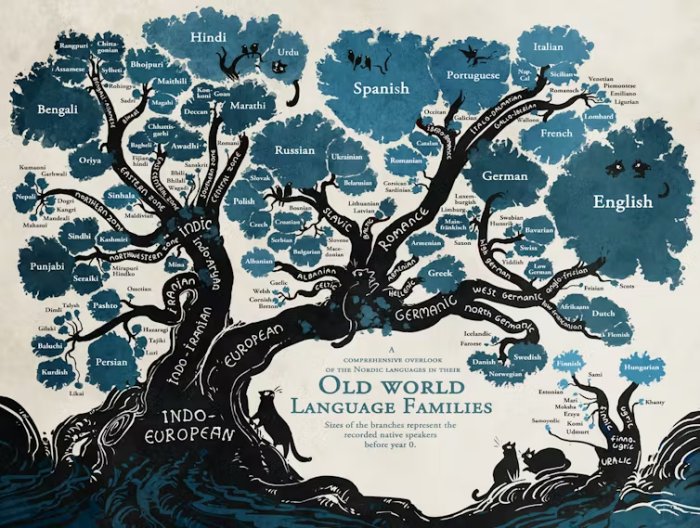
Family tree of Indo-European languages by artist Minna Sundberg in her book Stand Still. Stay Silent. Minna Sundberg.
Ever since the discovery, over two centuries ago, that these languages belong to the same family, philologists have worked to reconstruct the first Indo-European language (known as Proto-Indo-European) and establish a "language family tree," where branches represent the evolution and separation of languages over time. This approach draws on phylogenetics—the study of how biological species evolve—which also provides the most appropriate model for describing and quantifying the historical relationships between languages.
Despite numerous studies, many questions still remain as to the origin of Indo-European: where was the original Indo-European language spoken in prehistoric times? How long ago did this language group emerge? How did it spread across Eurasia?
Anatolia or the Pontic Steppe?
There are two main, though apparently contradictory, established hypotheses. On one side we have the Anatolian Hypothesis, which traces the origins of the Indo-European people to Anatolia, in modern day Turkey, during the Neolithic era. According to this hypothesis, created by British archaeologist Colin Renfrew, Indo-European languages began to spread towards Europe around 9,000 years ago, alongside the expansion of agriculture.
On the other side we have the Steppe Hypothesis, which places the origin of Indo-European languages further north, in the Pontic Steppe. This theory states that Proto-Indo-European language emerged somewhere north of the Black Sea around 5,000 or 6,000 years ago. It is linked to Kurgan culture, known for its distinctive burial mounds and horse breeding practices.
DNA comparison
In order to decide which of these two hypotheses is correct, genetic studies have been carried out to compare DNA found at prehistoric sites with that of modern humans. However, this type of research can only provide indirect clues as to the origins of Indo-European languages, since language, unlike, for example, blood type, is not inherited through genes.
A new study published in Science has approached the question from a different angle by using direct linguistic data to assess the timelines put forward by both hypotheses.
In this project, carried out by over 80 linguists under the direction of Paul Heggarty and Cormac Anderson from the Max Planck Institute for Evolutionary Anthropology in Leipzig, we applied a new methodology that allowed us to obtain more exact results.
More comprehensive sampling
The samples used in earlier phylogenetic studies were taken from a limited pool of languages. Moreover, some analyses had assumed that modern languages are derived directly from ancient written languages, when they actually come from oral variants that were spoken during the same period—Spanish, for example, did not come from the classical Latin found in Virgil's works, but from the popular or "vulgar" Latin which was spoken by ordinary people. These shortcomings and assumptions have distorted age estimates for Indo-European language family subgroups such as Germanic, Slavic or Romance.
The new study addresses these issues, eliminating inconsistencies and taking data from a wider range of sources (from 161 languages, to be exact), to provide a more balanced and complete sample set. This data then underwent a Bayesian phylogenetic analysis, a statistical method for establishing the most probable relationships between languages and branches of the family tree.
The study showed, for example, that an Italo-Celtic language family cannot exist, since the Italic and Celtic languages separated several centuries before the separation of the Germanic and Celtic languages, which took place around 5,000 years ago.
An eight thousand year old language family
Regarding the question of the origin of Indo-European languages, calculations based on the new data show that they were first spoken approximately 8,000 years ago.
The results of this research do not line up neatly with either the Anatolian or the Kurgan hypotheses. Instead they suggest that the birthplace of Indo-European languages is somewhere in the south of the Caucasus region. From there, they then expanded in various directions: westward towards Greece and Albania; eastward towards India, and northward towards the Pontic Steppe.

Credit: Adobe Stock - Elena
Around three millennia later there was then a second wave of expansion from the Pontic Steppe towards Europe, which gave rise to the majority of the languages that are spoken today in Europe. This hybrid hypothesis, which marries up the two previously established theories, also aligns with the results of the most recent studies in the field of genetic anthropology.
In addition to bringing us closer to solving the centuries-old enigma of the origin of our languages, this research illustrates how disciplines as disparate as genetics and linguistics can complement each other to provide more reliable answers to questions of human prehistory. It is hoped that the same methodology will also serve, in future research, to expand our understanding of how languages and populations spread to other continents.
Written by Kim Schulte, Profesor Titular (lingüística, traducción), Universitat Jaume I
Provided by The Conversation
This article is republished from The Conversation under a Creative Commons license. Read the original article.
More From Ancient Pages
-
 Ostracism: Political Practice In Ancient Athens
-
 Is The Mystery Of Controversial Phaistos Disk Solved?
-
 Goblins: Antisocial, Grotesque, Ugly And Vengeful Fairy Creatures In Ancient Beliefs
-
 On This Day In History: Battle Of Lagos Took Place Between Royal Navy Of Britain and France – On August 19, 1759
-
 Vikings’ Unicorn Bluff Fooled Europeans For Hundreds Of Years
-
 Unknown Ancient Structures Discovered At Machu Picchu By LIDAR
-
 8,000-Year-Old House Remains Discovered In Svinjarička Čuka, Serbia Raise Questions About Europe’s First Farmers
-
 Long-Lost Artifact Re-Discovered In Michigan Offers Evidence Of Overseas Visitors In Pre-Columbian Times
-
 A 2,500-Year-Old Marble Disc, Designed To Protect Ancient Ships And Ward Off The Evil Eye – Discovered
-
 Child’s Play: Are Tibetan Hand And Foot Traces The Earliest Example Of Parietal Art?
-
 Resourceful Pre-Hispanic Society In Bolivia Had Flourishing Agriculture Despite Harsh Environment Of The Andes
-
 Queen Dido Of Carthage: Founder Of Prosperous City On Africa’s Northern Coast
-
 Unfinished Roman Aqueduct Discovered In The Hellenistic Royal City Of Artashat-Artaxata In Ancient Armenia
-
 Magnificent Ancient Rock-Cut Lycian Tombs Of Myra, Antalya, Turkey
-
 Remarkable Viking Puzzle – The Forgotten Story Of Ivar The Boneless And Ímar
-
 Thousands Magnificent Jade Artifacts Discovered In Han Dynasty Tombs – China’s Golden Age In New Light
-
 Mysterious Forest Of Treasure – Why Is It Forbidden To Stay In Nidhivan After Sunset?
-
 Bronze Age Human Remains Uncovered In Dorset During Excavation Of Iron Age Settlement
-
 This Is One Of The Oldest Pieces Of Cloth In The World And It’s Made Of Bast Fibers!
-
 Guardians Of The Mounds – Battle To Save Scythian Burial Mounds From Destruction Continues

